Saint Vitalian
Died January 27, 672
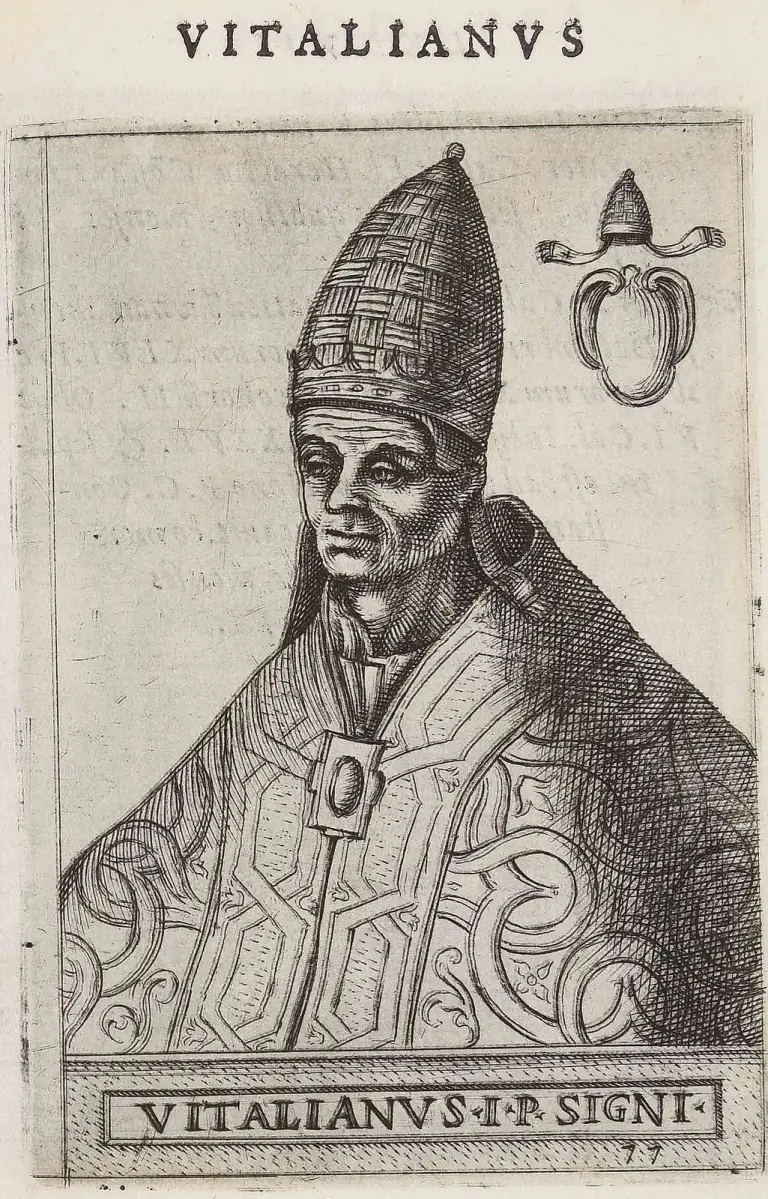
Saint Vitalian was pope from 657 to 672, when Rome and Constantinople were divided over whether Christ has one will or two, and he chose to keep talking to the emperor rather than break with him. 12 His most lasting decision concerned England: in 668 he consecrated the Greek monk Theodore of Tarsus archbishop of Canterbury and sent him north with the abbot Hadrian. 14 His feast is January 27. 5
From Segni
Almost nothing is known of Vitalian before he became pope. J.P. Kirsch, in the Catholic Encyclopedia, says so in as many words, and gives what the Liber Pontificalis records: he came from Segni in the Campagna, south of Rome, and his father was named Anastasius. 1 katolsk.no and the Holy See agree on Segni. 26
Pope Eugene I died at the beginning of June 657, and Vitalian was elected to succeed him and consecrated on July 30. 126
Peace with Constantinople
The Church he inherited was at odds with the empire. Relations had been strained to the breaking point over the teaching that Christ has only one will, and the imperial edict on the question, the Typos, was still in force. 2 Kirsch says Vitalian, "like his predecessor," tried to restore the connection with Constantinople "by friendly advances" and to prepare the way for a settlement. 1 He sent envoys with letters announcing his election to the emperor Constans II and to Peter, the patriarch of Constantinople, who leaned toward the one-will teaching. 12
The answers were warm. Constans confirmed the privileges of the Roman Church and sent Saint Peter's a book of the Gospels bound in gold and set with precious stones. 12 The patriarch replied without committing himself, in a way that made him seem to agree with the pope. 1 Vitalian's name was entered on the diptychs of Constantinople, the lists of those prayed for in the liturgy; Kirsch says it was the only pope's name so entered between Honorius I and the council of 680. 1
Not everyone has admired the price of this peace. katolsk.no calls Vitalian a mild and yielding man who depended on the secular power, who held to the Roman position but was deliberately conciliatory, played down the questions of doctrine, and passed over in silence the Lateran synod of 649 that had condemned the one-will teaching. 2
The emperor in Rome
In July 663 Constans came to Rome for twelve days in the course of his war against the Lombards. 12 Kirsch describes the visit day by day. On July 5 the pope and the Roman clergy went out to the sixth milestone to meet him and brought him to Saint Peter's, where he left gifts. The next Sunday he went to Saint Peter's in state, offered a pallium woven with gold, and attended the pope's Mass. He dined with the pope the following Saturday and heard Mass again on the Sunday before he left. 1
katolsk.no adds what was left unsaid: Vitalian and his clergy received with honor the emperor who had treated Pope Martin I brutally and issued the Typos, and they said nothing about either. 2 When Constans left, he took with him a great quantity of bronze from the city, stripping even the bronze tiles from the roof of the Pantheon, which had become a church. 12 He went on to Sicily, where he oppressed the population, and he was murdered at Syracuse in 668. 12
Vitalian backed the dead emperor's son against a usurper, and the young man reigned as Constantine IV. 12 Kirsch thinks the pope then took a firmer stand against the one-will teaching, since the new emperor had no wish to enforce his father's edict. 1 katolsk.no says he went so far as to reject the letters of a new patriarch of Constantinople as unorthodox. 2
The two accounts part over what followed. Kirsch says the patriarch Theodore removed Vitalian's name from the diptychs, and that it was restored only after the Sixth Ecumenical Council suppressed monothelitism. 1 katolsk.no says Theodore wanted to remove it and the emperor firmly opposed him. 2
Theodore of Tarsus
In England the Synod of Whitby had decided in 664 for the Roman way of keeping Easter and of cutting the tonsure. 12 The kings Oswy of Northumbria and Egbert of Kent then sent a priest named Wighard to Rome to be consecrated archbishop of Canterbury, but Wighard died of the plague there with almost all his companions. 341
Vitalian wrote to Oswy. Bede preserves the letter. The pope rejoices that the king "studies day and night the conversion of all his subjects to the Catholic and apostolic faith," urges him to follow Roman practice "in celebrating Easter," and promises a bishop: "We have not been able now to find, considering the length of the journey, a man, docile, and qualified in all respects to be a bishop." 3 With the letter went relics of Peter and Paul and other martyrs, and for the queen a cross with a gold key "made out of the most holy chains of the apostles." 3
The search took time. Vitalian first chose Hadrian, an African abbot of a monastery near Naples, "excellently skilled both in the Greek and Latin tongues," Bede says, but Hadrian thought himself unworthy and proposed others. 41 At last he offered Theodore, a monk then in Rome, born at Tarsus in Cilicia, learned in Greek and Latin, and sixty-six years old. 4 The pope agreed, on condition that Hadrian go with him, partly because Hadrian knew the road through France, and partly so that Theodore "should not, according to the custom of the Greeks, introduce anything contrary to the true faith." 4 katolsk.no adds that Benedict Biscop went with them. 2
Theodore had to wait four months for his hair to grow out so that it could be tonsured in the Roman manner. 4 Vitalian ordained him on Sunday, March 26, 668, and sent him north on May 27. 41 Kirsch says he "was recognized as the head of the Church of England by all the clergy, Saxon and British," and that the pope confirmed to him the privileges Gregory the Great had given Augustine. 1 katolsk.no says it opened a golden age for the Anglo-Saxon Church. 2
Ravenna, Crete and the Roman chant
Not every quarrel ended so well. Archbishop Maurus of Ravenna wanted his see independent of Rome. When Vitalian summoned him to account for his teaching he refused, and when the pope excommunicated him he excommunicated the pope in return. 1 Constans took Maurus's side and, by an edict katolsk.no dates to March 1, 666, made Ravenna independent of Rome. 12 The breach was not healed until the reign of Leo II. 1
From Crete came an appeal. Bishop John of Lappa had been deposed by a synod under his metropolitan (Paulus, according to Kirsch; another John, according to katolsk.no), appealed to Rome, and was imprisoned for it. 12 He escaped to Rome, where Vitalian held a synod in December 667, found him innocent, and ordered him restored to his diocese. 12
At home, katolsk.no says, he developed the schola cantorum at the Lateran, the papal choir founded under Gregory the Great, and its chant tones came to be called the Vitaliani after him. 2
Vitalian died on January 27, 672, and was buried in Saint Peter's. 125
What is Saint Vitalian the patron saint of?
Saint Vitalian's feast day
Saint Vitalian's feast day is January 27, the day he died. 25 The Roman Martyrology, in the text published by the Italian bishops, enters on that day the burial at Saint Peter's of Saint Vitalian, pope, who worked with particular care for the salvation of the English. 5 katolsk.no gives the same day for his memorial. 2
Praying with Saint Vitalian
Vitalian kept a long peace with an emperor who had mistreated his predecessors, and his sources do not agree on what to make of it. 12 Kirsch saw patient diplomacy that prepared the way for the council of 680; katolsk.no saw a pope who stayed quiet when he might have spoken. 12
His letter to Oswy shows another side. The king of a far island had asked for a bishop, and the man he sent had died in Rome. The pope wrote that he had not yet found the right man. The search Bede describes went through two refusals before it ended with Theodore, who was sent north with Hadrian beside him to watch over his teaching. 34
The Martyrology, choosing one thing to say about him, chose that: he worked for the salvation of the English. 5
Saint Vitalian, pray for us.
Sources
- 1.J.P. Kirsch, "Pope St. Vitalian," The Catholic Encyclopedia, vol. 15 (New York: Robert Appleton Company, 1912).
- 2."Den hellige pave Vitalian ( - 672)," Den katolske kirke (katolsk.no), Catholic Diocese of Oslo (in Norwegian).
- 3.Bede, Ecclesiastical History of the English Nation, Book III, chapter 29, with the letter of Pope Vitalian to King Oswy, Internet Medieval Sourcebook, Fordham University.
- 4.Bede, Ecclesiastical History of the English Nation, Book IV, chapter 1, Internet Medieval Sourcebook, Fordham University.
- 5.Roman Martyrology, entry for January 27, "San Vitaliano, papa," as printed in "Santo del giorno," Conferenza Episcopale Italiana (in Italian).
- 6."Vitalian," The Supreme Pontiffs, The Holy See.
Saints to turn to next
Others in this collection who are turned to for some of the same things.
- Saint AgathoDied January 10, 681DiscernmentStudy and teaching
- Saint Angela MericiMarch 21, 1474 - January 27, 1540Study and teachingDiscernment
- Saint Augustine of HippoNovember 13, 354 - August 28, 430Study and teachingDiscernment
- Saint Bonaventure1217 or 1221 - July 15, 1274Study and teachingDiscernment