Saint Agatho
Died January 10, 681
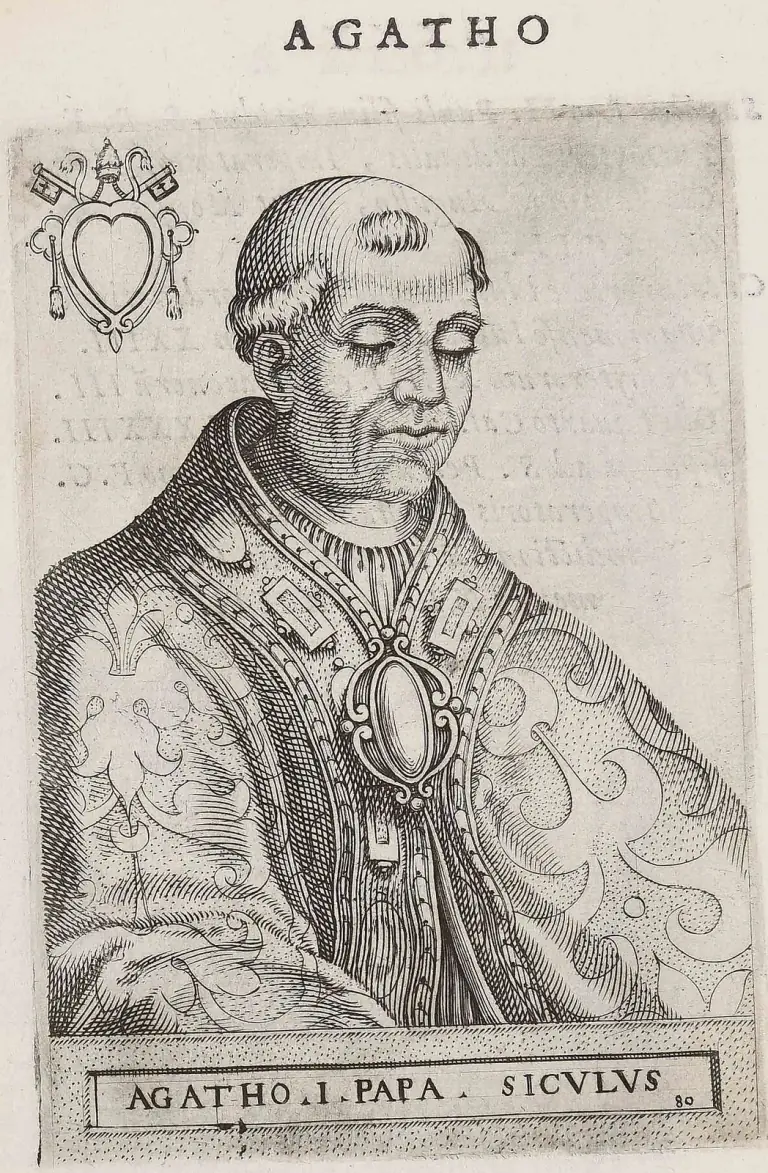
- Pope
- June 27, 678, to January 10, 681; the 79th pope in the Holy See's list 29; 679 to 682, says Butler 6
Saint Agatho was a Sicilian, very old by some accounts, who became pope in 678 and died in January 681, before the council he had prepared for was over. 12 His letter to the emperor, setting out that Christ has a human will as well as a divine one, was read at the Third Council of Constantinople, and the bishops told the emperor, "Peter spoke through Agatho." 3 His feast is January 10. 7
A monk from Sicily
Agatho was born in Sicily, in the island's Greek-speaking population and probably at Palermo, according to katolsk.no, which adds that he had been a monk and knew both Latin and Greek. 29 Michael Ott, in the Catholic Encyclopedia, writes that "it is generally believed" he had been a Benedictine monk at Saint Hermes in Palermo, and that "there is good authority that he was more than 100 years old" when he was elected. 1
katolsk.no is more careful. Gregory the Great once wrote to the abbot of Saint Hermes telling him to receive a man named Agatho into the monastery if Agatho's wife was willing to enter a convent. There is reason to think the future pope was that man, katolsk.no says, but if he was, he would have been very old indeed. 2
Pope Donus died in April 678, and Agatho was consecrated on June 27, after the imperial exarch at Ravenna had quickly approved his election. 29 Butler puts his accession in 679. 6 He was, in Ott's words, "remarkable for his affability and charity." 1 Butler adds that he had been treasurer of the Roman Church for some years; katolsk.no says rather that as pope he took the treasurer's office on himself, against custom, to look after the Church's strained finances, and kept it until his health failed. 62
Wilfrid of York
Early in his pontificate an English bishop arrived in Rome to appeal. Saint Wilfrid had been driven from York, and Archbishop Theodore of Canterbury had divided his diocese and appointed three bishops to it. 12 Bede says the wind had blown Wilfrid's ship to Frisia on the way, and that he spent the winter preaching there before going on. 5 At Rome his cause "being tried before Pope Agatho and several bishops, he was by their universal consent, acquitted of what had been laid to his charge." 5
Ott says Wilfrid was restored to his see. 1 katolsk.no gives the ruling more exactly: the diocese would still be divided, but Wilfrid himself would name the new bishops. It calls this the first appeal to Rome by an Anglo-Saxon bishop. 2 Years later, when Wilfrid came back to Rome under another accusation, the record of Agatho's synod was read out, and Boniface, the pope's counselor, and others who had seen him in Agatho's day remembered him as the bishop Agatho had cleared. 5
Agatho also sent John, the archchanter of Saint Peter's, to England with the abbot Benedict Biscop, to teach the monks at Wearmouth "the method of singing throughout the year, as it was practised at St. Peter's at Rome." 5 John had a second errand. He was to find out whether the English Church was free of the error then troubling Constantinople. A synod was called, "the Catholic faith was found untainted in them all," and John was given a copy to carry to Rome, but he fell ill soon after crossing the sea and died, and was buried at Tours. 5
One will or two?
That error was monothelitism, the teaching that Christ, though he has two natures, has only one will. 34 It had been put forward in the East to win back the Monophysites, who rejected the Council of Chalcedon; katolsk.no says it failed to do that and was never acceptable in the West. 24 Thomas Shahan, in the encyclopedia's article on the council, says the emperor Constans II had imposed silence on the question by an edict that amounted to "a practical suppression of the orthodox truth." 4
His son Constantine IV wanted peace in the Church as well as in the empire. In August 678 he wrote to Rome proposing a conference to settle the question, and the letter reached Agatho soon after his consecration. 2 Agatho welcomed it, but first had synods held across the West so that the Latin bishops would speak with one voice. 24 The largest met at the Lateran at Easter 680. Bede and the council's documents give it 125 bishops; katolsk.no says its decree was signed by 150. 532
The legates who went east carried two documents: the synod's letter and Agatho's own. 34 The pope's letter answers the question plainly. Christ has "two natural wills, viz.: the divine and the human," and his human will was obedient: when he says he came not to do his own will, he teaches "that through obedience we should submit our wills to the Divine Will." 3
He also apologized, in his way, for the men he was sending. They were not scholars. "For, among men placed amid the Gentiles, and earning their daily bread by bodily labour with considerable distraction, how could a knowledge of the Scriptures, in its fullness, be found," he asked, unless by keeping "in simplicity of heart" what the councils had already defined? 3 Their faith would be stated "not in words of worldly eloquence," but "in the integrity of the apostolic faith, in which having been taught from the cradle, we pray that we may serve." 3
The Third Council of Constantinople
The council opened on November 7, 680, in a domed hall of the imperial palace, under the presidency of the papal legates. 4 Shahan counts 100 bishops at the start and 174 by the end; katolsk.no gives 170. 42 Agatho's letter was read at the second session. 4 George, the patriarch of Constantinople, examined it against the Fathers and declared that he had "found that all the testimonies of the holy and accepted Fathers" in it agreed with them. 3 Macarius of Antioch held out to the end and was deposed. 4
The council's definition took up Agatho's teaching: in Christ "two natural wills and two natural operations," the human will "not as resisting and reluctant, but rather as subject to his divine and omnipotent will." 3 It condemned the leaders of the one-will party by name, and with them, at the thirteenth session, Pope Honorius I, for his letter to Sergius of Constantinople. 34 The meaning of that condemnation was argued over for centuries, and Shahan's article records the controversy. 4
When it was over, the bishops told the emperor what they thought had happened: "Peter spoke through Agatho." 3 Butler, a thousand years later, still described Agatho's letter as "approved as a rule of faith by the same council." 6
Death before the end
Agatho did not see the outcome. He died in Rome on January 10, 681, according to katolsk.no and the Holy See, months before the council closed in September; Ott gives January 10 as the day he was buried in Saint Peter's. 2914 Butler dates his death to 682. 6 The council's decrees reached Rome under his successor, Leo II. 14
He left a reputation as a kindly man whom people liked, and katolsk.no says that though the Church was short of money he left a generous bequest to his clergy. 2 Butler, citing the chronicler he calls Anastasius, says the number of his miracles earned him the title Thaumaturgus, the Wonderworker, and Ott repeats it. 61 Ott says his memory "is celebrated by the Latin as well as the Greek Church." 1
What is Saint Agatho the patron saint of?
Saint Agatho's feast day
Saint Agatho's feast day is January 10. 67 The Roman Martyrology, in the text published by the Italian bishops, enters on that day the burial at Saint Peter's of Saint Agatho, pope, who kept the faith whole against the errors of the monothelites and furthered the unity of the Church through synods. 7 The 1897 English Martyrology had him on the same day, "who, after having shone by his sanctity and learning, rested in peace." 8
Praying with Saint Agatho
Agatho did not claim to be learned, and he did not claim it for the men he sent to Constantinople. He described them as men who lived among the Gentiles and earned their bread by bodily labor, and who could offer the emperor nothing more than the faith they had been taught from the cradle. 3
As he set that faith out, much of it turned on obedience. The question before the council was whether Christ, as man, had a will of his own. Agatho's answer was that he had, and that he gave it freely to the Father: "not to do his own will" was, in the pope's reading, a lesson that we should "submit our wills to the Divine Will." 3
He worked at the council's preparation for most of his short reign and died before it ended. 24 The bishops who finished it gave him the credit anyway. 3
Saint Agatho, pray for us.
Sources
- 1.Michael Ott, "Pope St. Agatho," The Catholic Encyclopedia, vol. 1 (New York: Robert Appleton Company, 1907).
- 2."Den hellige pave Agatho ( - 681)," Den katolske kirke (katolsk.no), Catholic Diocese of Oslo (in Norwegian).
- 3.The Third Council of Constantinople: the letters of Pope Agatho and of the Roman synod, the definition of faith and the acclamations, translated by Henry R. Percival, Nicene and Post-Nicene Fathers, Second Series, vol. 14 (Buffalo: Christian Literature Publishing Co., 1900), as hosted by New Advent.
- 4.Thomas Shahan, "Third Council of Constantinople," The Catholic Encyclopedia, vol. 4 (New York: Robert Appleton Company, 1908).
- 5.Bede, Ecclesiastical History of the English Nation, Book IV, chapter 18, and Book V, chapter 19, Internet Medieval Sourcebook, Fordham University.
- 6.Alban Butler, "St. Agatho, Pope," January 10, The Lives of the Fathers, Martyrs, and Other Principal Saints, Vol. I.
- 7.Roman Martyrology, entry for January 10, "Sant'Agatone, papa," as printed in "Santo del giorno," Conferenza Episcopale Italiana (in Italian).
- 8.The Roman Martyrology, January 10 (Baltimore: John Murphy Company, 1897).
- 9."Agatho," The Supreme Pontiffs, The Holy See.
Saints to turn to next
Others in this collection who are turned to for some of the same things.
- Saint Angela MericiMarch 21, 1474 - January 27, 1540Study and teachingDiscernment
- Saint Augustine of HippoNovember 13, 354 - August 28, 430Study and teachingDiscernment
- Saint Bonaventure1217 or 1221 - July 15, 1274Study and teachingDiscernment
- Saint Brunoc. 1030 - October 6, 1101DiscernmentStudy and teaching