Saint Bruno
c. 1030 - October 6, 1101
- Patron saint of
- Neither source assigns him a patronage. He is invoked for solitude and by contemplatives 12
- Feast day
- October 6. Mougel: "His feast is kept on the 6th of October" 1
- Taught
- The episcopal school at Reims for about twenty years, 1057 to 1075. One of his pupils became Pope Urban II 1
- Founded
- The Chartreuse, in the Alps above Grenoble, in 1084 - the house that named the Carthusians 12
- Canonized
- Never formally. His order disliked publicity. Clement X extended his feast to the whole Church in 1674 2
Saint Bruno was the most admired teacher in France, chancellor of the church of Reims, and the man who brought down a corrupt archbishop - and he gave all of it up at about fifty-five to live in a hut in the Alps. 12 When a former pupil became pope and summoned him to Rome, he went, served quietly, refused an archbishopric, and asked to be let go back to the wilderness. 1 He got his wish, and died in Calabria.
Twenty years at the head of the best school in France
He was born at Cologne about 1030, of a leading family of the city, and went young to Reims for the reputation of its episcopal school and its director, Heriman. 1 He finished his classical studies there and gave himself to scripture and the Fathers, becoming, in the words of his contemporaries, "learned both in human and in Divine science." 1
He returned to Cologne with a canonry at St. Cunibert's and was probably ordained about 1055. 1 A year later Bishop Gervais called him back to Reims to help Heriman run the school. When Heriman left the world for religious life in 1057, Bruno found himself head of it - a post Mougel calls "difficult as it was elevated, for it then included the direction of the public schools and the oversight of all the educational establishments of the diocese." 1
He held it for about twenty years and did not let it slip. 1 The measure of the teaching is in the pupils: Eudes of Chatillon, who became Pope Urban II; Rangier, Cardinal and Bishop of Reggio; Robert, Bishop of Langres; "and a large number of prelates and abbots." 1 The funeral verses written for him praise his eloquence and his poetic, philosophical, exegetical and theological gifts. 1
In 1075 he was made chancellor of the church of Reims and turned to administering the diocese. 1 Franciscan Media notes he was forty-five. 2 By any ordinary reckoning he had arrived.
The archbishop who razed his house
Then Gervais died and Manasses de Gournai succeeded him, and Mougel does not soften it: he "quickly became odious for his impiety and violence." 1
Bruno did not stay out of it. He and two other canons were commissioned to carry the complaints of the clergy to the papal legate, Hugh of Die, and at the Council of Autun in 1077 they obtained the suspension of the man. 1 Franciscan Media frames it as part of a larger fight: he "supported Pope Gregory VII in his fight against the decadence of the clergy, and took part in the removal of his own scandalous archbishop, Manasses." 2
The reply was direct. Manasses "raze[d] the houses of his accusers." 1 Franciscan Media: "Saint Bruno suffered the plundering of his house for his pains." 2 He had won, and it had cost him his home.
Seven men and seven stars
What he did next was not a reaction to the archbishop. Franciscan Media says he "had a dream of living in solitude and prayer, and persuaded a few friends to join him in a hermitage." 2
The first attempt failed. He went to St. Robert, who had settled at Molesme in 1075 with a band of solitaries who would later become the Cistercians, and found within a short stay at Seche-Fontaine "that this was not his vocation." 1 Franciscan Media: "After a while he felt the place unsuitable." 2 He left two companions behind and took six others to Hugh of Chateauneuf, Bishop of Grenoble.
Mougel records what happened then in a line worth repeating: the bishop, "to whom God had shown these men in a dream, under the image of seven stars, conducted and installed them himself (1084) in a wild spot on the Alps of Dauphine named Chartreuse, about four leagues from Grenoble, in the midst of precipitous rocks and mountains almost always covered with snow." 1 Bruno is sometimes shown crowned with seven stars for that dream. 1
The site did the work. Franciscan Media is clear-eyed about why he chose it: "The climate, desert, mountainous terrain, and inaccessibility guaranteed silence, poverty, and small numbers." 2 Not a hardship to be endured but a design. A place like that cannot become popular.
They built an oratory with small cells set apart from each other, met for Matins and Vespers, and spent the rest of the day alone, eating together only on great feasts. 2 Their chief work was copying manuscripts. 2 With Bruno were Landuin, the two Stephens of Bourg and Die, and Hugh the Chaplain - "all, the most learned men of their time" - and two laymen, Andrew and Guerin, who became the first lay brothers. 1 Guibert of Nogent visited them and left a description. 1
The name of the place became the name of the order: Chartreuse, Carthusians. 2 Bruno lived there a little over six years.
Summoned, and effaced
In 1088 his old pupil Eudes became Urban II. Fighting an antipope and the Emperor Henry IV, and set on continuing Gregory VII's reform, Urban called for his former master "ad Sedis Apostolicae servitium" - to the service of the Apostolic See. 1 In 1090 Bruno left the Chartreuse, followed by part of his community, who could not bear to be separated from him. 1
What he did in Rome cannot be recovered, and Mougel says so rather than guessing: his influence "was entirely hidden and confidential", and although he lodged in the pope's own palace, sat on his councils and helped prepare business for the councils of those years, "he took care always to keep himself in the background." Then, flatly: "His part in history is effaced." 1
That is an extraordinary sentence to find in an encyclopedia entry, and it is the most exact thing anyone says about him. A man at the center of the reform papacy left no trace of himself in it on purpose.
When Urban had to abandon Rome before the emperor's forces and withdrew south, the clergy of Reggio in Calabria elected Bruno their archbishop, and both the pope and the Norman duke Roger pressed him to accept. 1 At Reims he had escaped a similar honor by flight; this time he arranged for his pupil Rangier to be elected instead. 1 Fearing it would happen again, and "weary of the agitated life imposed upon him", he begged permission to return to solitude, and after much trouble got it. 1
He meant to rejoin his brethren in Dauphine and was not allowed to go that far. 1 He spent his last years in the wilderness of Calabria and died there on 6 October 1101. 12
What is Saint Bruno the patron saint of?
Neither Mougel nor Franciscan Media assigns Saint Bruno a patronage, and this page will not invent one for him. 12 He is invoked in practice by contemplatives, by people making retreats, and by those weighing whether to step back from a public career - all of which follow from the life rather than from any grant.
The absence is fitting. A man whose part in history was effaced on purpose, and whose order refused to hold a canonization for him because it would have been publicity, is not an obvious candidate for a specialty. 2
Saint Bruno's feast day
The feast of Saint Bruno is October 6, the day he died in Calabria in 1101. Mougel states it outright: "His feast is kept on the 6th of October." 1 Franciscan Media presents him on the same day. 2
How it became a feast at all is the strange part. Franciscan Media: "Saint Bruno was never formally canonized, because the Carthusians were averse to all occasions of publicity. However, Pope Clement X extended his feast to the whole Church in 1674." 2 There was no canonization ceremony. There was a pope, five hundred and seventy-three years later, putting him on the calendar of the universal Church anyway.
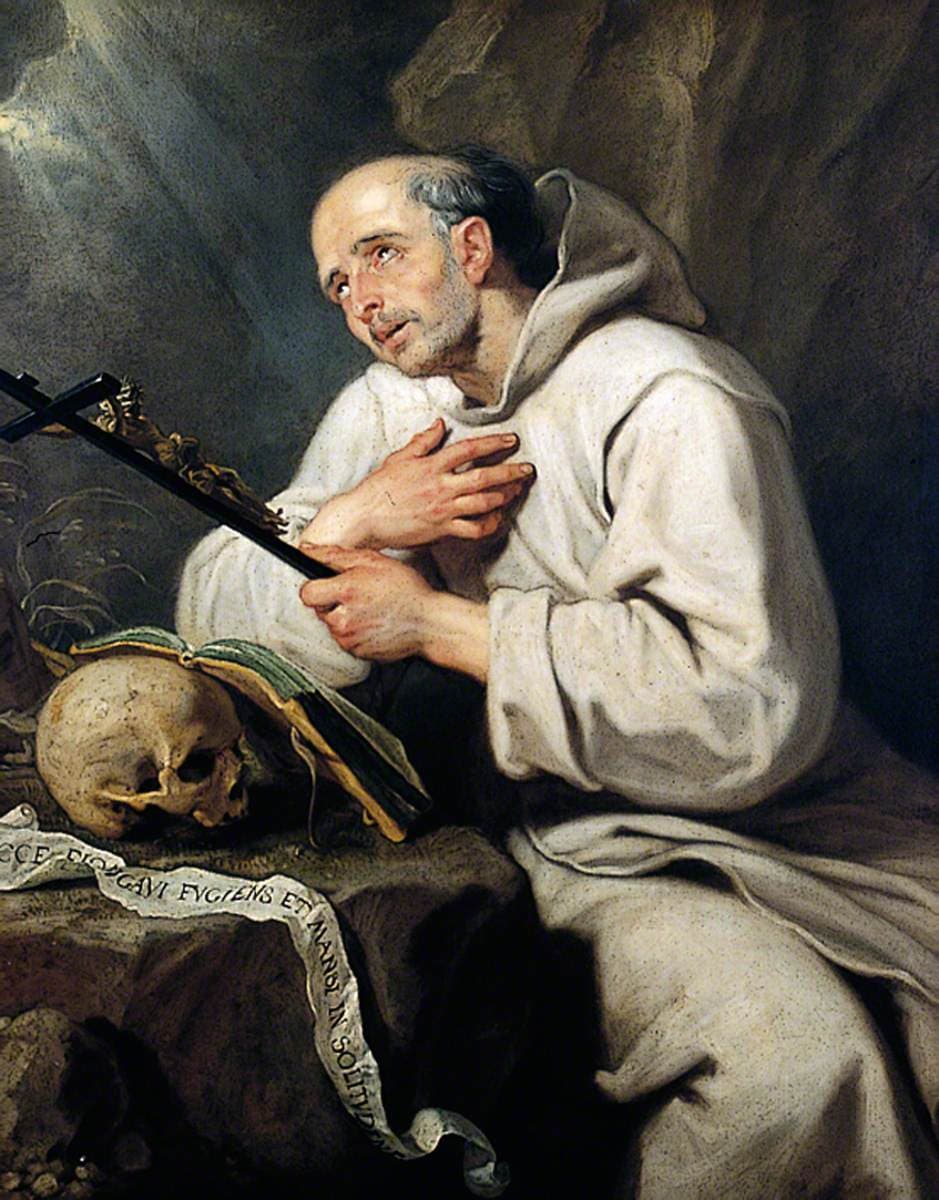
In art he is usually shown with a skull in his hands, a book and a cross, or crowned with seven stars for the bishop's dream, or with a scroll bearing the words O Bonitas. 1
Praying with Saint Bruno
He is the saint for people who succeeded at the thing they were good at and then found it was not what they wanted. Bruno was not driven out of Reims. He was the most respected teacher in France, he had just been made chancellor, he had won his fight with the archbishop, and he left. 12 Nothing had gone wrong except that he had stopped wanting it.
The six years at the Chartreuse are the only period of his life he chose freely and kept, and they were interrupted by an order he could not refuse. 1 What he did with the interruption is the test. He went, he served, he said nothing about himself, he turned down an archbishopric by arranging for someone else to have it, and he asked to leave. Mougel's verdict - "His part in history is effaced" - is not a complaint about missing records. It is a description of a deliberate achievement.
Franciscan Media repeats a saying about his order: it "has never had to be reformed because it was never deformed", and immediately adds that "both the founder and the members would reject such high praise." 2 The saying is worth holding lightly for exactly that reason. What kept the Carthusians from drifting was not virtue in the abstract but a site chosen so that silence, poverty and small numbers were guaranteed by the snow. 2 He built the conditions and let them do the work, which is a more usable lesson than admiring the outcome.
The absence of a canonization is the last thing he did, in a sense, and it is consistent with everything else. 2 A man who spent his life declining to be visible was left unpublicized by the brothers who knew him best, and the Church put him on the calendar regardless.
Saint Bruno, pray for us.
Sources
Saints to turn to next
Others in this collection who are turned to for some of the same things.
- Saint Gertrude the GreatJanuary 6, 1256 - November 17, 1302PrayerStudy and teachingDiscernment
- Saint Thomas Aquinasc. 1225 - March 7, 1274Study and teachingPrayerDiscernment
- Saint Bonaventure1217 or 1221 - July 15, 1274Study and teachingPrayerDiscernment
- Saint Robert BellarmineOctober 4, 1542 - September 17, 1621Study and teachingPrayerDiscernment