Saint Gertrude the Great
January 6, 1256 - November 17, 1302
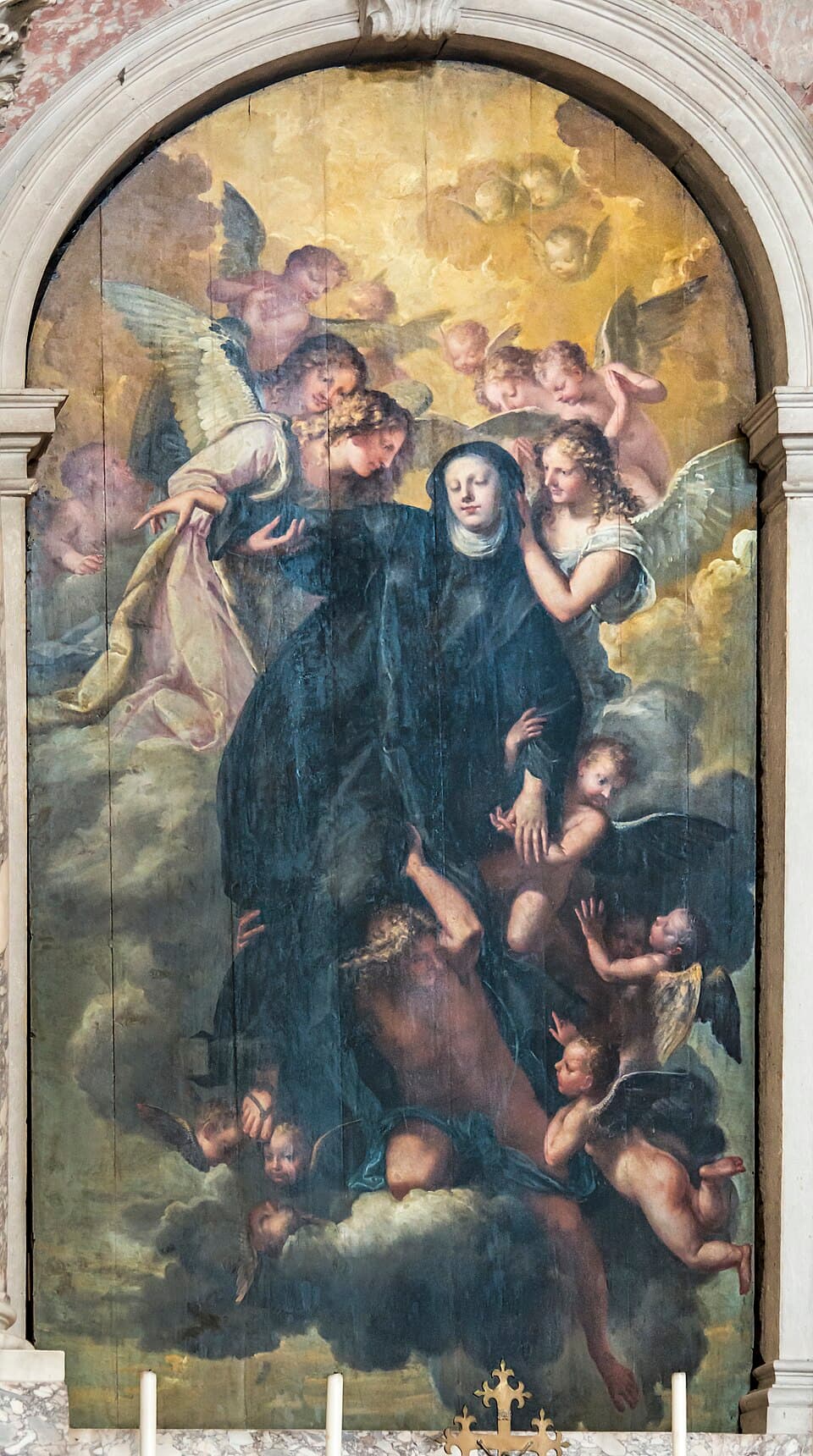
- Born
- 6 January 1256, in Germany. "Nothing is known of her family, not even the name of her parents" 1
- Entered Helfta
- At five years old, and never left 1
- First vision
- In her twenty-sixth year, beginning a series that ended only with her life 1
- Wrote
- The Legatus divinae pietatis - the Herald of Divine Love 1
Saint Gertrude the Great went into the monastery at Helfta when she was five years old and died there about fifty years later, and in between nothing dramatic happened to her. 1 She read, she taught, she copied and translated, and in her twenty-sixth year she began to have visions that did not stop. 1 Her biographer states the thing that makes her unusual among saints: there was "no sudden conversion from sin to holiness." 1
A child given to a library
She was born in Germany on 6 January 1256, and that is nearly all the biography there is. Casanova opens by conceding it: "Nothing is known of her family, not even the name of her parents." 1 We know only from a remark in her own book that she was not born near Eisleben. 1
At five she entered the alumnate - the school - at Helfta, and Casanova describes what she was walking into. The house was governed by Abbess Gertrude of Hackeborn, "under whose rule it prospered exceedingly, both in monastic observance and in that intellectual activity which St. Lioba and her Anglo-Saxon nuns had transmitted to their foundations in Germany." 1 Helfta was one of the great learned communities of Europe, and the learning had come down a line of women running back to the eighth century.
She was placed in the care of Saint Mechtilde, the abbess's sister. 1 Franciscan Media calls Mechtild "her friend and teacher", and Casanova describes a bond "which deepened and strengthened with time." 12 The child had "the gift of winning the hearts", and her biographer records "many details of her exceptional charms, which matured with advancing years." 1
And she worked. "Partly in the alumnate, partly in the community, Gertrude had devoted herself to study with the greatest ardour." 1
From grammarian to theologian
In her twenty-sixth year came "the first of that series of visions of which the wonderful sequence ended only with life." 1
What it changed was what she read. Casanova puts it in a phrase taken from the Legatus itself: "from being a grammarian became a theologian", abandoning secular studies "for the Scriptures, patristic writings, and treatises on theology." 1 The same energy, redirected - "to these she brought the same earnestness which had characterized her former studies, and with indefatigable zeal copied, translated, and wrote for the spiritual benefit of others." 1
Gertrude afterward accused herself of having wasted the years before. Casanova declines to accept the charge and explains why with some subtlety. The words "express the indignant self-condemnation of a soul called to the highest sanctity", and while an inordinate love of study "had proved a hindrance alike to contemplation and interior recollection, yet it had none the less surely safeguarded her from more serious and grievous failings." 1 The books had kept her out of trouble.
Casanova also names what she actually had to fight, and it is not what the self-accusation suggests: "Her struggle lay in the conquest of a sensitive and impetuous nature." 1 Not sin, temperament.
The life with no turning point
Then the sentence that defines her. "In St. Gertrude's life there are no abrupt phases, no sudden conversion from sin to holiness. She passed from alumnate to the community. Outwardly her life was that of the simple Benedictine nun, of which she stands forth preeminently as the type." 1
She went from the school into the choir, in the same building, among the same women. Nothing happened. That is the biography, and Casanova - herself a Benedictine - clearly regards it as the point rather than a shortage of material.
What is recorded instead of events is character. Her charity "embraced rich and poor, learned and simple, the monarch on his throne and the peasant in the field", and showed itself especially "in tender sympathy towards the souls in purgatory" and in "a great yearning for the perfection of souls consecrated to God." 1 Her humility "was so profound that she wondered how the earth could support so sinful a creature as herself." 1 Her raptures were frequent and so absorbing that she became insensible to what went on around her. 1
What she actually taught
Franciscan Media gives the substance of her spirituality better than any summary of events could.
She and Mechtild practiced what it calls "nuptial mysticism, that is, she came to see herself as the bride of Christ." Her interior life was "a deeply personal union with Jesus and his Sacred Heart, leading her into the very life of the Trinity." 2 She is one of the sources from which devotion to the Sacred Heart later came.
And then the correction that keeps her from being misread: "But this was no individualistic piety. Gertrude lived the rhythm of the liturgy, where she found Christ. In the liturgy and in Scripture she found the themes and images to enrich and express her piety. There was no clash between her personal prayer life and the liturgy." 2
That is unusual and worth dwelling on. A great deal of mystical writing reads as private experience set alongside, or above, the public prayer of the Church. Gertrude's visions came out of the Office she was singing seven times a day. The images in her books are the images in the liturgy because that is where she got them.
She wrote it down. The Legatus divinae pietatis - the Herald of Divine Love - is the record, and it is the reason we know anything at all about a woman whose parents' names are lost. 1
What is Saint Gertrude the Great the patron saint of?
Neither Casanova nor Franciscan Media assigns Saint Gertrude a formal patronage, and this page does not invent one. 12
She is in practice invoked for the souls in purgatory, and that does rest on something in the sources: Casanova singles out her "tender sympathy towards the souls in purgatory" as a mark of her charity. 1 A prayer for the dead attributed to her is widely used, though neither source here mentions it, and this page will not vouch for the attribution.
She is also, reasonably, a patron for students and scholars - a woman who was a grammarian before she was a theologian, who copied and translated and wrote, and who accused herself of loving books too much. 1
Saint Gertrude the Great's feast day
The feast of Saint Gertrude the Great is November 16. Franciscan Media states it outright: "The Liturgical Feast of Saint Gertrude the Great is November 16." 2
Casanova gives her death as 17 November, and is not certain of the year - "1301 or 1302." 1 So the feast falls the day before the anniversary of her death. Neither source explains why, and this page will not guess.
She is not to be confused with Gertrude of Hackeborn, the abbess who ran Helfta when she arrived, nor with her teacher Mechtilde, who was that abbess's sister. 1 Three women, one house, two of them named Gertrude.
Praying with Saint Gertrude
She is the saint for people who have no conversion story. A great many lives in this library turn on a moment - a sermon, a deathbed, a road, a coffin - and Gertrude's does not. She was handed to a monastery at five and stayed. 1 If the only model of holiness on offer is the dramatic reversal, then most people are disqualified, and Casanova's flat statement that Gertrude had no such phase is a kindness to all of them.
What she did have was a change of attention in her twenties: the same ardour, pointed somewhere else. 1 Not less study, different study. That is a more realistic account of how a person actually changes than any sudden reversal, and it is worth noticing that she did not stop being a scholar. She went on copying and translating for the rest of her life.
Her self-accusation is instructive in a way she did not intend. She thought her years of study had been a waste; her biographer, looking at the same years, thought they had kept her safe. 1 People are unreliable witnesses about their own past, and saints are not exempt. If Gertrude could be wrong about Gertrude, a reader can be wrong about themselves in the same direction.
The last thing to take from her is the liturgy. Her visions were not an alternative to the Church's public prayer; they grew inside it, from psalms she sang every day in a stone choir in Saxony with the same women for fifty years. 2 Franciscan Media's line - "There was no clash between her personal prayer life and the liturgy" - is the whole of her spiritual method, and it is available to anyone who goes to Mass on Sunday.
Saint Gertrude the Great, pray for us.
Sources
Saints to turn to next
Others in this collection who are turned to for some of the same things.
- Saint Brunoc. 1030 - October 6, 1101PrayerDiscernmentStudy and teaching
- Saint Thomas Aquinasc. 1225 - March 7, 1274Study and teachingPrayerDiscernment
- Saint Bonaventure1217 or 1221 - July 15, 1274Study and teachingPrayerDiscernment
- Saint Robert BellarmineOctober 4, 1542 - September 17, 1621Study and teachingPrayerDiscernment