Saint Vincent de Paul
1580 - September 27, 1660
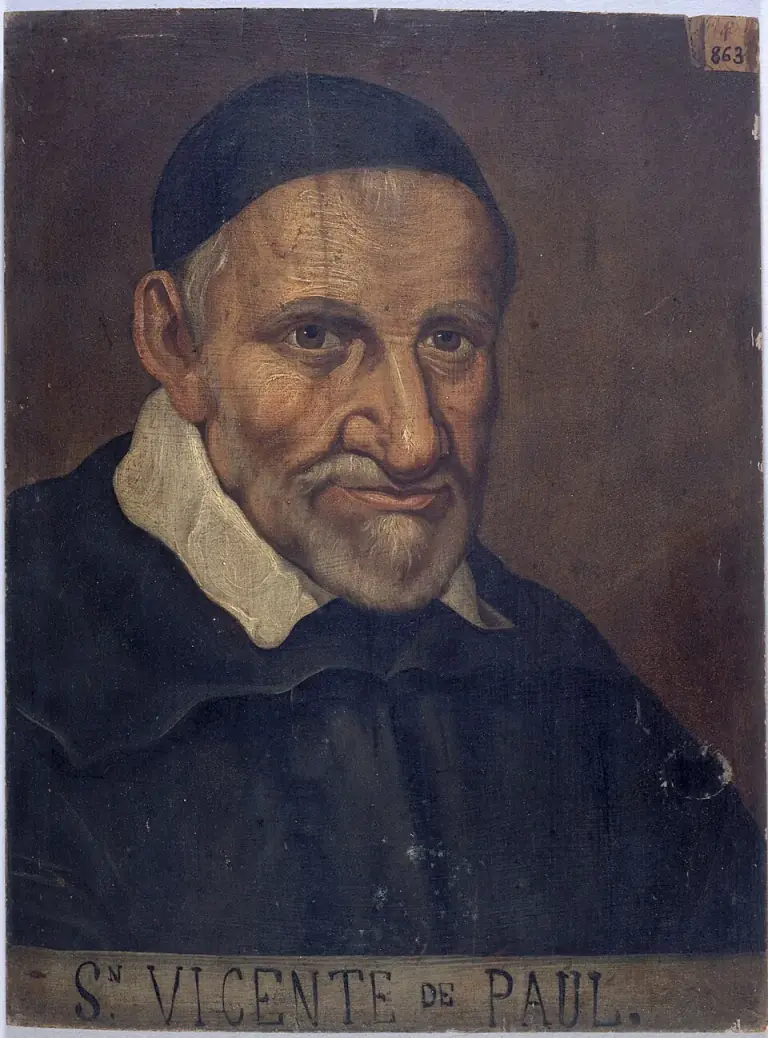
- Born
- Pouy, in Gascony, in 1580, to a peasant family; the encyclopedia notes that some authorities say 1576 1
- Enslaved
- Taken by pirates to Tunis in 1605 and sold; escaped in 1607 1
- Founded
- The Congregation of the Mission, and with Saint Louise de Marillac the Daughters of Charity 2
Saint Vincent de Paul was a farmer's son from Gascony who became a priest, in his own account, with no larger ambition than a comfortable living. 2 Then pirates took him to Tunis and sold him, and he got out after two years. Forty years later he was running the largest charitable operation in France and had ransomed twelve hundred slaves off the Barbary coast - the encyclopedia notes that of all his overseas work none interested him more, "whose lot he had once shared." 1
A comfortable living
Vincent was born at Pouy in Gascony in 1580 - the encyclopedia adds that "some authorities have said 1576" - into a peasant family. He studied with the Cordeliers at Dax and read theology at Toulouse, with an interruption at Saragossa, and was ordained in 1600, after which he stayed around Toulouse tutoring and studying. 1
Franciscan Media is blunt about what he was then: a man "who had become a priest with little more ambition than to have a comfortable life." 2 Nothing in the record contradicts that, and it is the reason the rest of his life is worth reading.
Two years a slave
In 1605, returning by sea after collecting an inheritance at Marseilles, he was captured by Turkish pirates and taken to Tunis, where he was sold. He escaped in 1607, and he did not escape alone: he took his master with him, "a renegade whom he converted." 1
Back in France he went to the papal vice-legate at Avignon, followed him to Rome to continue his studies, and was sent back in 1609 on a secret mission to Henry IV, after which he became almoner to Queen Marguerite of Valois and was given a small abbey. 1 It reads like the beginning of exactly the comfortable career he had wanted.
The confession that changed his mind
In 1612 he took charge of the parish of Clichy and then entered the service of the Gondi, an illustrious French family, to educate their children; he became the spiritual director of Madame de Gondi. 1 Franciscan Media identifies the moment things turned: "The deathbed confession of a dying servant opened Saint Vincent de Paul's eyes to the crying spiritual needs of the peasantry of France." 2
Madame de Gondi persuaded her husband to endow a group of missionaries to work among poor tenant farmers and country people. 2 Vincent began giving missions on the Gondi estates - and then, to get away from the esteem it was earning him, left and had himself made curé of Châtillon-les-Dombes, where he founded the first conference of charity for the relief of the poor. 1 The Gondi called him back five months later, in 1617, and he resumed the peasant missions with several learned Paris priests who had been won over by his example. Nearly everywhere a mission went, a conference of charity was founded behind it, and some of them lasted until the Revolution. 1
The galleys, and the slaves of Barbary
Monsieur de Gondi was general of the galleys of France, which gave Vincent access to the convicts. Before being taken aboard, or when illness forced them ashore, condemned men were crowded into damp dungeons with chains on their legs. 1 Franciscan Media notes that he worked among the imprisoned galley slaves of Paris before he was willing to lead anything. 2
From 1645 he sent his own priests and brothers to the Christian captives of North Africa - between twenty-five and thirty thousand people, the encyclopedia estimates, held mainly at Tunis, Algiers and Bizerte, carried off from their families by corsairs and worked as beasts of burden with no care of any kind. He even had one of his men appointed consul so that he could act more effectively for them. 1
By the time Vincent died his missionaries had ransomed twelve hundred slaves and spent 1,200,000 livres doing it, on top of the affronts and persecutions they absorbed. 1 Franciscan Media counts the same twelve hundred. 2 And the encyclopedia supplies the sentence that holds his life together: "Of all the works carried on abroad none perhaps interested him so much as the poor slaves of Barbary, whose lot he had once shared." 1
The Congregation of the Mission and the Daughters of Charity
Vincent was too humble to take the leadership at first, but he returned to head what became the Congregation of the Mission, or the Vincentians - priests under vows of poverty, chastity, obedience and stability, committed entirely to people in smaller towns and villages rather than to the cities. 2
Out of the parish confraternities of charity, and with the help of Saint Louise de Marillac, came the Daughters of Charity, described in a phrase that was startling at the time and is still the clearest statement of what he was doing: "whose convent is the sickroom, whose chapel is the parish church, whose cloister is the streets of the city." 2 Women in religious life were not, in the France of the 1630s, expected to be out in the streets.
The rest of the list is long. He organized the wealthy women of Paris to raise money for the missions, founded several hospitals, collected relief funds for the victims of war, ran retreats for clergy at a time of considerable laxity and ignorance among them, and was a pioneer of clerical training and the establishment of seminaries. 2
He was not naturally nice
Franciscan Media includes the detail that makes him usable: "Most remarkably, Saint Vincent de Paul was by temperament a very irascible person—even his friends admitted it. He said that except for the grace of God he would have been 'hard and repulsive, rough and cross.' But he became a tender and affectionate man, very sensitive to the needs of others." 2
That is a report about a man in his seventies looking back, not a pious flourish. The gentleness people remember was constructed, at length, over a temper he never claimed to have been born without.
What is Saint Vincent de Paul the patron saint of?
Saint Vincent de Paul is the patron of all charitable societies, a designation Franciscan Media attributes to Leo XIII and which the encyclopedia's article on patron saints dates precisely to 1 May 1885. 23 The best known of those societies is the Society of St Vincent de Paul, founded in 1833 - nearly two centuries after his death - by his admirer Blessed Frédéric Ozanam. 2
Saint Vincent de Paul's feast day
Praying with Saint Vincent
He was a slave for two years and then spent the second half of his life buying other people out of the same thing. 1 The encyclopedia says nothing about how the captivity affected him and does not need to; the twelve hundred ransoms are the comment. Whatever happened to him at Tunis, it did not turn into avoidance.
The turning point was somebody else's deathbed confession, overheard in the course of ordinary parish duty. 2 He had been a priest for over a decade by then, with modest plans. Vocations are often described as arriving at the start; his arrived in the middle, from a dying servant, and rearranged everything after it.
He kept trying to get out of being in charge. He left the Gondi to escape the reputation he was building and buried himself in a country parish, and they fetched him back. 1 Franciscan Media says he was too humble to accept leadership of the missionaries at first. 2 The work found him anyway, which is not the same as his having wanted it.
And by temperament he was difficult - his own friends said so, and he thought that without grace he would have been hard and rough and cross. 2 The most famous charitable saint in the Church was not a naturally warm man. He became one, slowly, while doing the work.
Saint Vincent de Paul, pray for us.
Sources
Saints to turn to next
Others in this collection who are turned to for some of the same things.
- Saint CajetanOctober 1480 - August 7, 1547Work and vocationPoverty and simplicity
- Saint John Francis RegisJanuary 31, 1597 - December 1640Work and vocationPoverty and simplicity
- Saint Mary MacKillopJanuary 15, 1842 - August 8, 1909Poverty and simplicityWork and vocation
- Saint Notburgac. 1265 - 1313Work and vocationPoverty and simplicity