Saint Notburga
c. 1265 - 1313
- Buried
- The church of St. Rupert at Eben am Achensee, where her skeleton stands above the high altar 124
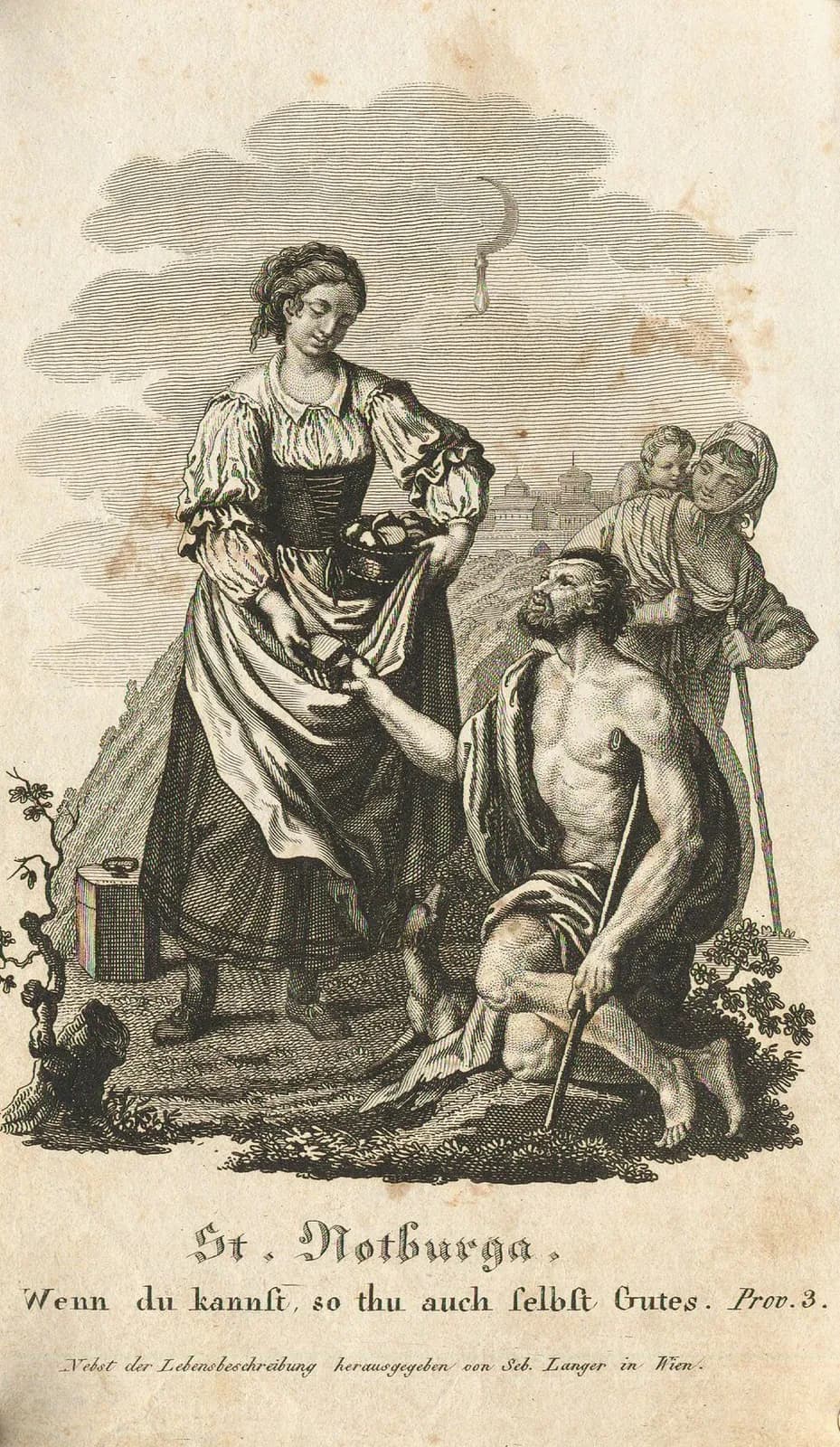
Saint Notburga was a kitchen maid in the Tyrol around the year 1300 who gave the castle's leftovers, and then her own food, to the poor at the gate, and who is said to have thrown her sickle into the air when a farmer told her to keep working after the bell had rung for Sunday. 14 The sickle stayed there. 1 The Diocese of Innsbruck, which keeps her as its own, admits that no document proves she ever lived, and its bishop still calls her the only official saint of the Tyrol. 45
A maid at the Rottenburg
Notburga was born about 1265 at Rattenberg on the river Inn. 14 Bishop Manfred Scheuer of Innsbruck, writing for the seven hundredth anniversary of her death, calls her the daughter of a hatmaker; the Norwegian biography on katolsk.no calls her the daughter of a poor peasant. 24 At eighteen she went into service at the castle of Rottenburg under Count Henry I, who was steward of the Tyrol. 24 The household liked her, Scheuer writes, and she rose to be chief cook and keeper of the castle door. 4
What was left over from the table, along with what she saved from her own mouth, she gave to the poor. 4 katolsk.no puts it sharply: the castle threw more food to the pigs each day than her own parents ate in a week, and the poor gathered daily at a side gate to receive it. 2 Michael Ott, writing in the 1911 Catholic Encyclopedia, says that "she, therefore, saved some of her own food, especially on Fridays, and brought it to the poor." 1
The trouble came with a new mistress. In Scheuer's telling, after the old count and his wife, Gutta, died, the young count married Ottilie, a hard and grasping woman who turned the poor away from the castle and then dismissed Notburga herself. 4 The encyclopedia makes Ottilia the wife of the count who first employed her, and the Norwegian biography has the count's mother protecting Notburga until her death. 12 The encyclopedia and katolsk.no agree that Ottilia ordered the scraps to go to the pigs. 12
One day, the encyclopedia's version of the legend says, her master met her and "commanded her to show him what she was carrying. She obeyed, but instead of the food he saw only shavings, and the wine he found to be vinegar." 1 Scheuer's letter calls it the wood-shavings miracle. 4
The sickle
Dismissed from the castle, she went to work as a maid for a farmer at Eben, in the mountains above the Achensee. 124 The encyclopedia says she took the place "on condition that she be permitted to go to church evenings before Sundays and festivals." 1
The story that made her famous happened at harvest. Scheuer tells it in a few lines: one Saturday the farmer ordered her to keep working, though the evening bell had rung, until the crop was under cover, and she threw her sickle into the air, where it stayed. 4 In the encyclopedia she says, "Let my sickle be judge between me and you," and "the sickle remained suspended in the air." 1 katolsk.no has her call out that the bell was ringing for evening prayer, and the sickle hang there for all to see until the ringing stopped. 2 A memorial tablet still marks the farm at Eben where it is said to have happened. 2
The Norwegian biography is clear about what kind of story this is. Her life was first written down in 1646, and by then, it says, the account had been considerably embroidered. 2 The encyclopedia names the author of that first life, Guarinoni, and calls it "her legendary life." 1
Back at the castle
Meanwhile, the legend says, things went badly for the count. The encyclopedia says he "was visited with great reverses which he ascribed to the dismissal of Notburga," and took her back, "and thenceforth all went well in his household." 1 In the Innsbruck version Notburga first forgave the dying Ottilie and nursed her, and then returned at the count's request; with her, peace came back to the castle, the poor had their place and their bread again, and she reconciled the count with his estranged brother, Count Seifried. 45 The encyclopedia also has her nursing Ottilia and preparing her for death. 1
She died at the Rottenburg in 1313. 24 The encyclopedia gives the date as about September 16; katolsk.no says about September 14, at forty-eight. 12 Before she died, she asked that her body be laid on a cart drawn by two oxen and buried wherever they stopped. 14 Scheuer says the oxen drew it through the Inn and up to Eben, and she was buried in the church of St. Rupert there. 4 The encyclopedia calls it "the chapel of St. Rupert near Eben." 1
Did she live?
The diocese's 2013 supplement asks the question directly. By the strict standards of modern history, it says, it is not possible to prove that Notburga existed; there are no documents. 5 It gives its reasons for believing she did all the same. A maid was neither noble nor clergy, and shares the fate of the great mass of medieval "little people" whom nobody wrote down. 5 Pictures and written witnesses to her cult appear relatively early. The veneration of the people has never broken off. And in 1862, after long research, Pope Pius IX officially approved it. 5
katolsk.no adds that scholars do not even agree on when she lived, and that some place her as early as the tenth century. 2 The oldest text of her legend was in German, painted on a wooden panel at her grave; the panel disappeared in 1862, but the text had been copied. 2
Her cult was confirmed on March 27, 1862. 12 In 1718 her grave at Eben was opened and her body raised to the high altar, and when the old Gothic chapel had been rebuilt as the larger baroque church of St. Rupert she was brought back there in September 1738. 2 Her skeleton still stands upright above the high altar in a glass shrine, dressed in white brocade, a sickle in its right hand. 2
What is Saint Notburga the patron saint of?
Saint Notburga is the patron saint of servants and of farmers. The 1911 encyclopedia calls her "patroness of servants and peasants"; Scheuer names farmers, maids and the poor. 14 katolsk.no adds that she is invoked for rest from work and for a happy childbirth, and against cattle disease and every kind of trouble on the farm. 2 In Scheuer's letter she is also becoming, more and more, an advocate for Sunday. 4
Saint Notburga's feast day
Saint Notburga's feast day is September 14. The Roman Martyrology enters her on that day, as a housekeeper of the village of Eben who served Christ in the poor and left country people a model of holiness, and the encyclopedia and katolsk.no give the same date. 123 In the Tyrol it is September 13: Bishop Scheuer and the Diocese of Innsbruck give that as her day, and katolsk.no says Innsbruck and Salzburg keep her then. 245 In 2013, seven hundred years after her death, the diocese kept an anniversary year, and Scheuer wrote his pastoral letter for Notburga Sunday, September 15. 4
Praying with Saint Notburga
Bishop Scheuer called her a saint of little people and of the everyday, and said that she imitated in a special way the hidden life of Jesus at work in Nazareth. 4 There is nothing in her story but kitchens, gates, fields and a farmer's harvest. Whatever holiness she had was spent on the people in front of her, beginning with the beggars at the side door.
Her name, Scheuer pointed out, can be heard as Burg in der Not, a stronghold in time of need, and that is what she was for the poor. 4 He saw her as a bridge between rich and poor, high and low, and people who had fallen out with each other, and he noticed that the woman who had turned her out of the castle was one of the people she forgave. 4
And then the sickle. Scheuer read it as a refusal to let the pressures of the moment crowd out the inner life, and said that without the Lord and the day that belongs to him, life does not succeed. 4 The supplement called her a reminder that people have a right to the end of the working day. 5
Saint Notburga, pray for us.
Sources
- 1.Michael Ott, "St. Notburga," The Catholic Encyclopedia, Vol. 11 (New York: Robert Appleton Company, 1911).
- 2.Per Einar Odden, "Den hellige Notburga," Den katolske kirke (the Catholic Church in Norway), katolsk.no (in Norwegian).
- 3.Roman Martyrology, entry for September 14, "Santa Notburga, vergine," as printed in "Santo del giorno," Conferenza Episcopale Italiana (in Italian).
- 4.Manfred Scheuer, Bishop of Innsbruck, "700 Jahre hl. Notburga," pastoral letter for Notburga Sunday, September 15, 2013, as published by the Diocese of Linz (in German).
- 5."Die heilige Notburga," Moment, special supplement of the Diocese of Innsbruck and the Archdiocese of Salzburg, January 18, 2013 (in German).
Saints to turn to next
Others in this collection who are turned to for some of the same things.
- Saint Isidore the Farmerc. 1070 - May 15, 1130Work and vocationPrayerPoverty and simplicity
- Saint Guy of Anderlechtc. 950 - c. 1012Poverty and simplicityWork and vocationPrayer
- Saint Wendelin of Trierc. 554 - c. 617PrayerWork and vocationPoverty and simplicity
- Saint Zita of LuccaEarly 13th century - April 27, 1271, 1272 or 1278Work and vocationPoverty and simplicityPrayer