Saint Wendelin of Trier
c. 554 - c. 617
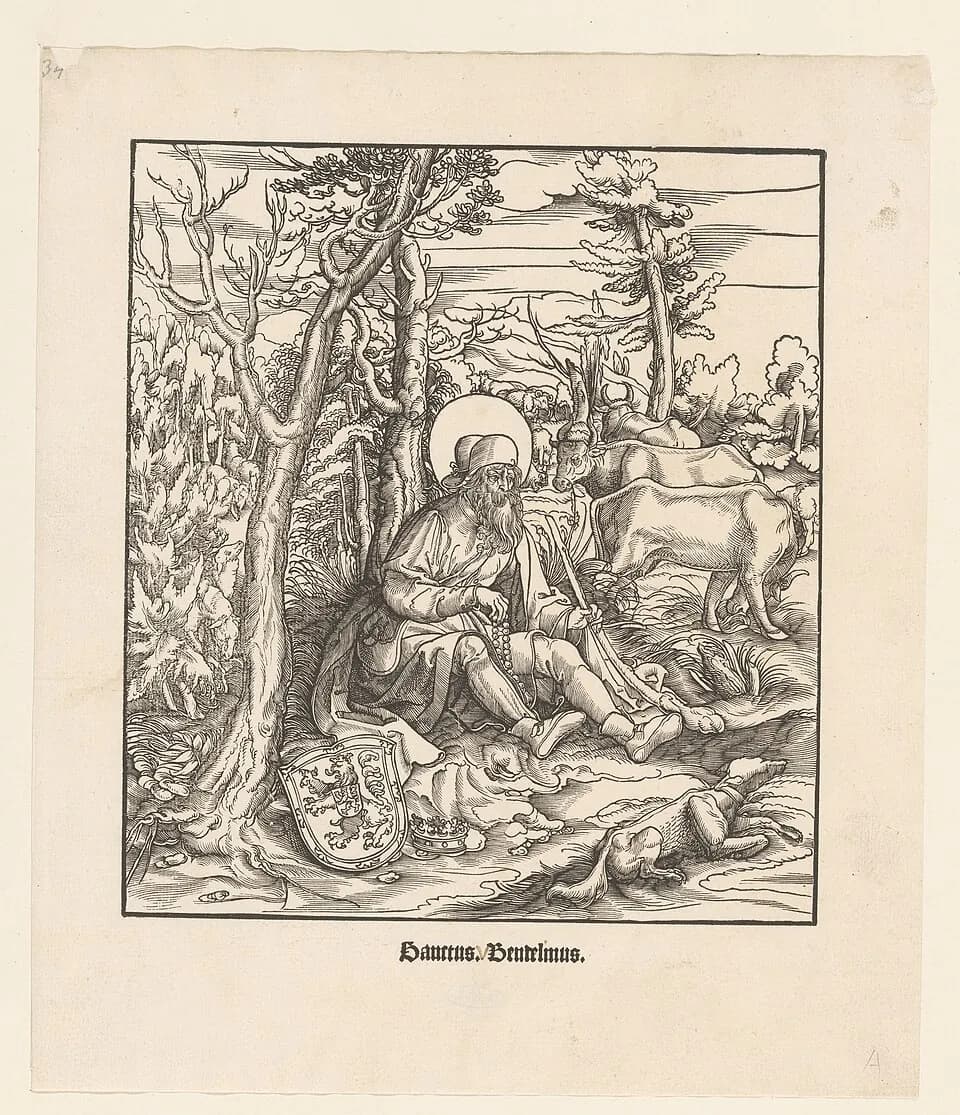
Saint Wendelin of Trier was a sixth-century hermit who lived in the forest country of the Diocese of Trier in the time of Bishop Magnerich, and whose grave gave its name to the town of St. Wendel in the Saarland. 34 The legend that made him a king's son turned cowherd was written some eight hundred years later, and it made him the patron of herdsmen, farmers and their cattle across the German-speaking lands. 18 The Diocese of Trier keeps his feast on October 20, and the Roman Martyrology enters him on October 21. 57
What can be known
The firm ground is narrow. The Diocese of Trier, on its own list of its saints, says that Wendelin lived as a monk or hermit in the time of Bishop Magnerich, in the forest highland then called Vosagus, a name that covered more country than the Vosges do now. 4 The Archdiocese of Freiburg, reprinting a Herder lexicon of saints, names the document behind this: a life of Magnerich written about the year 1000 by Abbot Eberwin of Tholey, which mentions Wendelin as a hermit and a messenger of the faith. 3 The Diocese of Augsburg points to a twelfth-century chronicle, the Gesta Treverorum, for the same dating, and adds that Magnerich counted on hermits like him to bring the Church to the countryside around the old imperial city of Trier. 2
Wendelin's own dates are estimates. The 1913 Catholic Encyclopedia says he was born about 554 and died "probably in 617." 1 Augsburg and Freiburg put his birth about 550 and agree on 617. 23 Domradio, the broadcaster of the Archdiocese of Cologne, says simply that he lived about 570, and calls him a Frankish hermit or monk. 8
One more fact is early. His grave is attested by about the year 1000, and the place where it lay took his name. 48 Beyond that, the encyclopedia is frank: "It is difficult to say how far the later biographers are trustworthy." 1
The king's son and the cattle
The earliest lives of Wendelin, two in Latin and two in German, "did not appear until after 1417." 1 Their story begins with a prince. Wendelin was the son of a Scottish king who, after a devout youth, slipped away from home in secret to go on pilgrimage to Rome. 1 Augsburg notes that the legend's word is Scotia, which then meant Ireland as much as Scotland, and it gives him an Irish birth and an Irish name, Fionnalán. 2
On the way back from Rome he settled as a hermit in Westrich, in the Diocese of Trier. 1 In the encyclopedia's telling, a great landowner reproached him for his idle life, and Wendelin entered the man's service as a herdsman. 1 Augsburg tells it with more edge. He was begging his way along and knocked at the door of an estate, and the owner snapped at him that he would do better to work than to beg. Out of humility he took the job of herding. 2
He was good with the animals, but he drove the herds a long way from the farm. 2 One day the landowner found him far out and rode off angry, sure that there would be no meat ready in time for his guests. When he rode into his own yard, Wendelin and the herd were already there. 2 The man recognized a saint, and built him a hermitage, where Wendelin lived in prayer and silence and became known for his counsel. 2 The encyclopedia compresses all of this into a sentence: "Later a miracle obliged this lord to allow him to return to his solitude." 1 Freiburg adds that he had chosen the life of a hermit and plain cowherd so that he could pray in the quiet of the open country, and that he was said to have healed a possessed man and a blind man. 3
Was he abbot of Tholey?
The legend ends with a miter. Word of the hermit reached the monks of Tholey, to the west, and they made him their abbot; Freiburg remarks that he never received priestly ordination. 23 The encyclopedia has him gather a company of hermits out of which the Benedictine abbey of Tholey grew, and be consecrated abbot about 597, "according to the later legends." 1 By 1291 the oldest known seal of the church at St. Wendel showed him as an abbot. 6
The sources do not agree on what to make of it. The encyclopedia observes that Tholey "was apparently founded as a collegiate body about 630," which is after the year it gives for his death. 1 The Diocese of Trier says only that the legend made him a king's son and the founder and abbot of Tholey. 4 Augsburg thinks he probably was the founding abbot, and suggests he may have joined forces with Gallo-Roman Christians who had stayed on in the region. 2 The abbey itself counts him among the chief patrons of its church, says he brought the pagan people of the northern Saarland to Christianity, and ties him closely to its founding. 9
The ox cart and the grave
His burial has a story of its own. The morning after the funeral the monks found his body lying beside the grave. They laid it on an ox cart and let the animals go where they would, and the oxen walked straight to his old hermitage, the place where he had most liked to pray. The monks buried him there. 23 The encyclopedia says more plainly that he was buried in his cell and that a chapel was built over the grave. 1
Pilgrims came, and a settlement grew around them that became the town of St. Wendel. 12 The parish that keeps the grave traces its first written mention to a deed of gift of 1180. 6 In 1320, when a pestilence was held to have been checked through his intercession, Archbishop Baldwin of Trier had the chapel rebuilt, and his successor Boemund II built what the encyclopedia calls "the present beautiful Gothic church," dedicated in 1360. 1
The relics were moved into the new church. 1 In 1506 they were laid in what the encyclopedia calls a stone sarcophagus and the parish calls a new chest. 16 In 1960 Pope John XXIII raised the pilgrimage church to the rank of a minor basilica. 6
A saint of the countryside
His reputation traveled well beyond the Saar. The encyclopedia found him "still venerated in Germany, Austria, and Switzerland." 1 The Diocese of Trier says that church dedications and popular devotion to him reach across western and southern Germany, and that emigrants carried the devotion to North America about 1800, and later to South America and eastern Europe. 4 According to Augsburg he gave his name to the Wendelstein, and great pilgrimages on horseback are still held in his honor in the districts of Biberach, Rastatt, Rhein-Neckar and Tirschenreuth. 2 St. Wendel has had its own riders' pilgrimage on Whit Monday since 1924. 6
Artists paint the legend. The encyclopedia describes him as a youth or a bearded man with a shepherd's bag, a book and a crook, among lambs, cattle and swine, "while a crown and a shield are placed at his feet." 1 Freiburg notes that he also appears as a Benedictine abbot in a black habit. 3
What is Saint Wendelin of Trier the patron saint of?
Saint Wendelin of Trier is, in the encyclopedia's words, "the patron saint of country people and herdsmen." 1 The German dioceses spell it out: farmers, herdsmen and shepherds, cattle, and the fields. 23 Domradio adds favorable weather and a good harvest. 8
He is also invoked against disease in livestock. 238 The encyclopedia says his intercession "was powerful in times of pestilence and contagious diseases among cattle" and connects the rebuilding of his chapel to the pestilence of 1320. 1
Saint Wendelin of Trier's feast day
Saint Wendelin of Trier's feast day is October 20 in the Diocese of Trier, where he is buried, and the dioceses of Augsburg and Freiburg list him on the same day. 2345 The current Roman Martyrology enters him a day later, on October 21: near Trier in Austrasia, in what is now Germany, Saint Wendelin, hermit. 7
Older books give a third date. Writing in 1912, the encyclopedia said that he "is not mentioned in the Roman Martyrology, but his feast is observed in the Diocese of Trier on 22 October." 1 At St. Wendel the feast falls inside a pilgrimage week. In 2025 it opened with the unveiling of his shrine on October 14, included a walk on foot from Tholey Abbey to the basilica, and closed with solemn vespers on October 21. 5
Praying with Saint Wendelin of Trier
The earliest record is a mention in another man's life: a hermit, and a messenger of the faith. 3 Everything he is loved for was written centuries later, and the Church's own reference pages say so without embarrassment. 14 What is certain is that people prayed at his grave before anyone wrote his story, and kept coming until a town stood there. 24
The legend is worth reading for what it chose to praise. A king's son is told by a stranger to stop begging and get to work, and he does, taking a herdsman's place on the estate. 2 Yet the story never lets the work swallow him, since the reason he drove the herds so far, on Freiburg's reading, was to pray where it was quiet. 23
It also understood the people who would call on him. Farmers and herdsmen prayed to Wendelin about sick cattle, the weather and the harvest, the things that decide whether a household gets through the year. 18
In 2025 the parish priest of St. Wendel, Klaus Leist, called him an original pilgrim of hope, someone who sought God's nearness and found it, and a model of faith, simplicity and trust. 5 The women who walked from Tholey to his shrine that October covered roughly the ground the ox cart is said to have crossed. 25
Saint Wendelin of Trier, pray for us.
Sources
- 1.Klemens Löffler, "St. Wendelin of Trier," The Catholic Encyclopedia, Vol. 15 (New York: Robert Appleton Company, 1912).
- 2."Wendelin," Heilige des Tages, Bistum Augsburg (in German).
- 3."Wendelin," Erzdiözese Freiburg, from Albert Urban, ed., Lexikon der Heiligen und Namenstage (Freiburg: Herder, 2010) (in German).
- 4."Heilige und Selige im Bistum Trier, sortiert nach Alphabet," entry "Wendelin - Gedenktag am 20. Oktober," Bistum Trier (in German).
- 5.Ute Kirch, "Der heilige Wendelin – ein Urpilger der Hoffnung," Bistum Trier, October 9, 2025 (in German).
- 6."Chronik der Pfarrei St. Wendelin," Pfarreiengemeinschaft St. Wendel (in German).
- 7.Roman Martyrology, entry for October 21, "San Vendelino, eremita," as printed in "Santo del giorno," Conferenza Episcopale Italiana (in Italian).
- 8."Wendelin," Domradio.de, Archdiocese of Cologne (in German).
- 9."Abtei Tholey und ihre Heiligen," Benediktinerabtei St. Mauritius, Tholey (in German).
Saints to turn to next
Others in this collection who are turned to for some of the same things.
- Saint Guy of Anderlechtc. 950 - c. 1012Poverty and simplicityWork and vocationPrayer
- Saint Isidore the Farmerc. 1070 - May 15, 1130Work and vocationPrayerPoverty and simplicity
- Saint Notburgac. 1265 - 1313Work and vocationPoverty and simplicityPrayer
- Saint André BessetteAugust 9, 1845 - January 6, 1937PrayerWork and vocationPoverty and simplicity