Saint Guy of Anderlecht
c. 950 - c. 1012
- Canonized
- June 24, 1112, by the bishop of Cambrai 2
Saint Guy of Anderlecht was a poor farm worker from Brabant who became the sacristan of a church at Laeken, lost everything in one attempt at business, and spent seven years as a pilgrim to Rome and the Holy Land before dying in his home village around 1012. 135 CathoBel, the Belgian Catholic news site, warns that very little about him is certain and that the accounts are full of legend. 2 He is kept on September 12, and in Belgium he is called the Poor Man of Anderlecht. 26
What is known and what is told
CathoBel, the Catholic news site that hosts the official portal of the Church in Belgium, is candid about the record. Very little is known for certain, the stories that have come down are marked by legend, and some historians have doubted that he existed at all. The traditional date of his death, September 12, 1012, is itself contested. 2
Two things CathoBel treats as solid. The bishop of Cambrai canonized him on June 24, 1112, at a time when that decision still belonged to the local bishop and not to the pope. 2 And the bones kept in his shrine at Anderlecht were studied for months before a verdict was announced in September 2014: they are those of a man who lived in the tenth century and died between the ages of thirty and forty. 2 That sits awkwardly beside the dates Catholic Culture prints, 950 to 1012, which would make him about sixty. 3 What follows, then, is the life as these Church pages tell it, with the legend left in and labeled. 123
The sacristan of Laeken
Vatican News and CathoBel say he was born at Anderlecht, in Brabant, to a poor peasant family; Butler's Lives speaks instead of "his poor home at Brussels." 123 Butler opens with a sentence that sums up the rest: "As a child Guy had two loves, the Church and the poor." 3 Aleteia, which calls him Guido, adds a story that angels would sometimes guide his plow so that his prayer was not interrupted. 5
He left the farm while still young and came to Laeken, near Brussels. 12 In Butler's telling he prayed with such devotion at the shrine of Our Lady there that the priest asked him to stay and serve the church. 3 He became its sacristan, and Butler lists the work with evident pleasure: "sweeping the floor and ceiling, polishing the altars, and cleansing the sacred vessels." 3 The Roman Martyrology remembers him first as the keeper of that church and as a man known for his generosity to the poor. 4
He had little, and gave away what he had. Vatican News says that depriving himself for others is why he is counted a forerunner of Saint Francis of Assisi and why he was nicknamed the Poor Man of Anderlecht. 12
The ship that sank
Then he went into trade, and here the sources tell three different stories. In the Vatican News and CathoBel account the idea was his own. Meeting want every day in his work, he decided to start a business whose income would go entirely to the poor of the city. 12 In Butler, a merchant of Brussels who had heard of the generous sacristan offered him a share in his business. Guy did not want to leave the church, but "the offer seemed providential," and he accepted. 3 Aleteia says a merchant tricked him into investing. 5
All three end the same way. The first ship was lost, in the river port of Brussels according to Vatican News. 135 Butler adds that when Guy went back to Laeken his place had been filled, and he reads the whole episode severely: "The rest of his life was one long penance for his inconstancy." 3 Vatican News is gentler. Guy understood from the wreck that the easy road was not the one meant for him, left everything, and put on the dress of a pilgrim. 1
Seven years a pilgrim
He walked for seven years. 124 Vatican News says he visited the great shrines of Christendom and went as far as the Holy Land, speaking of Christ to the people he met and giving them bread when they needed it. 1 Catholic Culture says he went on foot to Rome and then to Jerusalem, where he worked for a time as a guide to other pilgrims. 3
One story from the road is told by CathoBel expressly as legend. He often gave away his own ration and filled his bag with earth so that no one would notice the gift, and the bag was found full of bread again. 2
On the way home, at Rome, he met the dean of Anderlecht, who was dying and asked Guy to carry the news of his death home. 12 Guy made the journey and arrived worn out and ill. He died soon afterward, of dysentery according to CathoBel. 12 Butler's account closes with a light shining around him as he died, "and a voice was heard proclaiming his eternal reward." 3
Anderlecht remembers
Vatican News says he was forgotten for a long time and that wonders at his tomb brought him back to mind. 1 Catholic Culture passes on the tradition that the grave was found when a horse kicked it. 3 His remains lie in the Collegiate Church of Saints Peter and Guido at Anderlecht, one of the major Gothic churches of Brussels, which housed a chapter of canons from the end of the eleventh century until 1796. 23
The old pilgrimage belonged to working animals and the people who drove them. Catholic Culture records that the cab drivers of Brabant led a yearly pilgrimage to Anderlecht "until the beginning of World War I in 1914," at the head of a procession of farmers, grooms and stable boys, all leading their animals to be blessed. 3 Anderlecht still holds a procession each September, on the Saturday before its annual market, with some three hundred people in medieval dress and seven horse-drawn floats telling his life. 2 He remains on the arms of the commune. 2
What is Saint Guy of Anderlecht the patron saint of?
CathoBel names Saint Guy of Anderlecht as patron of sacristans, bell ringers and cattle dealers, among others. 2 Aleteia calls him a patron of bachelors, because he neither married nor took vows in a religious order. 5
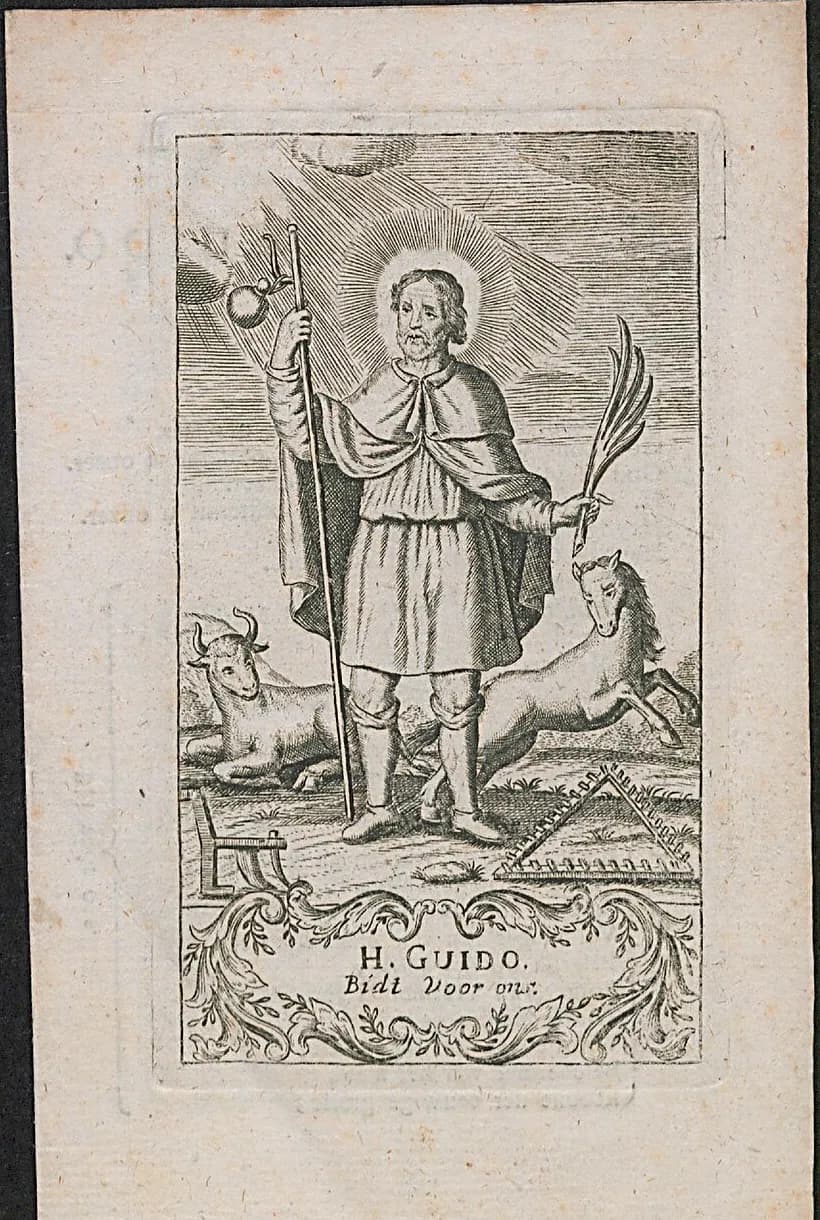
Catholic Culture prints a much longer list without naming an authority for it: against epilepsy, hydrophobia and convulsions, and for horned animals, work horses, bachelors, bell ringers, farmers, laborers, sacristans, sextons and the protection of sheds and stables. 3 The farmers and animals shown for him in this library rest on that list and on the old Anderlecht blessing of animals it describes. 3
Saint Guy of Anderlecht's feast day
Praying with Saint Guy of Anderlecht
He held no office and joined no order. Aleteia describes him as "interiorly dedicated to serving the Church in any capacity necessary," and what that meant in practice was a broom, a polishing cloth and alms for the poor. 35
The one large decision of his life went wrong, and the sources cannot agree whether it was a fault. Butler calls it inconstancy. Vatican News calls it a road that turned out not to be his. 13 Either way a good intention ended in a shipwreck, and by Butler's account he had no post to go back to. 13
What he did next was walk. Seven years is a long answer to a failure. 14 The accounts of the pilgrimage show him doing on the road what he had done at Laeken, giving away bread and looking after other travelers. 13
His last act was an errand for a dying man. He carried a message home, delivered it, and died himself. 12 Anderlecht has honored him since at least 1112, and the Church there is honest enough to say how little else it knows. 2
Saint Guy of Anderlecht, pray for us.
Sources
- 1."San Guido del Brabante," Santo del giorno, 12 settembre, Vatican News (in Italian).
- 2."12 septembre : fête de saint Guidon, le 'pauvre d'Anderlecht'," CathoBel, September 12, 2025 (in French).
- 3."St. Guy of Anderlecht," Liturgical Year, September 12, 2026, Catholic Culture, with an excerpt from Alban Butler, Lives of the Saints (Benziger Bros., 1894).
- 4.Roman Martyrology, entry for September 12, "San Guido," as printed in "Santo del giorno," Conferenza Episcopale Italiana (in Italian).
- 5.Philip Kosloski, "Even bachelors have a patron saint they can imitate," Aleteia, October 14, 2017.
- 6."St. Guy of Anderlecht," Saint of the Day, 12 September, Vatican News.
Saints to turn to next
Others in this collection who are turned to for some of the same things.
- Saint Wendelin of Trierc. 554 - c. 617PrayerWork and vocationPoverty and simplicity
- Saint Isidore the Farmerc. 1070 - May 15, 1130Work and vocationPrayerPoverty and simplicity
- Saint Notburgac. 1265 - 1313Work and vocationPoverty and simplicityPrayer
- Saint André BessetteAugust 9, 1845 - January 6, 1937PrayerWork and vocationPoverty and simplicity