Saint Victor I
Died 198 or 199
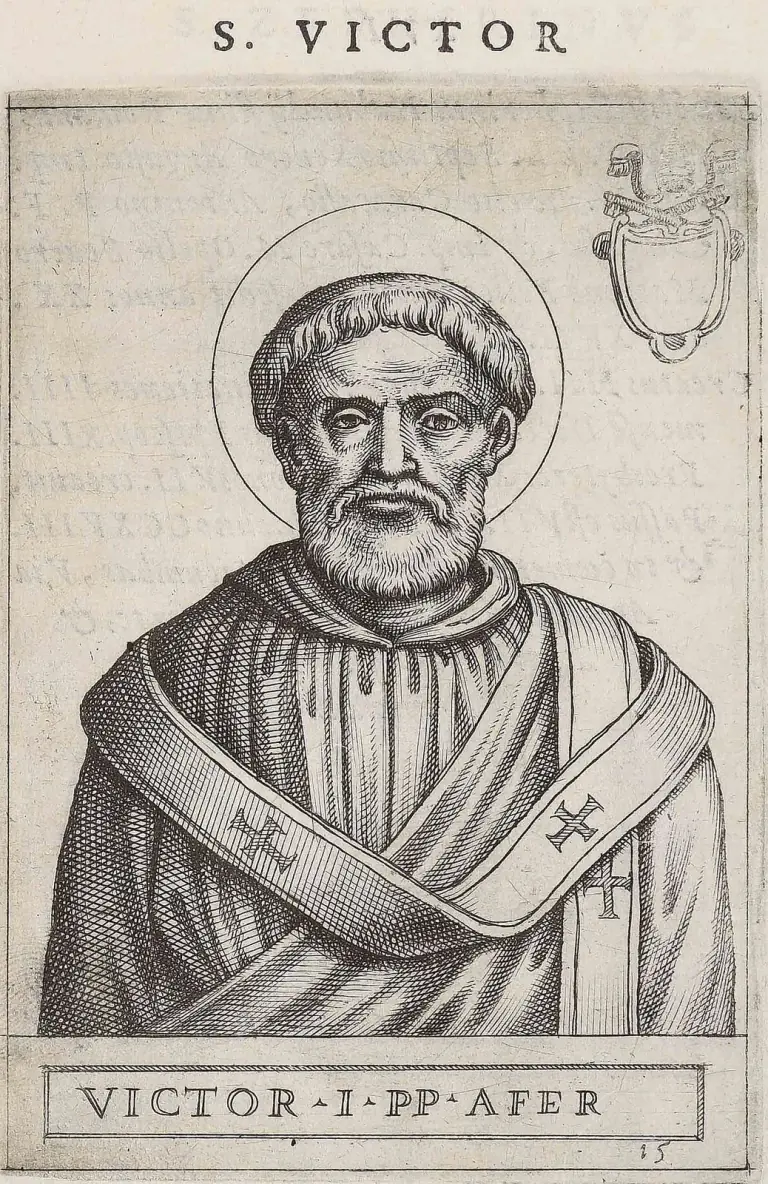
- Pope
- About 189 to 198 or 199, according to Kirsch; 186 to 197, according to the Liber Pontificalis; ten years, according to Eusebius and Jerome 1245
- Known for
- Pressing every church to keep Easter on a Sunday; the earliest Roman synod known; Irenaeus's rebuke 12
- Buried
- Near Saint Peter on the Vatican, on July 28, according to the Liber Pontificalis 5
Saint Victor I was bishop of Rome in the last years of the second century, an African by birth, and the pope who tried to make every church in the world keep Easter on a Sunday. 15 When the bishops of Asia refused, he moved to cut them off from communion, and Saint Irenaeus of Lyons wrote to tell him that his predecessors had never broken with anyone over it. 2 His feast is July 28. 7
An African bishop of Rome
The Liber Pontificalis, the early book of papal lives, says that Victor was "by nationality an African, son of Felix." 5 Nothing else is known of him before he became bishop. J.P. Kirsch, in the Catholic Encyclopedia, notes that even his years are uncertain. 1 Kirsch gives 189 to 198 or 199. The Liber Pontificalis counts from 186 to 197, while Eusebius says only that "his bishopric lasted ten years," and Jerome that he "ruled the church for ten years in the reign of the Emperor Severus." 1245
Rome was quiet for the Christians in those years. Kirsch describes a Church that "enjoyed in general great external peace" under Commodus and the early Septimius Severus, with Christians serving as officials at the imperial court. 1 The Norwegian bishops' saints database (katolsk.no) calls Victor the first pope known to have had dealings with the imperial household. 6
Marcia and the prisoners in Sardinia
The clearest picture of Victor at work comes from Hippolytus, a Roman priest of the next generation and no friend of the popes. Marcia, the emperor's mistress, whom Hippolytus calls "a God-loving female," wanted to do some good, and she "invited into her presence the blessed Victor" to ask which Christians were held in the mines of Sardinia. 3 Victor gave her the names, she obtained a pardon from Commodus, and an elderly eunuch named Hyacinthus sailed to the island with the order of release. 3
One of the convicts was Callistus, later pope himself, who had been sent to the mines after a banking scandal. Here the accounts part. Hippolytus says Victor left Callistus off the list, "knowing the acts he had ventured upon," and that Callistus got himself freed by begging Hyacinthus on his knees. 3 Kirsch says simply that the pope handed over the list and that Callistus "had been among those deported." 1 Both agree on what followed. Victor was "very much grieved," Hippolytus says, "but since he was a compassionate man, he took no action in the matter." 3 He sent Callistus to live at Antium and gave him a monthly allowance. 13
The Easter question
The churches of the province of Asia kept the Pascha on the fourteenth day of the Jewish month of Nisan, the day of the Passover lamb, "whatever day of the week it should happen to be," and ended their fast then. 2 Everywhere else, as Eusebius puts it, the fast ended "on no other day than on that of the resurrection of our Saviour." 2 Christians from Asia living in Rome kept their own custom there, and Kirsch says the difference "inevitably led to trouble." 1
Victor set out to settle it. He called a meeting of Italian bishops at Rome, which Kirsch calls "the earliest Roman synod known," and wrote to the leading bishops elsewhere asking them to meet and consider the question. 1 Eusebius lists the answers he still had in his own day: from the bishops of Palestine under Theophilus of Caesarea and Narcissus of Jerusalem, from Pontus, from Irenaeus and the churches of Gaul, from Osrhoene, from Bacchylus of Corinth, and a Roman letter "which bears the name of Bishop Victor." 2 All gave the same judgment, that the Resurrection be celebrated "on no other but the Lord's day." 2
Polycrates answers
The bishops of Asia met at Victor's request, under Polycrates of Ephesus, and refused. 12 Polycrates's letter to Victor survives in Eusebius, and it is a proud one. Asia, he writes, holds the graves of "great lights": Philip the apostle at Hierapolis, John "who reclined upon the bosom of the Lord" at Ephesus, Polycarp at Smyrna, Melito at Sardis. "All these observed the fourteenth day of the passover according to the Gospel." 2 Seven of his own relatives had been bishops before him. 2
Then he speaks directly to the pope. "I, therefore, brethren, who have lived sixty-five years in the Lord, and have met with the brethren throughout the world, and have gone through every Holy Scripture, am not affrighted by terrifying words. For those greater than I have said 'We ought to obey God rather than man.'" 2
What Victor did next is told in two ways. Eusebius says he "immediately attempted to cut off from the common unity the parishes of all Asia, with the churches that agreed with them, as heterodox; and he wrote letters and declared all the brethren there wholly excommunicate." 2 Kirsch makes it a demand with a condition: Victor called on them to accept Sunday, and "in case they would not do this he declared they would be excluded from the fellowship of the Church." 1 katolsk.no calls it a threat. 6 Kirsch also says Victor "acted throughout the entire matter as the head of Catholic Christendom." 1
Irenaeus intervenes
"But this did not please all the bishops," Eusebius continues, and some wrote "sharply rebuking Victor." 2 The best known is Irenaeus of Lyons, who agreed with Victor about Sunday and told him not to cut off "whole churches of God which observed the tradition of an ancient custom." 2 The fast itself had never been kept one way everywhere, he wrote, "and the disagreement in regard to the fast confirms the agreement in the faith." 2
He reminded Victor of his own predecessors. The bishops of Rome before him had never kept the Asian custom, Irenaeus wrote, "and yet though not observing it, they were none the less at peace with those who came to them." 2 When Polycarp visited Pope Anicetus in Rome, neither could persuade the other, yet Anicetus let Polycarp celebrate the Eucharist in his church, "and they parted from each other in peace." 2 Jerome, two centuries later, summed up the letter: Irenaeus warned Victor "not lightly to break the unity of the fraternity," and "even those who differed from them did not support Victor in his opinion." 4
How it ended under Victor is not recorded. Kirsch says plainly, "We have no information concerning the further course of the matter," only that the Roman practice gradually became universal in the following century. 1 katolsk.no thinks Victor seems to have let himself be calmed. 6
Trouble at home
In Rome itself, Kirsch says, Victor enforced the Sunday Easter on all Christians, and an Easterner named Blastus started a small schism over it that "did not grow in importance." 1 A Roman priest named Florinus, who had taken up Gnostic teaching, was probably deposed. 1
Victor also excommunicated Theodotus, a leather-worker from Byzantium who taught that Christ was "a mere man." 12 A writer whom Eusebius quotes used the fact against Theodotus's followers, who claimed Victor had been on their side: "if Victor agreed with their opinions, as their slander affirms, how came he to cast out Theodotus, the inventor of this heresy?" 2 Tertullian mentions a bishop of Rome who first accepted the prophecies of Montanus and was then talked out of it; Kirsch says some think this was Victor and some his predecessor Eleutherius, and that "the question cannot be decided positively." 1
Jerome counted Victor the first Latin writer of the Church and says he wrote "On the Paschal Controversy and some other small works." 14 None of it survives beyond the Easter letters. 1 katolsk.no thinks he probably wrote a treatise against dice players that has come down under Saint Cyprian's name; Kirsch says that idea "is now universally rejected." 16
Was Victor a martyr?
The Liber Pontificalis says that Victor "was crowned with martyrdom" and was "buried near the body of the blessed apostle Peter in the Vatican, July 28." 5 The 1897 English edition of the Roman Martyrology entered "the martyrdom of St. Victor, pope and martyr" on that day. 8 Kirsch does not mention a martyrdom. 1 katolsk.no calls the Liber Pontificalis notices of his martyrdom and burial near Peter routine and historically worthless. 6 The current Roman Martyrology remembers him as pope and makes no mention of a martyrdom. 7
What is Saint Victor I the patron saint of?
Saint Victor I's feast day
Saint Victor I's feast day is July 28. 78 The Roman Martyrology, in the text published by the Italian bishops, remembers on that day at Rome Saint Victor I, pope, an African, who established that all the churches should celebrate holy Easter on the Sunday after the Jewish Passover. 7 The day is the one the Liber Pontificalis gives for his burial. 5
katolsk.no adds that his memorial stood in the Roman calendar on July 28, shared with Pope Innocent I, until 1969. 6
Praying with Saint Victor I
The Church remembers Victor for the decision Irenaeus scolded him over. 27 Sunday Easter became the practice of the whole Church, and the Martyrology credits him with it. 17 But the way he pressed for it was answered by bishops who agreed with him, and their objection was to the breach in communion, not to the date. 24
Polycrates and Irenaeus both appealed to the dead. Polycrates named the apostles and martyrs buried in Asia; Irenaeus named Victor's own predecessors at Rome, who had kept the peace with churches whose custom they did not share. 2 Between them they set out the question every bishop of Rome has had to weigh since, of how much a common practice is worth against the unity it is meant to serve.
Hippolytus, who had little good to say about the popes of his day, still called Victor "a compassionate man." 3 He used the word of a pope who was grieved at a convict's release and let it stand, and who sent the man away with an allowance rather than back to the mines. 3
Saint Victor I, pray for us.
Sources
- 1.J.P. Kirsch, "Pope St. Victor I," The Catholic Encyclopedia, Vol. 15 (New York: Robert Appleton Company, 1912).
- 2.Eusebius, Church History, Book V, chapters 22-25 and 28, translated by Arthur Cushman McGiffert, Nicene and Post-Nicene Fathers, Second Series, Vol. 1 (Buffalo: Christian Literature Publishing Co., 1890), as hosted by New Advent.
- 3.Hippolytus, Refutation of All Heresies, Book IX, chapter 7, translated by J.H. MacMahon, Ante-Nicene Fathers, Vol. 5 (Buffalo: Christian Literature Publishing Co., 1886), as hosted by New Advent.
- 4.Jerome, De viris illustribus (On Illustrious Men), chapters 34 and 35, translated by Ernest Cushing Richardson, Nicene and Post-Nicene Fathers, Second Series, Vol. 3 (Buffalo: Christian Literature Publishing Co., 1892), as hosted by New Advent.
- 5.The Book of the Popes (Liber Pontificalis), Vol. 1, "XV. Victor," translated by Louise Ropes Loomis (New York: Columbia University Press, 1916).
- 6."Den hellige pave Viktor I ( - ~199)," Den katolske kirke (katolsk.no), Catholic Diocese of Oslo (in Norwegian).
- 7.Roman Martyrology, entry for July 28, "San Vittore I, papa," as printed in "Santo del giorno," Conferenza Episcopale Italiana (in Italian).
- 8.The Roman Martyrology, July 28 (Baltimore: John Murphy Company, 1897).
Saints to turn to next
Others in this collection who are turned to for some of the same things.