Saints Victor and Corona
Martyred in the second or third century
- Died
- In Syria, says the Roman Martyrology 2; at Damascus, Antioch or Alexandria in the different traditions 13; about 171, or under Diocletian 13
- Shown with
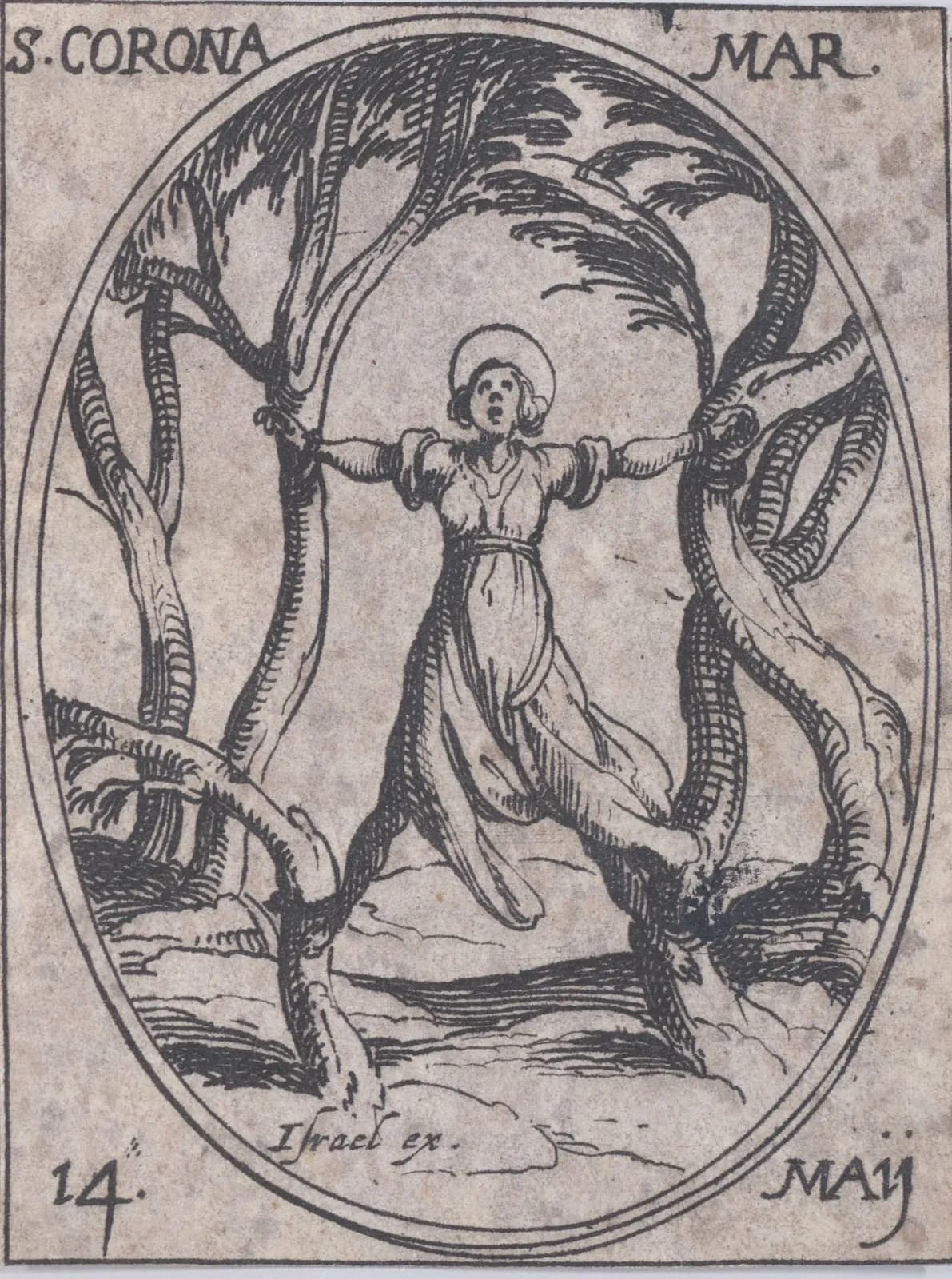
- Corona with a palm, bound to two bent palms, or holding a piece of gold 1
- Patron of
- Corona: treasure hunters and lumberjacks, according to CNA 4
Saints Victor and Corona are two early martyrs remembered together on May 14: Victor, a Christian soldier tortured for refusing to deny his faith, and Corona, a young soldier's wife who encouraged him aloud and was condemned for it. 13 The Roman Martyrology says only that they suffered together in Syria, and the older traditions disagree about the city and the century. 23 Their cult, from the sixth century on, is far better documented than their lives. 1
The soldier and the young wife
The story survives in several versions, and the Norwegian bishops' saints database (katolsk.no) tells it this way. Victor came from Cilicia, in the south of what is now Turkey, and was a soldier like his father, Romanus. 13 Stationed in Egypt under Marcus Aurelius, he would not deny his faith in public and was condemned as a Christian before the tribunal of a Roman prefect named Sebastian. 1 Antonio Borrelli, in the Spanish santoral of Catholic.net, also names the magistrate Sebastian, but sets the trial in the persecution of Diocletian. 3
Victor was tortured at length. katolsk.no lists what the legend puts him through, from the rack and the furnace to blinding, and says he was then beheaded. 1 A few lines later it adds, more candidly, that it is not actually known how he died, though pictures show him beheaded. 1 Borrelli says simply that the young soldier was beheaded. 3
Corona enters the story at the place of torture. She was the wife of another soldier in Victor's unit, and no more than sixteen. 13 She came forward while he was suffering, encouraged him to hold out and called him blessed in front of everyone. 13 That was enough to have her arrested. 13 Her death is the part of the legend everyone remembers: the tops of two palm trees, or laurels in some tellings, were bent down to the ground, she was tied between them, and when they were let go they tore her apart. 13
Where and when
Borrelli opens his account by admitting that the study of these two martyrs is complicated: they appear in many ancient Latin, Greek and Coptic calendars, and those do not agree. 3 The Greek passion puts the martyrdom at Damascus, the Coptic at Antioch, and Latin sources at Alexandria in Egypt or even in Sicily. 3 The Greek sources date it under Emperor Antoninus, the Coptic under Diocletian. 3 katolsk.no has him sentenced in 168 or 171 and puts the martyrdom at Alexandria or Damascus on May 14, 171, and notes that some place it in 303 under Diocletian; it explains the Sicilian version as a confusion of Sicily with Cilicia. 1 Catholic News Agency, in 2020, said simply that Corona is believed to have died at sixteen in the second century, and that "few details are known about her." 4
The Roman Martyrology settles none of this. Its entry for May 14 reads, in the Italian bishops' edition, that in Syria Saints Victor and Corona suffered martyrdom together. 2 Borrelli quotes it with a death date in the third century and notes that it does not name the place. 3 katolsk.no thinks the legend probably arose in the East: the Greek version, which sets it at Damascus, circulated widely in many forms, and a Coptic and a Latin version grew from it in the fifth century. 1
Otricoli and Feltre
In Italy two towns came to hold that the martyrs rested with them. An old local tradition at Otricoli, in Umbria, makes Victor a citizen of the Roman town of Ocriculum. 1 katolsk.no tells it this way: his comrades brought his body home by boat up the Tiber and hid it in a small cave near the river, and in 540 Bishop Fulgentius of Otricoli found it and moved it to the high altar of the cathedral. 1 When the Lombards destroyed the old town, probably in 601, its people moved up into the hills, and in 1351 the bishop of Narni carried Victor's remains from the ruined church by the Tiber to the collegiate church of Santa Maria Assunta in Otricoli, along with Fulgentius's old inscription. 1
Feltre, in the Veneto, has a different tradition: the relics of both saints arrived there in the ninth century, and an altar was raised for them on Monte Miesna between 1096 and 1101. 1 When the tomb was opened in 1943, katolsk.no says, it held a seventh-century lead tablet with a twelve-line Latin inscription. 1 As katolsk.no reads it, the tablet records a first translation of the bodies to Cyprus in the year 205 by Theodore, a martyr of Ceronia, and a second burial by Solinus, bishop of Ceronia, on September 18, 605. 1 The relics are then said to have gone from Cyprus to Sicily, to Venice in 804 and on to Feltre. 1 A rival story at Feltre gives the credit to a crusader, Giovanni da Vidor, who brought them from Syria and built a church that his son, Bishop Arpone, consecrated in 1096. 1 Feltre keeps September 18 as the feast of the translation. 1
Aachen, Prague and the north
The cult traveled north with the relics. In 997 Emperor Otto III took relics of Corona from Otricoli to the cathedral at Aachen. 1 In 1354, on his way to Rome to be crowned, Emperor Charles IV obtained at Feltre a head said to be Victor's and an arm of Corona and brought both to Prague; Siena also claimed to have Victor's head. 1 katolsk.no notes that in 1245 the Dominican Bartholomew of Trent recorded a further claim, by the Dominicans of Sant'Eustorgio in Milan. 1
Corona became especially popular in Bavaria and Lower Austria, where the Benedictines of Niederaltaich spread her cult. 1 katolsk.no names eleven pilgrimage places in Upper and Lower Bavaria alone, and in Lower Austria the village of St. Corona am Wechsel still bears her name. 1 Her devotion is widespread in Vienna as well. 1 In art she holds a palm, or is shown bound between two bent palms, or holds a piece of gold, and she often appears alongside Victor. 1
Aachen brought her back to public attention in March 2020. The cathedral had already planned to show her shrine, unseen by the public for twenty-five years, in an exhibition on goldwork, and a cathedral spokeswoman told Reuters she expected "more interest" because of the coincidence of the saint's name with the new virus. 4
What are Saints Victor and Corona the patron saints of?
In 2020 posts circulated online calling Saint Corona the patron saint of epidemics. Catholic News Agency answered that, despite them, "she is actually venerated as the patroness of treasure hunters and lumberjacks, the latter because of the tradition that she was martyred by being tied between two palm trees." 4 None of the sources explains the first, though katolsk.no notes that she is sometimes pictured holding a piece of gold. 1
None of the sources gives a patronage for Victor. katolsk.no mentions that a soldier saint named Victor is one of the four patrons of Siena, but says it is uncertain which Victor that is. 1
Saints Victor and Corona's feast day
The feast day of Saints Victor and Corona is May 14. 1234 The current Roman Martyrology keeps them together on that day, as martyrs in Syria. 2 Borrelli notes that they appear in many older calendars, and that his account follows only the May 14 entry of the Martyrology. 3 At Feltre, September 18 is kept as the feast of the translation of their relics. 1
Praying with Saints Victor and Corona
The most anyone can say with confidence about Victor and Corona is that the Church has remembered two martyrs by these names, together, for a very long time. 12 Even the sources that tell their story at length say how little of it is certain. 134
What the story keeps is the shape of Corona's part in it. She was not on trial. 13 She was a girl of sixteen at most, married to one of Victor's comrades, and she spoke up for a man in agony in front of the people who were hurting him. 13 It cost her her life. 13
Victor, in the legend, does not deny his faith in public, and Corona, by calling him blessed aloud, declares her own. 13 The Martyrology's single line about them says that they suffered together. 2
Saints Victor and Corona, pray for us.
Sources
- 1."De hellige Corona og Viktor av Syria (d. ~171)," Den katolske kirke (katolsk.no), Catholic Diocese of Oslo (in Norwegian).
- 2.Roman Martyrology, entry for May 14, "Santi Vittore e Corona, martiri," as printed in "Santo del giorno," Conferenza Episcopale Italiana (in Italian).
- 3.Antonio Borrelli, "Víctor y Corona, Santos," Santoral, Catholic.net (in Spanish).
- 4.CNA Staff, "Relics of St. Corona will be displayed in German cathedral, but after pandemic," Catholic News Agency, March 27, 2020, as published by Catholic World Report.
Saints to turn to next
Others in this collection who are turned to for some of the same things.