Saint Anastasia
Martyred at Sirmium, probably under Diocletian
- Died
- At Sirmium, probably in the persecution of Diocletian; Catholic Culture gives the year as 304 12
- Historical record
- The 1907 Catholic Encyclopedia calls her legend "purely legendary"; Catholic Culture's excerpt from Donald Attwater says "only worthless legends have survived" 12
- In the Mass
- Named in the Roman Canon since about the end of the fifth century, and commemorated at the second Mass of Christmas 12
- Patron saint of
- Martyrs, weavers, widows, and Borgorose in Italy, according to Catholic Culture's list 2
Saint Anastasia was a martyr of Sirmium whose name is said in the Roman Canon of the Mass and whose day is December 25, the same day as Christmas. 14 The 1907 Catholic Encyclopedia says she "enjoys the distinction, unique in the Roman liturgy, of having a special commemoration in the second Mass on Christmas day." 1 Of her life the same article allows one certain sentence, and it sets the rest aside as legend. 1
What is known
J.P. Kirsch, who wrote the encyclopedia's article, puts the whole of the history in a few words: "All that is certain is that a martyr named Anastasia gave her life for the faith in Sirmium, and that her memory was kept sacred in that church." 1 Catholic Culture says much the same a century later. "Nothing much is known factually" about her, it writes, except that she was martyred in the persecution of the emperor Diocletian, and that it happened at Sirmium, one of the imperial capitals of the later Roman Empire. 2 It gives the year of her death as 304. 2
Even the location of Sirmium is described in more than one way. Catholic Culture identifies it as Sremska Mitrovica in Serbia. 2 The current Roman Martyrology, as the Italian bishops publish it, commemorates her at Rome as a martyr of Srijem in Pannonia and places that in present-day Croatia. 4 The excerpt from Donald Attwater's Dictionary of Saints that Catholic Culture prints says "Sirmium in Dalmatia," and adds that she died "probably under Diocletian." 2
Kirsch is firm on one more point. Whatever the later stories say, he writes, "she is not a Roman saint, for she suffered martyrdom at Sirmium, and was not venerated at Rome until almost the end of the fifth century." 1
What the legend says
A later account, which Kirsch dates no earlier than the sixth century, makes her a Roman after all. In it she is the daughter of Praetextatus, a Roman of high rank, and the pupil of Saint Chrysogonus. Early in the persecution of Diocletian the emperor summons Chrysogonus to Aquileia, where he is martyred. Anastasia goes from Aquileia to Sirmium to visit the Christians there and is beheaded on the island of Palmaria on December 25, and her body is buried in the house of a woman named Apollonia, which had been made into a basilica. 1
Other tellings end differently. The older Roman Martyrology, as Kevin Di Camillo quotes it in the National Catholic Register, says that she first suffered "hard and cruel imprisonment at the hands of her husband Publius," was consoled in it by Chrysogonus, was then held by Florus, prefect of Illyria, "and at last was bound to stakes with her hands and feet stretched out and fire kindled about her." It adds that she had been deported to an island with 200 men and 70 women, who were killed in various ways. 5 Vatican News keeps a version of this: she helped persecuted Christians, was arrested in Sirmium, was put aboard "a leaking ship," escaped, and when captured again "was burned alive." 3
None of this is offered by the sources as fact. Kirsch's judgment on the Passio is short: "The whole account is purely legendary, and rests on no historical foundations." 1 Di Camillo quotes an edition of Butler's Lives of the Saints to the same effect: "These stories are entirely apocryphal." It adds that "so far as is known she had nothing to do with the City." 5 Attwater says simply that "only worthless legends have survived." 2
From Sirmium to Constantinople and Rome
What can be traced is the movement of her cult. According to Kirsch, the historian Theodorus Lector records that during the patriarchate of Gennadius (458-471) the body of the martyr was taken to Constantinople and buried in a church that had been known as the Anastasis, the Greek word for the Resurrection. From then on that church took the name of Anastasia. 1
Something similar happened in Rome. A church had stood since the fourth century at the foot of the Palatine, above the Circus Maximus, and Pope Damasus (366-384) had adorned it with a large mosaic. The Acts of the Roman Council of 499 already call it by Anastasia's name. 1 Kirsch reports two explanations for that name and does not choose between them. Either it was founded by a Roman matron called Anastasia, as several other titular churches were named for their founders, or it began, like the churches at Ravenna and Constantinople, as an Anastasis church dedicated to the Resurrection of Christ. 1
Either way, the church was a prominent one. Kirsch calls it "the only titular church in the centre of ancient Rome," with the Palatine and the imperial court inside its district, and says that only Saint John Lateran and Saint Mary Major ranked ahead of it. 1 When devotion to the martyr of Sirmium grew at Constantinople in the second half of the fifth century, he infers, the close ties between the two cities carried it to the church at the foot of the Palatine, and she became its titular saint. Her name entered the Roman Canon at about the same time, which in Kirsch's words shows "that she then occupied a unique position among the saints publicly venerated at Rome." 1
The Mass at dawn on Christmas
The Roman Christmas has three Masses, and the second was once hers. Kirsch says it "was originally celebrated not in honour of the birth of Christ, but in commemoration of this martyr." 1 C.C. Martindale's article on Christmas in the same encyclopedia explains how. The pope said the second Mass in what Martindale calls the "chapel royal" of the Byzantine court officials on the Palatine, which was Saint Anastasia's church, so that the Mass was probably "a papal compliment to the imperial church on its patronal feast." 6
Catholic Culture describes the same arrangement: the first Mass at Saint Mary Major, the second at Saint Anastasia's, and the third originally at Saint Peter's. Her church remains the station for the Mass at Dawn, which is "often referred to as the Mass of the Shepherds." 2 Attwater attributes her place in that Mass to "the influence of Byzantine officials" in Rome. 2
Kirsch, writing in 1907, called the commemoration "the last remnant of the former prominence enjoyed by this saint and her church in the life of Christian Rome." 1 Di Camillo, writing in 2017, says that she is recalled by name at the Dawn Mass in the older form of the Roman rite, and that few saints lost more when the calendar was revised after the Second Vatican Council. 5 Catholic Culture notes that she is still named in the first Eucharistic Prayer, the Roman Canon. 2
Two more notes come from Catholic Culture. Pope Francis granted the church of Sant'Anastasia to the Syro-Malabar Church in July 2020. 2 And the relics once taken to Constantinople were later kept at a monastery of Saint Anastasia in Chalkidiki, in Greece, from which they were stolen in 2012; they have not been recovered. 2 In Washington, a chapel in the Crypt Church of the Basilica of the National Shrine of the Immaculate Conception bears her name. 2
What is Saint Anastasia the patron saint of?
Catholic Culture lists Saint Anastasia as patron of martyrs, weavers and widows, and of the town of Borgorose in Italy. 2 It gives no authority for the list, and neither the Catholic Encyclopedia nor Vatican News names any patronage for her. 13 No source read for this page explains how the list arose.
Saint Anastasia's feast day
Saint Anastasia's feast is December 25. Kirsch notes that the old Hieronymian Martyrology records her name on that day, both for Sirmium and for Constantinople, and the current Roman Martyrology still commemorates her on it. 14 Vatican News lists "St. Anastasia, Martyr of Sirmium" among the saints of December 25, and Catholic Culture places her under the day's other commemorations, beneath the Nativity of the Lord. 23 Attwater notes that "the Byzantines keep her feast on December 22." 2
Praying with Saint Anastasia
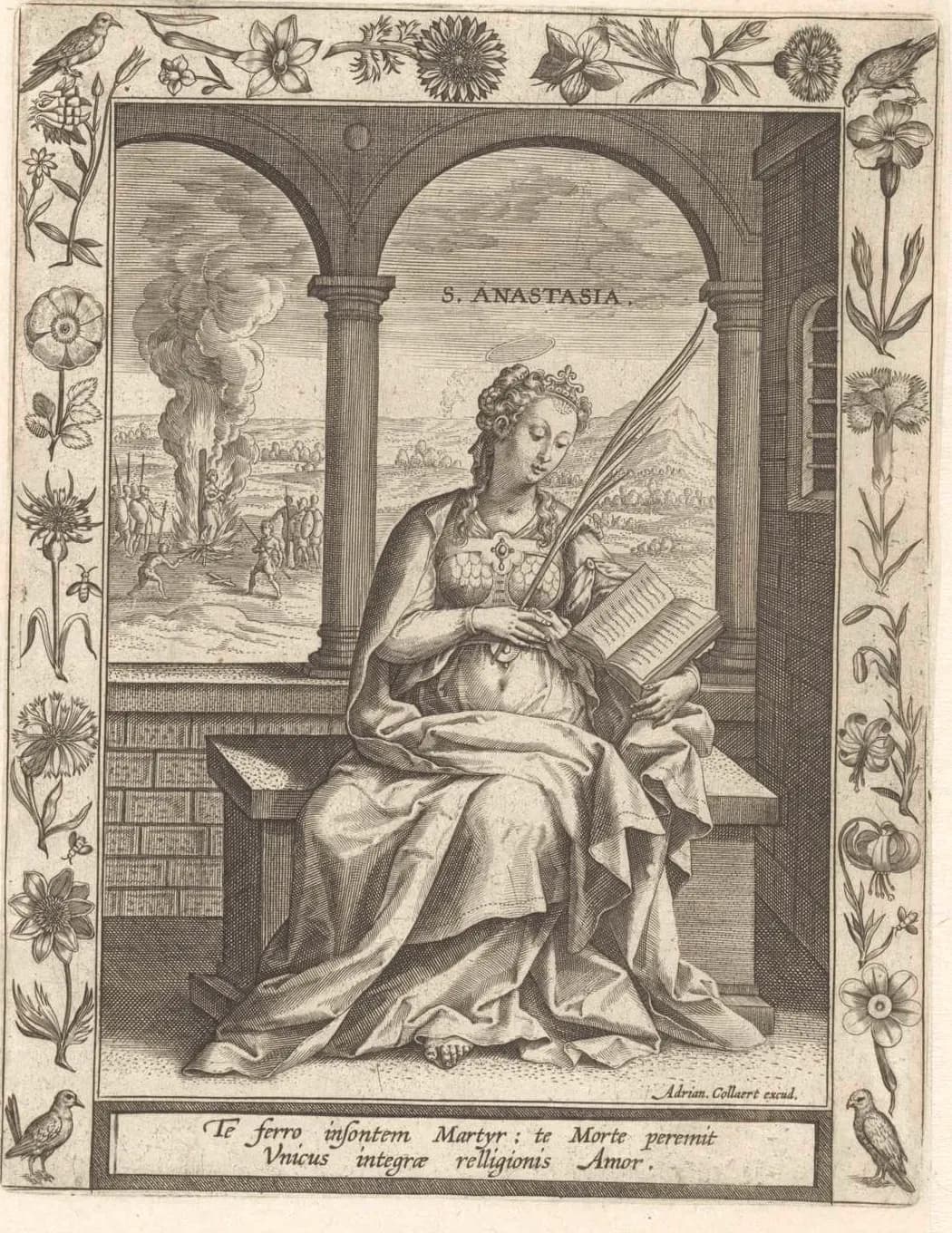
The engraving on this page shows her as the legend does, seated with a palm and an open book while a figure burns at a stake in the distance. It is a picture of a story that the encyclopedia says "rests on no historical foundations." 1 What stands behind it is smaller and harder: a woman at Sirmium, in a persecution, who died for the faith and whose own church did not forget her. 12
Her place in the liturgy is an odd one. She is named on the one day of the year when hardly anyone is thinking about a martyr, and the Mass that was once hers became the Mass of the Shepherds. 12 The sources do not suggest she was put there for a reason of devotion. They point to a church with a famous name, a court on the Palatine, and a pope paying a compliment. 16
Still, her name has been said at the altar since about the end of the fifth century, and it is said there now. 12 The Church at Rome took her from a distant city, knowing little more of her than that she had died for Christ, and has gone on naming her ever since. 1
Saint Anastasia, pray for us.
Sources
- 1.Johann Peter Kirsch, "St. Anastasia," The Catholic Encyclopedia, vol. 1 (New York: Robert Appleton Company, 1907).
- 2."Solemnity of the Nativity of the Lord (Christmas)," Liturgical Year, December 25, 2025, Catholic Culture (Trinity Communications); with an excerpt from Donald Attwater, A Dictionary of Saints.
- 3."St. Anastasia, Martyr of Sirmium," Saint of the Day, 25 December, Vatican News (Dicastery for Communication).
- 4.Santo del giorno, 25 dicembre, from the Roman Martyrology, Conferenza Episcopale Italiana (in Italian).
- 5.Kevin Di Camillo, "The Saint of Christmas Day," National Catholic Register, December 25, 2017; quoting the older Roman Martyrology, Butler's Lives of the Saints and John J. Delaney's Dictionary of Saints.
- 6.Cyril Charles Martindale, "Christmas," The Catholic Encyclopedia, vol. 3 (New York: Robert Appleton Company, 1908).
Saints to turn to next
Others in this collection who are turned to for some of the same things.