Saint Alphege
954 - April 19, 1012
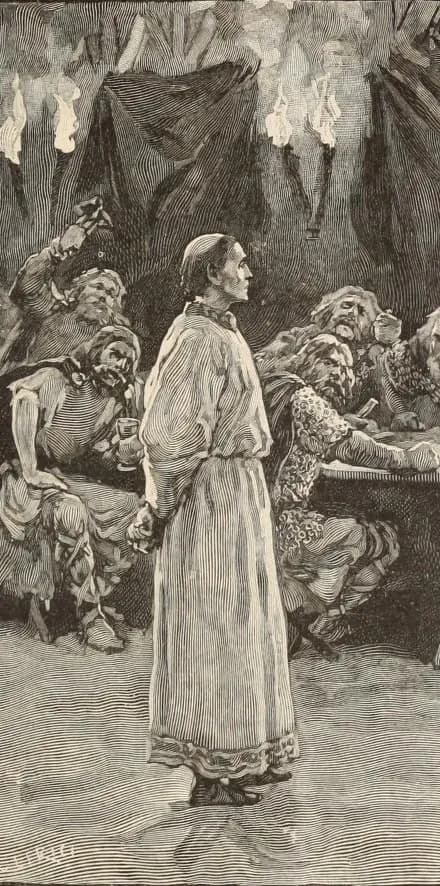
- Bishop of Winchester
- From October 19, 984 1
- Patron saint of
- Greenwich and Solihull, England; kidnap victims 2
Saint Alphege was the archbishop of Canterbury whom a Danish army carried off in 1011 and killed at Greenwich on April 19, 1012, because he would not let his people be taxed to ransom him. 12 He had been a monk, a hermit and for twenty-two years bishop of Winchester, and Catholic Culture notes that he was the first archbishop of Canterbury to die by violence. 12 His feast is April 19. 12
Monk, hermit, abbot
He was born in 954, into what Butler's Lives calls a noble Saxon family. 12 The Independent Catholic News report on his millennium places the birth at Little Weston, two miles from Bath. 4 The Catholic Encyclopedia says he left his widowed mother and his inheritance to enter the monastery of Deerhurst in Gloucestershire. 1 It also records that he was called Godwine. 1
After Deerhurst he lived for a time alone. The encyclopedia has him live "some years as an anchorite at Bath," and Butler agrees that the hermitage was near Bath; the ICN report puts it at Glastonbury. 124 He ended as an abbot at Bath in any case. Butler says he founded a community there under the Rule of Saint Benedict and was its first abbot, and the ICN report says Saint Dunstan, the archbishop of Canterbury, appointed him abbot of Bath in 976. 24
Bishop of Winchester
On October 19, 984, at thirty, he was made bishop of Winchester. 12 He held the see for twenty-two years, and ICN remembers him there for "his great generosity to the poor and his personal austerity." 23
These were years of Danish and Norwegian invasions, and in 994 he met one of the invading kings. 4 The encyclopedia says only that he "administered confirmation to Olaf of Norway at Andover." 1 ICN's account is fuller: King Ethelred sent him to negotiate with the leaders Anlaf and Swein, who had raided London and Wessex, and after meeting him Anlaf became a Christian and promised never again to come to England as an enemy, "a promise he kept." 3 The encyclopedia adds a suggestion that his patriotic spirit lay behind the decrees of the Council of Enham. 1
Canterbury, and the siege
In 1006 he became archbishop of Canterbury and went to Rome to receive the pallium. 13 Five years later the Danes were back. Toward the end of September 1011 they took Canterbury, sacked and burned it, "putting all to fire and sword," and made the archbishop their prisoner. 12 Catholic Culture says he was seized for urging the attackers to stop their killing and looting. 2 ICN's saint page dates the capture to 1012. 3
They took him to Greenwich and held him for ransom. 23 Butler says he spent seven months there in "a loathsome prison." 2 ICN gives the price as £3,000. 34
He would not have it paid. He was unwilling, Butler says, that his ruined church and people should be put to such expense. 2 When friends came and urged him to tax his tenants for the sum, Butler gives his answer: "What reward can I hope for," said he, "if I spend upon myself what belongs to the poor? Better give up to the poor what is ours, than take from them the little which is their own." 2 The ICN report has a shorter reply, which it says he is reported to have made when his captors demanded gold: "The gold I give you is the Word of God." 4
Greenwich, April 19, 1012
The end came on April 19, 1012. His captors, in the encyclopedia's words, were "drunk with wine, and enraged at ransom being refused," and they pelted him with ox bones and stones. 1 Butler says they beat him with the blunt sides of their weapons and bruised him with stones. 2 Then one man finished it with an axe.
The sources do not agree on who. The encyclopedia names him: "one Thurm dispatched him with an axe." 1 Butler does not name him but says he was a man "whom the Saint had baptized shortly before," and that the blow "put an end to his sufferings." 2 ICN adds something neither of the others has, that one man, Thorkel the Tall, tried to save him. 3
It was Easter Saturday, Butler says, and his last words were a prayer for his murderers. 2 A church dedicated to him stands at Greenwich on the place where he died. 24
From St. Paul's to Canterbury
He was buried at St. Paul's in London. 123 Eleven years later King Canute had the body carried to Canterbury. 14 ICN says the monks there venerated him at the beginning and the end of each day, and that he "very quickly became a national hero." 3 The ICN report states that Pope Gregory VII canonized him in 1078. 4
Catholic Culture says his remains lie under the high altar of Canterbury Cathedral, and that one of the oldest surviving windows there tells his life, with a panel of the siege that shows him taken hostage. 2 The encyclopedia notes that artists sometimes show him with an axe cleaving his skull; Catholic Culture adds a bishop holding an axe, or carrying stones in his chasuble. 12
A later archbishop of Canterbury remembered him. Thomas Becket, ICN says, commended his cause to God and Saint Alphege in his last sermon, and Catholic Culture says he was praying for Alphege's intercession just before he was murdered. 23
What is Saint Alphege the patron saint of?
Saint Alphege's feast day
Saint Alphege's feast day is April 19, the day of his death. The encyclopedia says, "His principal feast is kept on the 19th of April; that of his translation on the 8th of June." 1 Catholic Culture lists him on April 19 as a commemoration of the Roman Martyrology. 2
When the thousandth anniversary fell in 2012, ICN reported Masses for him in the dioceses of Southwark and Clifton, at Greenwich, at Canterbury, at the church of St Elphege in Wallington, and at the parish of Our Lady and St Alphege in Bath, the town where he had been abbot. 4
Praying with Saint Alphege
The refusal is the whole of his fame, and it is worth seeing what kind of refusal it was. Nobody asked him to deny his faith. He was offered his life for money, and the money would have had to come from his tenants, when his church and people were already ruined. 12 In Butler's telling he reasoned about it as a question of property: what he had belonged to the poor, and what they had was little enough. 2
It fits what is recorded of him before. He walked away from an inheritance as a young man, lived as a hermit, and as a bishop was known for giving to the poor and being hard on himself. 123 Seven months in prison at Greenwich did not change his mind. 2
Two details soften the ending without making it less brutal. One source says a man tried to save him, and another that the man who struck the last blow was someone he had baptized. 23 Butler has him die praying for the men who killed him. 2
Saint Alphege, pray for us.
Sources
- 1.Patrick W. F. Ryan, "St. Elphege," The Catholic Encyclopedia, vol. 5 (New York: Robert Appleton Company, 1909).
- 2."St. Alphege, Archbishop and Martyr (RM)," Liturgical Year, April 19, Catholic Culture, with an excerpt from Alban Butler, The Lives of the Saints (Benziger Bros., 1894).
- 3."St Alphege," Saint of the Day, Independent Catholic News.
- 4."St Alphege millennium celebrations," Independent Catholic News, April 18, 2012.
Saints to turn to next
Others in this collection who are turned to for some of the same things.
- Saint LawrenceDied August 10, 258CouragePoverty and simplicitySuffering and illness
- Saint Louis de MontfortJanuary 31, 1673 - April 28, 1716Poverty and simplicityCourageSuffering and illness
- Saint MartinaMartyred at Rome in the third century, traditionally about 228CourageSuffering and illnessPoverty and simplicity
- Saint Mary MacKillopJanuary 15, 1842 - August 8, 1909CouragePoverty and simplicitySuffering and illness