Saint Martina
Martyred at Rome in the third century, traditionally about 228
- Died
- Beheaded at Rome; in 226 "according to some authorities, more probably in 228" 1; Fernand Cabrol puts her death earlier, under Septimius Severus 3
- Historical record
- The accounts of her martyrdom are late and, the encyclopedia says, have no "historical value"; her cult is attested from the seventh century 12
- Relics found
- October 25, 1634, under Pope Urban VIII 1
Saint Martina is a Roman martyr of the third century who had a church by the Forum from the seventh century and was later, in the words of one liturgical writer, "forgotten for centuries." 23 In 1634 her relics were found in the crypt of that church, and Pope Urban VIII restored it, wrote hymns for her and set her feast on January 30. 12 The story of her tortures is old but not early, and the 1910 Catholic Encyclopedia says its details have no historical value. 1
What the sources treat as history
The firmest evidence is the devotion itself. The page published by the Governorate of Vatican City State says: "The earliest historical evidence of her cult dates to the 7th century, when Pope Honorius I had a church erected in her honor near the Roman Forum." 2 The current Roman Martyrology also ties her memory to that church, though it names a different pope, Donus, as the one who dedicated a basilica under her title in the Forum. 5 The Benedictine liturgist Fernand Cabrol, in the excerpt Catholic Culture prints, adds that her name appears in seventh- or eighth-century lists of relics moved under Honorius and under Adrian I. 3
Alban Butler, in the 1864 edition of his Lives that Catholic Culture also excerpts, pushes the devotion back a little further: "There stood a chapel consecrated to her memory in Rome, which was frequented with great devotion in the time of St. Gregory the Great." 3 The Vatican City State page says her feast was already being celebrated in the eighth century. 2
About her death Cabrol will commit to one sentence, and it does not match the legend. "It remains that, during a persecution, probably that of Septimus Severus (193-211), a group of Martyrs, of whom Martina was one, was put to death upon the Ostian Way." 3 The Vatican City State page gives the place more exactly, "at the tenth milestone of the Via Ostiense," where a church, now lost, was later built. 2
What the legend says
The traditional account is the one the Breviary read on her feast, and Catholic Culture reproduces it. Martina, "a noble virgin of Rome, was the daughter of a Consul." She lost her parents as a child and gave her great inheritance to the poor. Under the emperor Alexander Severus she was ordered to worship the gods and refused. 4 The Catholic Encyclopedia tells it the same way, calling her father an ex-consul, and dates her death to 226 "according to some authorities, more probably in 228." 1
Then come the torments, and they are many. She is scourged several times, torn with iron hooks, cut with swords and scalded with boiling oil. Condemned to the beasts in the amphitheater, she is "miraculously left untouched by them"; thrown on a burning pile, she escapes that as well. Some of her torturers are converted and beheaded. Earthquakes shake the city, fire falls from heaven, and the temples and idols are thrown down. At last the judge orders her beheaded. 4 The lessons place all this under the pontificate of Pope Urban I. 4
The sources that repeat the story are plain about its standing. Léon Clugnet, in the encyclopedia, writes that the accounts of her martyrdom "belong to a late period and as usual contain many amplifications which have not, as Baronius has already observed, any historical value." 1 Cabrol calls them "Acts of a more than doubtful authenticity," and notes that a Jesuit, Father Thurston, styled them "extravagant." 3 The Vatican City State page introduces her persecution with the words "According to tradition." 2
Found again in 1634
By the seventeenth century she had dropped out of mind. Cabrol says that the relics discovered under Urban VIII "revived the memory of this Martyr, forgotten for centuries." 3 The encyclopedia gives the day: they "were discovered on 25 Oct., 1634, in a crypt of an ancient church situated near Mamertine prison and dedicated to the saint." 1 The Breviary lessons add that her body was found together with those of the martyrs Concordius and Epiphanius and their companions, at the foot of the Capitoline Hill. 4
Urban VIII took up her cause with energy. The sources describe what he did to the church in three ways: Butler says he "built a new church in her honor," the encyclopedia that he "had the church repaired," and the Vatican City State page that the building "was later renovated in the 17th century by Pietro da Cortona." 123 The relics were put back, according to the Breviary lessons, "in the presence of a great concourse of people, and amidst shouts of joy from the whole city." 4 The church is the one now called Santi Luca e Martina. 2
The pope also wrote for her. The encyclopedia says that he, "it would seem, composed the hymns which are sung at the office of the noble martyr," and Butler states it without the hedge. 13 According to the Vatican City State page he fixed her celebration on January 30 and praised in his hymn "her purity, charity, and courage in bearing witness to Christ." 2 Cabrol notes that one stanza alludes to victories over the Turks and to plans for a new crusade. 3
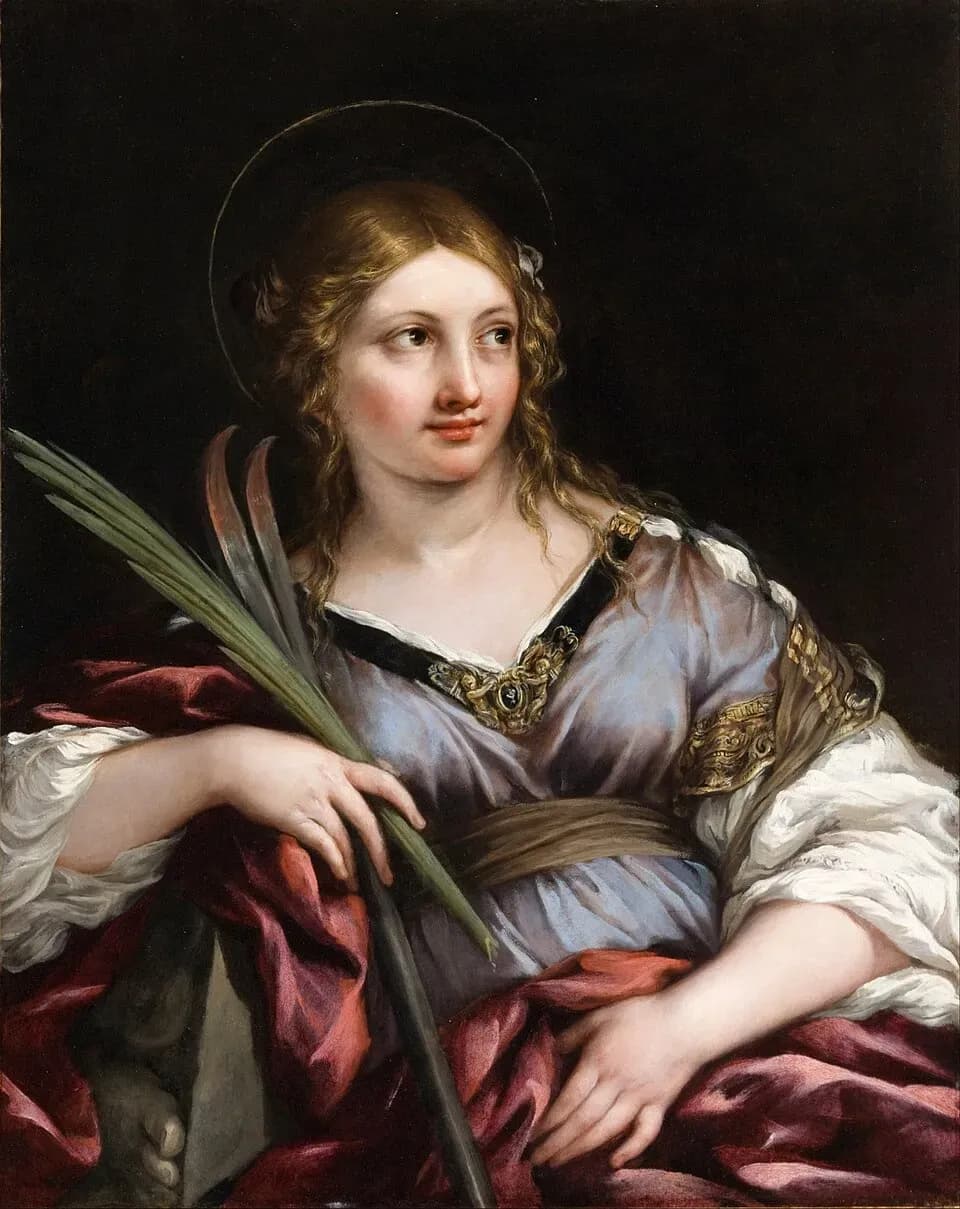
Pietro da Cortona, who renovated her church, also painted the picture on this page, a half-length of a young woman with a palm. 2 Catholic Culture lists among her emblems a maiden with a lion, a sword, and a two-pronged hook. 3
Martina Franca
Her name carried the devotion to one more place. The Vatican City State page tells how in 1730 Cardinal Tommaso Innico Caracciolo arranged for fragments of her relics to be sent from the Roman church to his native city, Martina Franca, in the province of Taranto. An altar was raised to her there, "and, sharing the name of the city, she was granted the title of co-Patron Saint." 2
What is Saint Martina the patron saint of?
Saint Martina is one of the patron saints of the city of Rome. Butler puts it this way: "The city of Rome ranks her among its particular patrons." 3 The Vatican City State page adds that she is co-patron of Martina Franca in southern Italy. 2 Catholic Culture's list also names nursing mothers. It gives no reason, and no other source read for this page repeats it. 3
Saint Martina's feast day
Saint Martina's feast is January 30. The Catholic Encyclopedia gives that date for her office, and the Vatican City State page says it was Urban VIII who fixed it there after the relics were found. 12 The current Roman Martyrology commemorates her on January 30, Vatican News lists "St. Martina, Martyr" on that day, and Catholic Culture places her among the day's other commemorations from the Martyrology. 356 An earlier Catholic Culture page notes that January 30 is her feast in the 1962 Missal as well. 7
Praying with Saint Martina
Martina comes down to the present in two layers. Underneath is a woman killed for her faith in Rome in the third century, one of a group, whose name the city kept and built a church around. 23 On top is a long story of hooks, lions and falling temples that the Church's own scholars have declined to vouch for since the time of Baronius. 1
The legend keeps one detail that is easy to pass over among the wonders. Before anything is done to her, the orphan with the great inheritance gives it away to the poor. 4 The Breviary tells it in a single clause and hurries on to the tortures, but it is the one thing in the story she does before anyone threatens her.
Then there is the forgetting. Rome let her memory lapse for centuries, and it took a crypt opened in 1634 to bring her back. 13 The joy the Breviary describes at her return, with the whole city shouting, was for someone nobody present could have told much about. 4 They knew she had been one of theirs and had died a martyr, and that was enough for them.
Saint Martina, pray for us.
Sources
- 1.Léon Clugnet, "St. Martina," The Catholic Encyclopedia, vol. 9 (New York: Robert Appleton Company, 1910).
- 2."January 30: Saint Martina, Martyr," Saint of the Day, Governorate of Vatican City State.
- 3.Liturgical Year, January 30, 2026, "St. Martina, Virgin and Martyr," Catholic Culture (Trinity Communications); with excerpts from Alban Butler, The Lives of the Fathers, Martyrs and Other Principal Saints, vol. 1 (1864 edition), and Fernand Cabrol, The Year's Liturgy, vol. 2.
- 4."Life of St. Martina," taken from the Breviary lessons for her feast, Liturgical Year activities, Catholic Culture (Trinity Communications).
- 5.Santo del giorno, 30 gennaio, from the Roman Martyrology, Conferenza Episcopale Italiana (in Italian).
- 6."St. Martina, Martyr," Saint of the Day, 30 January, Vatican News (Dicastery for Communication).
- 7.Liturgical Year, January 30, 2014, Catholic Culture (Trinity Communications).
Saints to turn to next
Others in this collection who are turned to for some of the same things.
- Saint Alphege954 - April 19, 1012CouragePoverty and simplicitySuffering and illness
- Saint LawrenceDied August 10, 258CouragePoverty and simplicitySuffering and illness
- Saint Louis de MontfortJanuary 31, 1673 - April 28, 1716Poverty and simplicityCourageSuffering and illness
- Saint Mary MacKillopJanuary 15, 1842 - August 8, 1909CouragePoverty and simplicitySuffering and illness