Saint Vicenta María López y Vicuña
March 1847 - December 26, 1890
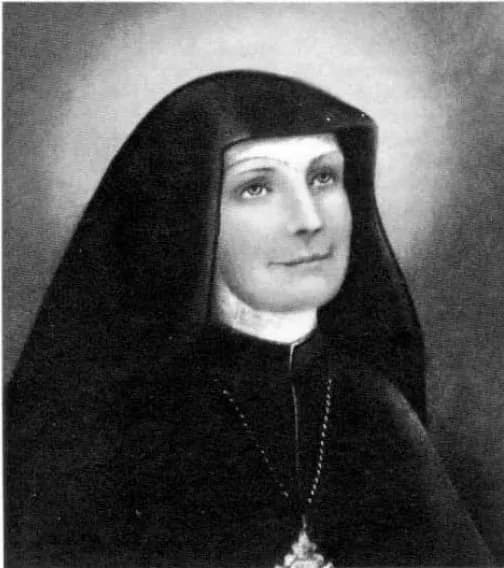
- Feast day
- December 26, by the New Catholic Encyclopedia 1; May 25, the day of her canonization, by the Archdiocese of Madrid 3
- Parents
- José María López and Nicolasa de Vicuña 3
- Founded
- The Daughters of Mary Immaculate for Domestic Service, now the Religious of Mary Immaculate, in Madrid in 1876 124
- Approved by the Holy See
- 1888 1
Saint Vicenta María López y Vicuña founded a congregation in Madrid in 1876 for one kind of person: the young women who came in from the countryside to work in other people's houses as maids. 14 Its sisters ran hospices for working girls and taught them domestic skills, and Paul VI, canonizing her in 1975, described her whole life as given to them. 12 She died in 1890 at 43, with houses already open across Spain. 12
A girl from Navarre in her aunt's house
She was born at Cascante, in Navarre, in March 1847. The New Catholic Encyclopedia and the Archdiocese of Madrid give March 22; Paul VI's canonization homily gives March 24. 123 Her parents were José María López and Nicolasa de Vicuña. 3 The encyclopedia calls them pious and middle-class, and the congregation she founded describes a wealthy family, one able to give a daughter an education at a time when few women had one. 14
That education took her to Madrid. The encyclopedia dates the move to 1854; the congregation says she was 10. 14 She lived with her uncle and aunt, Manuel María and María Eulalia de Vicuña. 34 The Madrid archdiocese says the uncle was a lawyer who took the cases of poor people without charge, and the aunt sheltered servant girls who had fallen on hard times in an old, small house. 3 The encyclopedia describes the aunt's work as a hospice for young, unemployed servants. 1
Paul VI, speaking at her canonization, credited her family with much of what she became, naming her mother, an uncle who was a priest and an aunt who was a religious. 2 The Madrid archdiocese adds that while still a student she taught the catechism to young women who had migrated to the city. 3
Who the work was for
The congregation describes the women she cared about as girls leaving the countryside to look for work in the city in the nineteenth century, when women had few ways to secure their futures. 4 Paul VI said such young women were often surrounded by difficulties and dangers of no small kind. 2 Many came to Madrid to work as maids, and her uncle and aunt had seen that they needed somewhere to turn. 4
Her own notes, which Paul VI cited in his homily, set out why she wanted to found something for them. The list is not a comfortable one: more poverty, more mortification of her own inclinations, a real risk of being despised and criticized, and continual effort and sacrifice, which she weighed against what she called the need of the age. 2
Her parents, and a decision
After a retreat in 1866, the Madrid archdiocese says, she decided to found an institute for domestic servants. 3 The encyclopedia records a private vow of chastity the same year. 1 Her parents did not agree. The encyclopedia says they urged her to marry or to join the Visitation nuns; the archdiocese says they put every obstacle in her way, because the plan undid the future they had imagined for her. 13
Paul VI described the weighing of that choice and quoted what she said when it was settled: "¡Las chicas han vencido!" 2 An English homily for her feast, published on the congregation's website, renders it "The Girls have triumphed." 6
From 1871 to 1876, the encyclopedia says, she lived a common life with her aunt and a few others. 1 Under the guidance of Father Hidalgo y Soba she drew up a constitution, which the auxiliary bishop of Toledo, Sancha y Hervás, approved in July 1876. 1
A congregation in 1876
The sources agree on the year and differ on the day. Paul VI says she received the habit with two companions on Trinity Sunday 1876, and that this was the birth of the Religious of Mary Immaculate. 2 The congregation dates its own beginning to June 11, 1876, in Madrid. 4 The Madrid archdiocese says the auxiliary bishop of Toledo, later Cardinal Sancha, gave the habit to the first three sisters on July 11, 1876. 3 Vows followed in 1878: in August, by the encyclopedia, or on Trinity Sunday, by the archdiocese. 13
The work, in the encyclopedia's words, was to run hospices for working girls and to teach them domestic arts. 1 The archdiocese lists more: Sunday and night schools, catechism for children, and human and professional formation. 3 Paul VI described the aim as a welcoming home where a young woman would find a friendly voice and could learn to better herself. 2
Houses across Spain, and a lost fortune
After Madrid came Zaragoza and Jerez, then Valladolid, Seville, Barcelona and a large house at Fuencarral in Madrid, by the archdiocese's list; the congregation's own list includes Burgos. 34 It was not smooth. The encyclopedia mentions early financial difficulties and the foundress's poor health. 1 The archdiocese tells of an administrator whose bad gamble on the stock exchange lost "un millón de reales" and left her, in its telling, to rely entirely on Providence. 3
The Holy See approved the institute in 1888. 1 Paul VI said that before she died she had houses throughout Spain and was hoping to found one in Buenos Aires, and that her congregation later spread to Europe, the Americas, Africa and Asia. 2 The encyclopedia counts more than 2,000 members and 81 houses by 1961. 1
Death, and canonization
She died in Madrid on December 26, 1890, aged 43. 134 Paul VI spoke of physical sufferings and, above all, moral ones before the end. 2 Pius XII beatified her on February 19, 1950, during that Holy Year. 13
Paul VI canonized her on May 25, 1975, together with the Trinitarian reformer John Baptist of the Conception. 2 It was another Holy Year and, as he noted, the International Women's Year, and his English greeting to pilgrims that day began: "Today is the Solemnity of the Most Blessed Trinity and we have two new Saints." 2 He presented her care for young working women as a task the present world still needs. 2
Half a century on, Leo XIV named her in an apostolic letter on education, alongside Frances Cabrini, Josephine Bakhita, Maria Montessori, Katharine Drexel and Elizabeth Ann Seton, as one of the "courageous women" who "opened doors for girls, migrants and the marginalized." 5
What is Saint Vicenta María López y Vicuña the patron saint of?
None of the sources consulted names a patronage for her, so this page does not claim one. 1234 Paul VI called the two new saints the patrons of their own religious families, which for her means the Religious of Mary Immaculate. 2 Her life's work was with young women in domestic service, and the congregation still describes itself by that beginning, but no source here makes her their patron saint. 4
Saint Vicenta María López y Vicuña's feast day
The New Catholic Encyclopedia gives her feast as December 26, the day she died. 1 The Archdiocese of Madrid gives another date: it says she was canonized on May 25, 1975, "día en que se celebra su fiesta," the day on which her feast is kept, and lists her among the saints of May 25. 3 Both are given here. Which applies depends on the calendar in use, and no source consulted settles it for the United States.
Praying with Saint Vicenta María López y Vicuña
Her vocation came out of a household. An aunt sheltered servant girls in a small house and an uncle took poor people's cases for nothing, and the niece living with them saw the work at close range for years before she made it her own. 3 Paul VI dwelt on that, on how much of a saint can be traced to the people she grew up among. 2
The choice cost her something specific. Her parents wanted a marriage or a quieter convent, and she wrote down beforehand that the foundation would mean more poverty and a real chance of being despised. 12 Paul VI says plainly that it was not an easy decision to carry out, and the sources do not say her parents were wrong to worry. 2
Much of what followed was ordinary institutional labor: rules drafted and approved, houses opened in one city after another, a fortune lost by an administrator on the stock exchange. 13 The women it served were maids, a group easy to overlook then and now, and Paul VI described the purpose as a home where each of them would be met with a friendly voice. 2
She died at 43, with the work approved but still young. 12 Leo XIV remembered her more than a century later as one of the women who opened doors for girls. 5 The congregation she left behind now works on four continents and still begins its own story with the girls who came to Madrid to work as maids. 4
Saint Vicenta María López y Vicuña, pray for us.
Sources
- 1.I. Bastarrika, "López y Vicuña, Vicenta María, Bl.," New Catholic Encyclopedia, via Encyclopedia.com.
- 2.Paul VI, Homily for the Canonization of Blessed John Baptist of the Conception and Blessed Vicenta María López y Vicuña, May 25, 1975 (Italian and Spanish, with greetings in French, English, German and Portuguese).
- 3."Vicenta María López y Vicuña, fundadora (1847-1890)," Oración y Liturgia, Archdiocese of Madrid, May 25, 2026 (in Spanish).
- 4."We are," Religious of Mary Immaculate (RMI World).
- 5.Leo XIV, Apostolic Letter "Drawing New Maps of Hope" on the 60th anniversary of the conciliar declaration Gravissimum educationis, October 27, 2025.
- 6."Vicenta Maria Lopez and Vicuna Feast Day, Washington DC," homily published by the Religious of Mary Immaculate (RMI World).
Saints to turn to next
Others in this collection who are turned to for some of the same things.
- Saint Albert ChmielowskiAugust 20, 1845 - December 25, 1916Poverty and simplicityDiscernmentWork and vocation
- Saint Eugene de MazenodAugust 1, 1782 - May 21, 1861Poverty and simplicityDiscernmentWork and vocation
- Saint José Gregorio HernándezOctober 26, 1864 - June 29, 1919Work and vocationDiscernmentPoverty and simplicity
- Saint Louis of ToulouseFebruary 1274 - August 19, 1297Poverty and simplicityWork and vocationDiscernment