Saint Veronica
First century, by tradition
- In Scripture
- Not named; she "does not appear in the Gospels" 2
- The name
- From vera icon, "true image," first the name of the relic at Rome 1
- Station of the Cross
- The sixth of the fourteen 5
- Patron of
- Laundry workers, domestic workers, seamstresses, photographers, the dying; invoked against bleeding 4
- Feast day
- July 12, by tradition; she is not in the Roman Martyrology 4
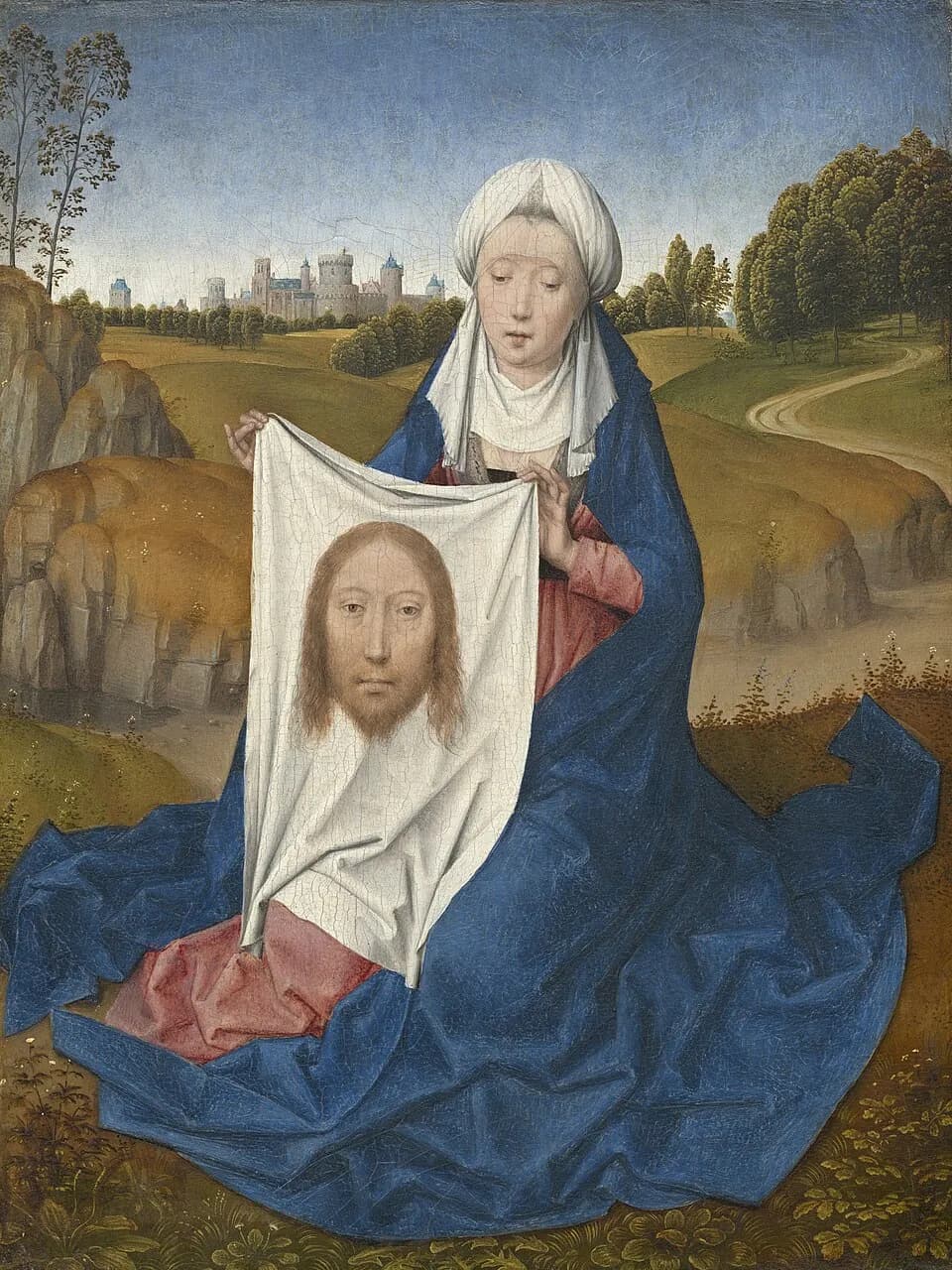
Saint Veronica is the woman who, by tradition, pushed through the soldiers on the road to Calvary and wiped the blood and sweat from the face of Jesus with a cloth, on which his face remained. 12 Hers is the sixth of the fourteen Stations of the Cross, and she is not in the Gospels. 25 The 1912 Catholic Encyclopedia holds that her name was first the name of a relic. 1 She has traditionally been honored on July 12, though the Roman Martyrology does not list her. 4
The woman on the road to Calvary
The story is short. The Catholic Encyclopedia gives it in a sentence: "a pious matron of Jerusalem" who, as one of the holy women accompanying Christ to Calvary, "offered Him a towel on which he left the imprint of His face." 1 John Paul II, leading the Way of the Cross at the Colosseum on Good Friday 2000, told it almost as briefly. A woman pushed her way through the soldiers escorting Jesus and with a veil wiped the sweat and blood from his face, and the face stayed on the veil. 2
Later tellings fill in the scene. In the version on CatholicCulture.org she sees Jesus fall under the cross, is moved with pity, and forces her way past the Roman soldiers. They push her off. She bundles the veil up and does not look at it until she is home, and when she unfolds it the face is there. 4
Cardinal Joseph Ratzinger, who wrote the Colosseum meditations for 2005, kept to what the gesture was. She "held out a facecloth to Jesus," he wrote, and "did not let herself be deterred by the brutality of the soldiers or the fear which gripped the disciples." 3
Not in the Gospels
None of this is in the New Testament, and the Church does not pretend otherwise. "Veronica does not appear in the Gospels," John Paul II said at the sixth station. "Her name is not mentioned, even though the names of other women who accompanied Jesus do appear." 2
Tradition has tried more than once to find her there. In many places, the encyclopedia says, she was identified with the woman in the Gospel who was cured of a hemorrhage, and CatholicCulture repeats that claim, giving her the name Bernice. 14 Ratzinger notes that Bernice is what the Greek tradition calls her. 3 Another story, which the encyclopedia traces to a confusion with a woman mentioned by Gregory of Tours, has her present at the beheading of John the Baptist. 14
A name that began as a relic
The encyclopedia's account of the name is blunt. Rome possessed several images believed to be authentic likenesses of Christ, a belief it connects with the old legend of Abgar of Edessa and an apocryphal text called the "Mors Pilati." To mark out the oldest and best known of them, people called it the vera icon, the true image, "which ordinary language soon made veronica." 1 Medieval texts use the word for the cloth itself. An old missal of Augsburg had a Mass headed "De S. Veronica seu Vultus Domini," and the chronicler Matthew of Westminster wrote of the image of the Savior's face "which is called Veronica." 1
Then the word changed owners. "By degrees," the article says, "popular imagination mistook this word for the name of a person and attached thereto several legends which vary according to the country." 1 Antonio Gaspari, writing in Inside the Vatican in 1999, reports the same judgment from modern critics, and adds that he finds the woman herself in the apocryphal Acts of Pilate, which he dates to about the sixth century. 6
John Paul II read the same fact from the other side. Because the Gospels do not name her, he said, the name may refer to what the woman did: the face left on her veil was a true icon, and so she is called by it. "If this is so, the name which evokes the memory of what this woman did carries with it the deepest truth about her." 2
One name, several legends
The legends the encyclopedia collects do not agree with one another, and it sorts them by country. In Italy, Veronica is summoned to Rome by the emperor Tiberius and cures him by having him touch the image. She stays in the city, living there at the same time as Peter and Paul, and at her death leaves the cloth to Pope Clement and his successors. 1
In France she is married to Zacheus, the convert of the Gospel. The two go to Rome, and afterward he becomes a hermit under the name Amadour in the region now called Rocamadour, while she helps Saint Martial in his preaching. A third version, from the country around Bordeaux, has her land at Soulac at the mouth of the Gironde soon after the Ascension, carrying relics of the Blessed Virgin. She preaches there, dies, and is buried in a tomb long venerated either at Soulac or in the church of St. Seurin at Bordeaux. 14
The article's verdict covers all of them: "These pious traditions cannot be documented." Yet there is no reason, it goes on, "why the belief that such an act of compassion did occur should not find expression in the veneration paid to one called Veronica." 1
The sixth station
Most Catholics meet Veronica on the wall of a parish church, between Simon of Cyrene and the second fall. 5 The encyclopedia's article on the Way of the Cross shows how late that place was settled. Her scene is missing from many of the earlier accounts of the devotion, and nearly all of those that include it set it just before Calvary, not early in the journey as now. 5 The number of stations varied from place to place for centuries until Clement XII fixed it at fourteen in 1731. 5
The veil, in Rome and at Manoppello
The cloth has a history of its own. The image brought to Rome "was long exposed to public veneration," the encyclopedia says. 1 Gaspari writes that it was displayed for the first Holy Year in 1300, and that Dante mentions it in the Paradiso. 6 According to CatholicCulture the veil is kept at St. Peter's Basilica and shown each year on the fifth Sunday of Lent. 4 Gaspari describes a statue of Veronica beside the main altar there, with a Latin inscription saying the veil is preserved within. 6
Some scholars think it is no longer there. In 1999 the Jesuit art historian Heinrich Pfeiffer of the Gregorian University announced that the true veil is a thin cloth kept by the Capuchins at Manoppello, in the Abruzzo, and argued that it was stolen from the Vatican in the years after 1600, while St. Peter's was being rebuilt. 6 The journalist Saverio Gaeta puts the loss earlier, in the sack of Rome in 1527. 7 Both say the Capuchins received the cloth in 1638, and Benedict XVI visited the shrine on September 1, 2006. 67 Gaspari also quotes an Oxford professor who called the claim "totally absurd," and records that the Vatican made no comment. He ends by noting that believing in the veil's authenticity or not "is not a matter of faith." 6
What is Saint Veronica the patron saint of?
The patronages that have gathered around Saint Veronica nearly all come from the cloth. CatholicCulture lists her as patron of laundry workers and washerwomen, linen weavers, seamstresses, domestic workers, maids and rectory housekeepers, of photographers, and of the dying, and as a saint invoked against bleeding and hemorrhages. 4 The last of these matches the tradition that identifies her with the woman healed in the Gospel. 14 None of the other sources read for this page names a patronage.
Saint Veronica's feast day
Saint Veronica's feast day is, by tradition, July 12. CatholicCulture's liturgical calendar gives that date as historically the feast of "St. Veronica of the Veil" and adds at once that she "is not included in the Roman Martyrology, but traditionally honored today." 4 The encyclopedia prints no date for her. It notes that her name found no place in the Hieronymian Martyrology or the oldest historical martyrologies, and that Saint Charles Borromeo removed the Office of St. Veronica from the Milan missal, where it had been introduced. 1
The Roman Martyrology does carry two later women who bore her name: Veronica of Binasco, at Milan, on January 13, and Veronica Giuliani on July 9. 1 Neither is the Veronica of the veil.
Praying with Saint Veronica
Veronica has no speech, no family and no recorded death. 12 What tradition kept of her is a single movement of the hands, made in a crowd, toward a condemned man on his way to execution. Ratzinger called it "an act of womanly kindness" and pointed out how little it was. She could not stop what was happening. "At first, Veronica saw only a buffeted and pain-filled face." 3
That smallness is why she has lasted. Simon of Cyrene, one station earlier, was made to carry the cross. 5 Nobody made Veronica do anything. In the telling, she steps out past armed men while the disciples are held by fear, and Ratzinger names the quality exactly: "the courage born of goodness." 3
John Paul II drew a plain conclusion from the image on the cloth. "Acts of love do not pass away," he said; every act of goodness, of understanding, of service leaves an imprint on people's hearts and makes the one who does it more like Christ. 2 For Ratzinger the image was first of all in her: the act of love "impressed the true image of Jesus on her heart." 3
It may seem strange to pray with a saint whose name may have started as a word for a relic. 1 The encyclopedia, which says so more bluntly than anyone, is also the source that defends the veneration, since what it honors is an act of compassion on the way of the cross. 1
Saint Veronica, pray for us.
Sources
- 1.Antoine Degert, "St. Veronica," The Catholic Encyclopedia, Vol. 15 (New York: Robert Appleton Company, 1912).
- 2.John Paul II, Way of the Cross at the Colosseum, Good Friday, April 21, 2000, Sixth Station: "Veronica wipes the face of Jesus."
- 3.Cardinal Joseph Ratzinger, Way of the Cross at the Colosseum, Good Friday 2005, meditations and prayers, Sixth Station: "Veronica wipes the face of Jesus," Office for the Liturgical Celebrations of the Supreme Pontiff.
- 4."Ordinary Time: July 12th," Liturgical Year calendar, CatholicCulture.org (Trinity Communications), entry for St. Veronica of the Veil.
- 5.George Cyprian Alston, "Way of the Cross," The Catholic Encyclopedia, Vol. 15 (New York: Robert Appleton Company, 1912).
- 6.Antonio Gaspari, "Has Veronica's Veil Been Found?," Inside the Vatican, November 1999, pp. 42-44, as reproduced in the CatholicCulture.org library.
- 7.Jesus Colina, "The Mystery of Veronica's Veil: Interview With Author Saverio Gaeta," ZENIT, April 14, 2010, as reproduced in the EWTN library.
Saints to turn to next
Others in this collection who are turned to for some of the same things.