Saint Thomas the Apostle
First century
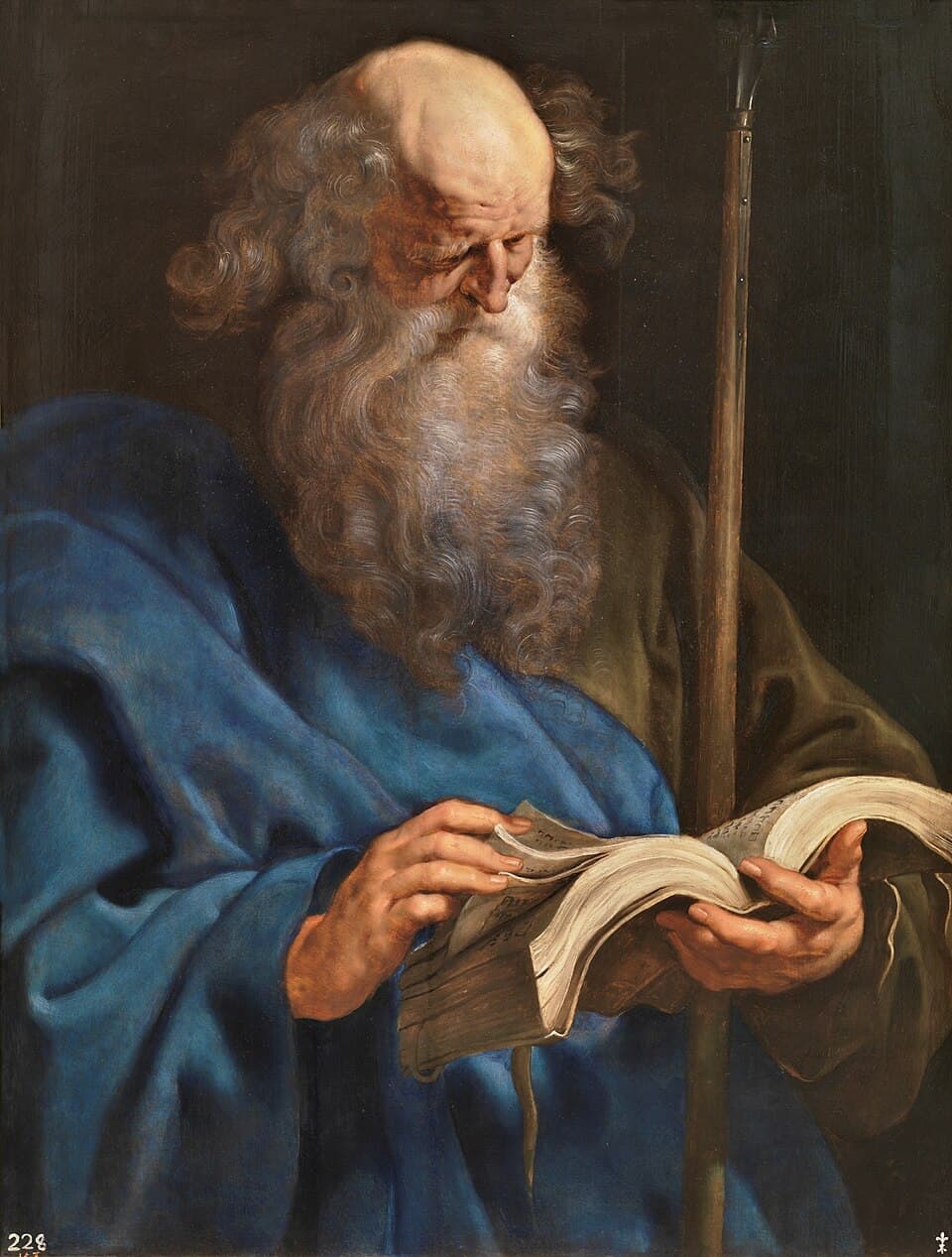
- Patron saint of
- Franciscan Media lists architects, builders, construction workers and surveyors; India, Pakistan and Sri Lanka; and theologians 3
- Feast day
- July 3 3
- What is certainly known
- Three scenes in the fourth Gospel. Thurston: this "exhausts all our certain knowledge regarding the Apostle" 1
- Relics
- Venerated at Edessa in the fourth century, translated to Chios in 1258 and afterward to Ortona 1
Saint Thomas said one thing in a locked room and has been named for it ever since. The same Gospel that records his refusal to believe also records him, months earlier, proposing that the Twelve walk into Judea and die there alongside Jesus, and it gives him the most explicit confession of Christ as God anywhere in the New Testament. 123 Almost everything else told about him comes from a document that also calls him the twin brother of Jesus. 1
The three scenes
Thomas appears in all the apostolic lists, but only the fourth Gospel gives him anything to do. 12 The first occasion is the decision to go back to Bethany after Lazarus has died, which meant walking to within two miles of the people who wanted Jesus dead. Thomas turned to the others and said: "Let us also go, that we may die with him." 12 Benedict XVI calls this readiness exemplary, a willingness to identify his own fate with his Master's. 2 It is worth holding onto, because the man who said it is remembered for the opposite.
The second is a question at the Last Supper. Jesus said the disciples knew the way to where he was going; Thomas said they did not. "Lord, we know not whither thou goest; and how can we know the way?" 1 Thurston lets the interruption stand as an objection. 1 Benedict is blunter about the level it came from, saying Thomas "places himself at a rather low level of understanding" - and then points out what the low level produced. The answer to that question is "I am the Way, and the Truth and the Life." 2 Nobody gets that sentence without Thomas asking for it.
The third is the famous one. Told that the others had seen the Lord, he set his terms: unless he saw the print of the nails and put his hand into the side, he would not believe. 12 Eight days later Jesus arrived and offered him exactly that, and Thomas answered "My Lord and my God!" 12 Augustine's comment, which Benedict quotes, is that Thomas "saw and touched the man, and acknowledged the God whom he neither saw nor touched." 2
What he was actually asking for
Benedict makes an observation about the terms Thomas set that changes how the scene reads. Thomas did not ask to see a face. He asked to see wounds. The conviction underneath the demand is that the risen Jesus is identified by his injuries rather than by his features, and Benedict's verdict on that instinct is short: "In this the Apostle is not mistaken." 2
The rebuke that follows has been read hard for centuries. Thurston records it as a rebuke without softening it. 1 The sentence itself - "blessed are they that have not seen, and have believed" - is addressed past Thomas to everyone who would come after him, which is the entire readership of the Gospel. 12 Benedict notes that Thomas Aquinas set it beside the apparently opposite beatitude in Luke, "blessed are the eyes which see what you see," and concluded that those who believe without seeing have the greater merit. 2
Franciscan Media makes the case for the defense in one line: "if he doubted, he also believed." 3 It also points out something usually missed in the retelling, which is that Thomas ran at the arrest like the rest of them, so his earlier offer to go and die was impetuous rather than insincere. 3 The Apostles are not presented anywhere in these sources as men who were good at this.
There is a fourth appearance, easy to miss. When the risen Jesus meets the disciples at the Sea of Tiberias, Thomas is listed immediately after Simon Peter. 2 Benedict reads the ordering as evidence rather than decoration, calling it "an evident sign of the considerable importance that he enjoyed in the context of the early Christian communities." 2 Whatever the later nickname did to his reputation, the men who wrote these lists put him near the front.
The problem with India
Here the two sources part company, and the disagreement is the most interesting thing on the page.
Benedict XVI states the tradition without hedging: Thomas first evangelized Syria and Persia, which Origen reports through Eusebius, and then went on to western India and finally to southern India. 2 Thurston, writing for the encyclopedia, is far more careful. He grants that the tradition that Thomas preached in "India" was widely spread in East and West and is found in Ephrem, Ambrose, Jerome and Gregory of Tours. Then he says that it is "difficult to discover any adequate support" for the long-accepted belief that Thomas went as far south as Mylapore. 1
The document underneath all of it is the "Acta Thomae," and Thurston handles it the way it deserves. It is Gnostic, possibly by Bardesanes, and Harnack dates it before A.D. 220, which is early. 1 It is also, in Thurston's words, "utterly extravagant" in many of its particulars, and in more than one place it makes Thomas the twin brother of Jesus. 1 The plot has Jesus selling Thomas into slavery to an Indian king's envoy, and Thomas meeting adventures from dragons and wild asses. 1
And yet. The king the "Acta" calls Gundafor was real. Coins of Parthian and Indian type, and the dated Takht-i-Bahi inscription, establish a King Gunduphara who probably began to reign about A.D. 20 and was still reigning in 46, ruling the country now covered by Afghanistan, Baluchistan, the Punjab and Sind. 1 Thurston quotes Fleet's severely critical judgment that the names in the Thomas story "are distinctly not such as have lived in Indian story and tradition" - that is, they do not look like set dressing a romancer would reach for. 1 An extravagant legend has a verifiable king in it, and the honest position is that this is strange and unresolved.
What is certain is smaller. The relics were at Edessa in the fourth century, went to Chios in 1258 and then to Ortona. 1 A body of Christians on the Malabar coast still uses a form of Syriac in its liturgy, and whether that Church goes back to the Apostle, to the Persian persecution of 345, or to Syrian missionaries around 745, Thurston says plainly, "seems difficult to determine." 1 He notes in passing that a Syro-Chaldean bishop named John, described as coming "from India and Persia," was at the Council of Nicaea in 325. 1
One other thing is worth knowing about the literature attached to his name, because people meet it and assume it is his. A "Gospel of Thomas" survives in an abbreviated form, originally Gnostic, which Thurston describes as by now merely a fantastical history of the childhood of Jesus. 1 A "Revelatio Thomae" was condemned as apocryphal in the Decree of Pope Gelasius. 1 Benedict mentions the Acts and the Gospel of Thomas as apocryphal works that are nonetheless important for studying Christian origins. 2 None of it is by Thomas, and none of it is why he is venerated.
What is Saint Thomas the Apostle the patron saint of?
Franciscan Media lists Saint Thomas as patron of architects, builders, construction workers and surveyors; of India, Pakistan and Sri Lanka; and of theologians. 3 The building trades come from the "Acta," where he is handed over as a carpenter and commissioned to build a palace for the king and spends the money on the poor instead. 1 The encyclopedia states no patronage for him at all.
Saint Thomas the Apostle's feast day
Praying with Saint Thomas
The useful thing about Thomas is that his doubt was specific. He did not announce that he had lost his faith or that the question was too large for him. He named a condition, in one sentence, and it was a condition that could be met. There is a great deal of difficulty in ordinary religious life that never gets that far, and stays a vague heaviness instead of a question somebody could answer.
Benedict draws out a second permission from the Last Supper scene. Thomas interrupting to say he does not understand gives the rest of us, as Benedict puts it, "the right, so to speak, to ask Jesus for explanations" - and he suggests the words: "I do not understand you, Lord; listen to me, help me to understand." 2 He calls that frankness "the true way of praying." 2 It is a lower bar than most people set themselves.
His case is worth something, Benedict says, for three reasons: it comforts us in our insecurity, it shows that a doubt can end somewhere brighter than the uncertainty it started in, and the words spoken to him describe what mature faith actually is. 2 None of that is a promise that doubts resolve on schedule. Thomas waited eight days, in a room with people who had seen what he had not.
What the sources will not give is a life. Three scenes, a nickname whose origin Benedict says is unclear, an early and unreliable romance, and a real Indian king sitting oddly in the middle of it. 12 Thomas is venerated across a span from Ortona to Kerala on the strength of that, and the veneration is old enough that the argument is about where he went rather than whether he was there to go.
Saint Thomas the Apostle, pray for us.
Sources
Saints to turn to next
Others in this collection who are turned to for some of the same things.