Saint Thomas of Hereford
c. 1218 - August 25, 1282
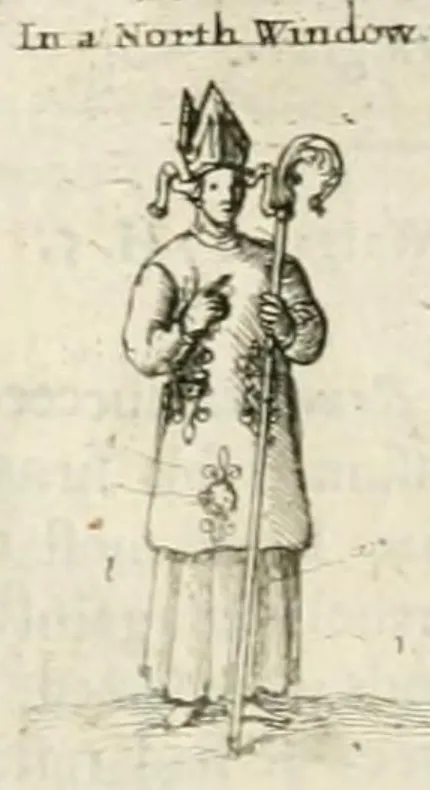
- Offices
- Chancellor of Oxford University, 1262; Chancellor of England, 1265 1
- Bishop of Hereford
- Appointed June 1275; consecrated September 8, 1275 1
- Relics
- Hereford Cathedral, Belmont Abbey, Downside Abbey and Holywell 2
Saint Thomas of Hereford, born Thomas Cantilupe, was an Oxford canon lawyer who served as chancellor of the university and of England before becoming Bishop of Hereford in 1275. 1 He died in Italy on August 25, 1282, while appealing to the pope against his own archbishop, who had excommunicated him. 12 Hundreds of miracles were recorded at his tomb, and in 1320 he became one of the last Englishmen canonized before the Reformation. 24 The Roman Martyrology keeps him on August 25; Hereford remembers him on October 2. 36
A scholar from a great family
He was born about 1218 at Hambledon in Buckinghamshire, the son of William de Cantelupe and Millicent de Gournay, into what the encyclopedia calls "an illustrious and influential family." 1 His uncle Walter was Bishop of Worcester and took charge of his education, first at Oxford and then at Paris. 1 While still a student he attended the Council of Lyons in 1245 and was made a papal chaplain there. 1 The window that tells his life at Belmont Abbey begins with his ordination in the same year. 4
He came back to Oxford to teach canon law and in 1262 was elected chancellor of the university. 1 Then politics took him. In the Barons' Wars he sided with the barons and argued their case before Saint Louis of France at Amiens in 1263. After the barons' victory at Lewes he was made Chancellor of England on February 22, 1265, "gaining wide renown for his judicial wisdom and fairness," the encyclopedia says. 1 It did not last. When Simon de Montfort was killed he lost the office and went abroad, and from 1265 to 1272 he lectured on theology and Scripture at Paris. 1
He returned to teach at Oxford until 1274, when he attended the second Council of Lyons. 14 During these years he held several church livings at once, and the encyclopedia is careful to say how: he appointed responsible vicars, visited the parishes regularly, and showed himself "a model pastor." 1
Bishop of Hereford
He was appointed Bishop of Hereford in June 1275 and consecrated on September 8 by his friend Cardinal Kilwardby. 1 The encyclopedia describes a working bishop, "labouring incessantly for the good of his people," reforming his clergy, and defending the rights and property of the diocese against Gilbert of Gloucester, Llewellyn and others. 1 The bull of his canonization, as Dean Tavinor quotes it, says he "stoutly defended the rights of his church, having put on justice as a breastplate." 2
He was not an easy man. Tavinor calls him feisty and adds, "he is said to have had red hair!" 2 The Prior of Belmont, preaching at his shrine in 2024, recalled the other side of the tradition, that people said of him, "he has the face of an angel." 5
Excommunicated
The fight that ended his life was with John Peckham, the Archbishop of Canterbury. The encyclopedia says it turned on questions of jurisdiction and that at the Council of Reading in July 1279 Thomas led the other bishops in resisting the archbishop's policy. 1 Tavinor says the argument was about land rights in the diocese of Hereford. 2 Thomas withdrew for a time to Normandy to avoid an interdict and to appeal to Rome. In 1282 Peckham excommunicated him. 1
He set out in March 1282 to put his case to Pope Martin IV in person, traveling by Paris, Nimes and Genoa, and reached Montefiascone, near Orvieto, in August. 2 The sources agree that the pope received him well and differ on how far the matter got. The encyclopedia says only that he was received kindly. 1 Tavinor says he "received absolution." 2 Abbot Paul of Belmont says the pope had revoked the excommunication and that Thomas was on his way home. 3
He did not get there. Worn out by the journey and the summer heat, he caught a fever and died on August 25, 1282. 12 The encyclopedia places his death at Orvieto; the Roman Martyrology and Tavinor place it at Montefiascone. 126
The bones come home
Tavinor records what was done next. The body was boiled to separate the flesh from the bones. The flesh was buried at the monastery of San Severo outside Orvieto, the heart was taken to a college of canons at Ashridge in Hertfordshire, and the bones were carried back to Hereford Cathedral. 2
Richard Swinfield, who succeeded him as bishop, made the dead man's cause his own. 2 On Maundy Thursday, April 3, 1287, the bones were moved from the Lady Chapel to a new tomb in the north transept. Shortly before, a woman named Edith, the wife of an ironmonger, had been cured of madness, and word spread fast. 2 Seventy-one miracles were recorded that April alone, and nearly five hundred between 1287 and 1312. 2 Many concerned children, and a large share were recoveries from apparent death by drowning or smothering. The crew of a wine ship caught in a storm on the Irish Sea prayed to him and the storm dropped. A Cornish knight bent a penny for him over a falcon trampled by a horse, and the bird recovered. 2
When the commissioners inquiring into his cause came to Hereford in 1307 they inventoried what pilgrims had left at the tomb. The list includes "170 ships in silver and 41 in wax," 108 crutches, and three wooden vehicles left behind by people who had been cured. 2 The encyclopedia says his shrine became "second only to that of St. Thomas of Canterbury." 1
Canonization and relics
Swinfield first petitioned Pope Nicholas IV in 1290, and King Edward I, the Archbishop of York and fifteen other bishops wrote in support. 2 The formal inquiry sat in London and Hereford through the summer and autumn of 1307. Swinfield died in 1317 with nothing decided. 2 At last, on Thursday, April 17, 1320, Pope John XXII canonized him at Avignon, preaching on the text, "He was tried and found perfect and he shall be in glory." 12 The bull says that Thomas, "from being a stranger and pilgrim became an illustrious citizen of heaven." 2
The shrine was destroyed at the Reformation, and the relics passed into the homes of devout Catholics. In 1610 they were carried through the city in a private procession at night to ask his help against the plague. 2 His skull went to the abbey of Lambspring in Germany, was found there in 1881, and now rests at Downside Abbey. A shin bone is at Holywell in north Wales. Smaller relics are at Belmont Abbey and in the restored shrine in the north transept of Hereford Cathedral, where the monks of Belmont have sung Vespers around his feast at the invitation of the dean and chapter. 235
What is Saint Thomas of Hereford the patron saint of?
None of the sources consulted for this page names Saint Thomas of Hereford as patron of any trade, place or cause, and the page does not supply one. 123 The Prior of Belmont calls him "one of our great, local saints," and the prayer printed with the Belmont window account addresses him as a helper of the sick. 45
Saint Thomas of Hereford's feast day
"Most saints have to be content with one feast day!" Dean Tavinor writes, and he credits Saint Thomas of Hereford with three, without listing them. 2 The sources consulted here supply three dates of their own. The Roman Martyrology enters him on August 25, the day he died, as a bishop of great learning who was hard on himself and generous to the poor. 6 The 2025 Ordo for Wales and Herefordshire follows it: "The Roman Martyrology notes the death on this day of St Thomas Cantelupe, Bishop of Hereford, in 1282." 7
Locally he is kept on October 2. "Today, whilst the Universal Church celebrates the feast of the Guardian Angels, in Herefordshire we keep the feast of St Thomas of Hereford," Abbot Paul of Belmont wrote on that day in 2023. 3 The encyclopedia, in 1912, said his festival was "formerly observed on 2 October" and was by then kept in England on October 3. 1
Praying with Saint Thomas of Hereford
He died excommunicated by his own archbishop, or within days of having that sentence lifted, depending on which account is right. 13 The Church canonized him anyway, thirty-eight years later, after a long inquiry. 2
The Prior of Belmont spoke about this at the shrine in 2024. Thomas, he said, "didn't shy away from taking risks," and fell out with church authorities when he thought he had to. 5 But the Prior put something else first: the visiting, the support of clergy and people, and what he called the "often elusive quality of charity and compassion." 5
The offerings at the tomb say who trusted him. Silver ships, wax limbs, crutches, nightgowns, and a knight's bent penny for a hurt bird. 2 A lawyer and royal official in life, he was remembered after death by the parents of drowned children. 2
The Roman Martyrology gives him one sentence, which Abbot Paul quotes in English: "resplendent with learning, severe toward himself, to the poor however he showed himself a generous benefactor." 3 He went to the pope for justice and died on the road. 13
Saint Thomas of Hereford, pray for us.
Sources
- 1.Edwin Burton, "St. Thomas of Hereford," The Catholic Encyclopedia, Vol. 14 (New York: Robert Appleton Company, 1912).
- 2.Michael Tavinor, Dean of Hereford Cathedral, "St Thomas of Hereford: A Life to Remember," Belmont Abbey, October 11, 2019.
- 3.Abbot Paul, "Message of Abbot Paul - Monday 2nd October 2023," Belmont Abbey.
- 4.Brendan Thomas and Brenda Warde, "700th Anniversary of the Canonisation of St Thomas Cantilupe," Belmont Abbey, April 16, 2020.
- 5."Vespers at Hereford Cathedral for St Thomas Cantilupe," with the homily of the Prior, Belmont Abbey, October 7, 2024.
- 6.Roman Martyrology, entry for August 25, "San Tommaso Cantelupe, vescovo," as printed in "Santo del giorno," Conferenza Episcopale Italiana (in Italian).
- 7.Wales & Herefordshire Ordo 2025, Archdiocese of Cardiff-Menevia and Diocese of Wrexham, entry for 25 August.
Saints to turn to next
Others in this collection who are turned to for some of the same things.
- Saints Cyril and MethodiusCyril c. 827 - 869; Methodius c. 826 - April 6, 885Study and teachingCourageWork and vocation
- Saint Gregory of Toursc. 538 - November 17, c. 594Study and teachingWork and vocationCourage
- Saint Józef BilczewskiApril 26, 1860 - March 20, 1923Study and teachingWork and vocationCourage
- Saint Marguerite BourgeoysApril 17, 1620 - January 12, 1700Study and teachingWork and vocationCourage