Saint Gregory of Tours
c. 538 - November 17, c. 594
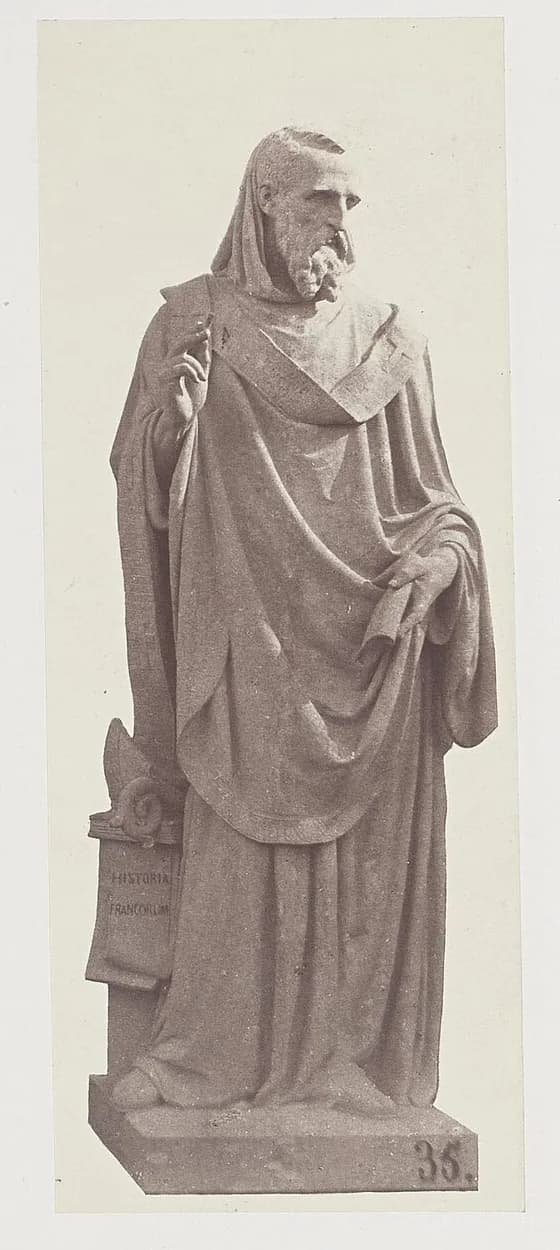
- Chief work
- The History of the Franks, in ten books 1
- Also wrote
- Seven books of miracles, lives of the Fathers, a commentary on the Psalms, a book on the course of the stars 1
Saint Gregory of Tours was a Gallo-Roman nobleman from Auvergne who became bishop of Tours in 573 and spent twenty years protecting his city from the wars of the Merovingian kings. 1 In the same years he wrote the History of the Franks, ten books without which, the Catholic Encyclopedia says, the origin of the Frankish monarchy "would be to no small extent unknown to us." 1 The French bishops' Nominis page calls him the first historian of France, and the Roman Martyrology keeps him on November 17. 35
A boy from Clermont
He was born in 538 or 539 at Arverni, the modern Clermont-Ferrand, into a distinguished Gallo-Roman family. 1 The Diocese of Clermont says the family had already given the Church a martyr and several bishops. 2 His name at first was Georgius Florentius. He took the name Gregory later, in memory of his mother's grandfather, Gregory, bishop of Langres. 1
His father died while he was young, and he was sent to live with his uncle Gallus, the bishop of Clermont, who saw to his schooling. 1 Another uncle, Nicetius, was bishop of Lyon. 2 An unexpected recovery from a serious illness turned the boy's mind toward serving the Church. 1 When Gallus died in 554, Gregory's mother went to live in Burgundy and left him at Clermont with a priest named Avitus, later bishop there himself, who set him to studying the Scriptures. 1
Gregory complained all his life that he had been taught too little grammar and rhetoric, that he mixed up his genders and used the wrong cases. The encyclopedia does not believe him: "it is a mere affectation on his part when he poses as ill-instructed." 1 The Diocese of Clermont adds that he served as a deacon at the basilica of Saint Julian at Brioude before he was a bishop. 2
Bishop of Tours
Euphronius, bishop of Tours, died in 573, and Gregory succeeded him. 15 The sources tell his coming to Tours in two ways. Nominis says that he went there to be healed at the tomb of Saint Martin and stayed. 3 The encyclopedia says that King Sigebert, who knew him and by then held the city, insisted that he accept, in deference to the wishes of the people of Tours. 1 The poet Venantius Fortunatus greeted the new bishop with a poem addressed to the citizens. 1
Tours held the tomb of Saint Martin and was, the encyclopedia says, one of the hardest sees to govern, because it kept changing masters. Chilperic of Neustria seized it in 573, lost it, took it again and lost it again, and held it for good only after Sigebert was assassinated. 1 Gregory took no direct part in these wars, but he wrote down what they did to his people. Of the war between Sigebert and Chilperic he wrote that it "has been more hurtful to the Church than the persecution of Diocletian." 1
He also rebuilt. The cathedral of Tours had burned under his predecessor, and Gregory raised it again and restored and decorated another of the city's churches. 1
A bishop among kings
The encyclopedia draws the age in hard colors: chiefs who took what they wanted, drunkenness in every class, vengeance without restraint, and a civil government that had stopped doing its work. Bishops stepped into the gap, and kings came to depend on them. 1 They were also slow to rebuke their masters. Gregory himself once told a king, "If one of us were to leave the path of justice, it would be for you to set him right; should you, however, chance to stray, who could correct or resist?" 1
He did not love Chilperic, and Chilperic hated him. A man the encyclopedia calls Leudot, who had lost his office through Gregory's complaints, accused the bishop of slandering Queen Fredegunde. Gregory was summoned before judges and swore to his innocence, and he carried himself so well that Chilperic was milder with him ever after. 1
Chilperic died in 584, and Tours passed to Guntram, king of Burgundy, who had long known and trusted Gregory. The encyclopedia calls what followed "an era of peace and almost of happiness." 1 In 587 the Treaty of Andelot gave the city to Sigebert's son Childebert II. He and his mother Brunehaut called Gregory often to court and sent him on missions, and that favor lasted until he died. 1 The encyclopedia's verdict on his years as bishop is short: "In him the Merovingian episcopate appears at its best." 1
The History of the Franks
He began to write as soon as he was a bishop, and he began with the miracles of Saint Martin. 1 He summed up his own works himself: ten books of history, seven of miracles, one of lives of the Fathers, a commentary on the Psalter, and one on the Church's liturgy. 1 His book on the courses of the stars had a practical purpose, which was to tell from their position when the night office should be sung. 1 The encyclopedia article on Fortunatus adds that it was Gregory who persuaded the poet to collect and publish his verses. 6
The History runs from Adam to his own day. The first book reaches the death of Saint Martin, the second is given to Clovis, and the last six cover the years from 575 to 591, which he lived through. 1 The encyclopedia is frank about its limits. Gregory could not trace effects to causes or weigh motives, and his eye went to crimes, wars and wonders more than to ordinary life. Its praise is as plain: "He tells a plain unvarnished tale of what he saw and heard." Apart from what concerned himself, it adds, he tried to state the truth impartially. 1 Nominis describes the book as stormy, passionate in its judgments and surprisingly respectful of the facts. 3
He believed, like nearly everyone around him, that God and the saints acted directly and daily in human affairs, and his books are full of miracles at tombs. 1 He was not simply credulous, though. He knew that frauds traded on people's faith, and he tells of an abbot who punished a young monk for thinking he had worked a miracle: "endeavour in all humility to grow in the fear of the Lord, instead of meddling with miracles." 1
He died at Tours on November 17. The encyclopedia gives the year as 593 or 594. The Diocese of Clermont and the Martyrology entry printed by Nominis say 594, while the heading of the Nominis page and the Diocese of Tours's list of its bishops say 595. 1234
What is Saint Gregory of Tours the patron saint of?
Saint Gregory of Tours's feast day
The Roman Martyrology lists Saint Gregory of Tours on November 17, the day he died, and Nominis records that date as a local feast. 135 The Diocese of Clermont says it celebrates him on November 16. 2 He is not on the general Roman calendar, which on November 17 keeps the memorial of Saint Elizabeth of Hungary. 5
Praying with Saint Gregory of Tours
Gregory is an odd saint to pray with, because most of what is known of him is what he chose to write down, and he wrote about other people. The Martyrology remembers him in one line for that work: he succeeded Euphronius and wrote a history of the Franks in a clear and simple style. 5
He did not pretend the times were better than they were. His pages are full of murders, sieges and royal crimes, set down by a man who had to go on dealing with the people who committed them. 1 The encyclopedia thinks he missed the quieter goodness that must also have been there, and it says so. 1
What he had instead of detachment was loyalty to a place. He stayed in a city that changed hands again and again, stood trial in front of a king who disliked him, and rebuilt the cathedral. 1
The Diocese of Clermont's prayer for his day asks, through his example, for the courage to get through trials. 2 It suits a bishop who wrote one book to tell from the stars when to sing the night office and ten more to record what he saw. 1
Saint Gregory of Tours, pray for us.
Sources
- 1.Henri Leclercq, "St. Gregory of Tours," The Catholic Encyclopedia, vol. 7 (New York: Robert Appleton Company, 1910).
- 2."Saint Grégoire de Tours," Diocèse de Clermont (in French).
- 3."Saint Grégoire de Tours," Nominis, Conférence des évêques de France (in French).
- 4."Son histoire," Diocèse de Tours, with the list of the bishops of Tours (in French).
- 5.Roman Martyrology entry for November 17, "Santo del giorno," Chiesa Cattolica Italiana (in Italian).
- 6.Paul Lejay, "Fortunatus," The Catholic Encyclopedia, vol. 6 (New York: Robert Appleton Company, 1909).
Saints to turn to next
Others in this collection who are turned to for some of the same things.
- Saints Cyril and MethodiusCyril c. 827 - 869; Methodius c. 826 - April 6, 885Study and teachingCourageWork and vocation
- Saint Józef BilczewskiApril 26, 1860 - March 20, 1923Study and teachingWork and vocationCourage
- Saint Marguerite BourgeoysApril 17, 1620 - January 12, 1700Study and teachingWork and vocationCourage
- Saint Rose Philippine DuchesneAugust 29, 1769 - November 18, 1852CourageWork and vocationStudy and teaching