Saint Józef Bilczewski
April 26, 1860 - March 20, 1923
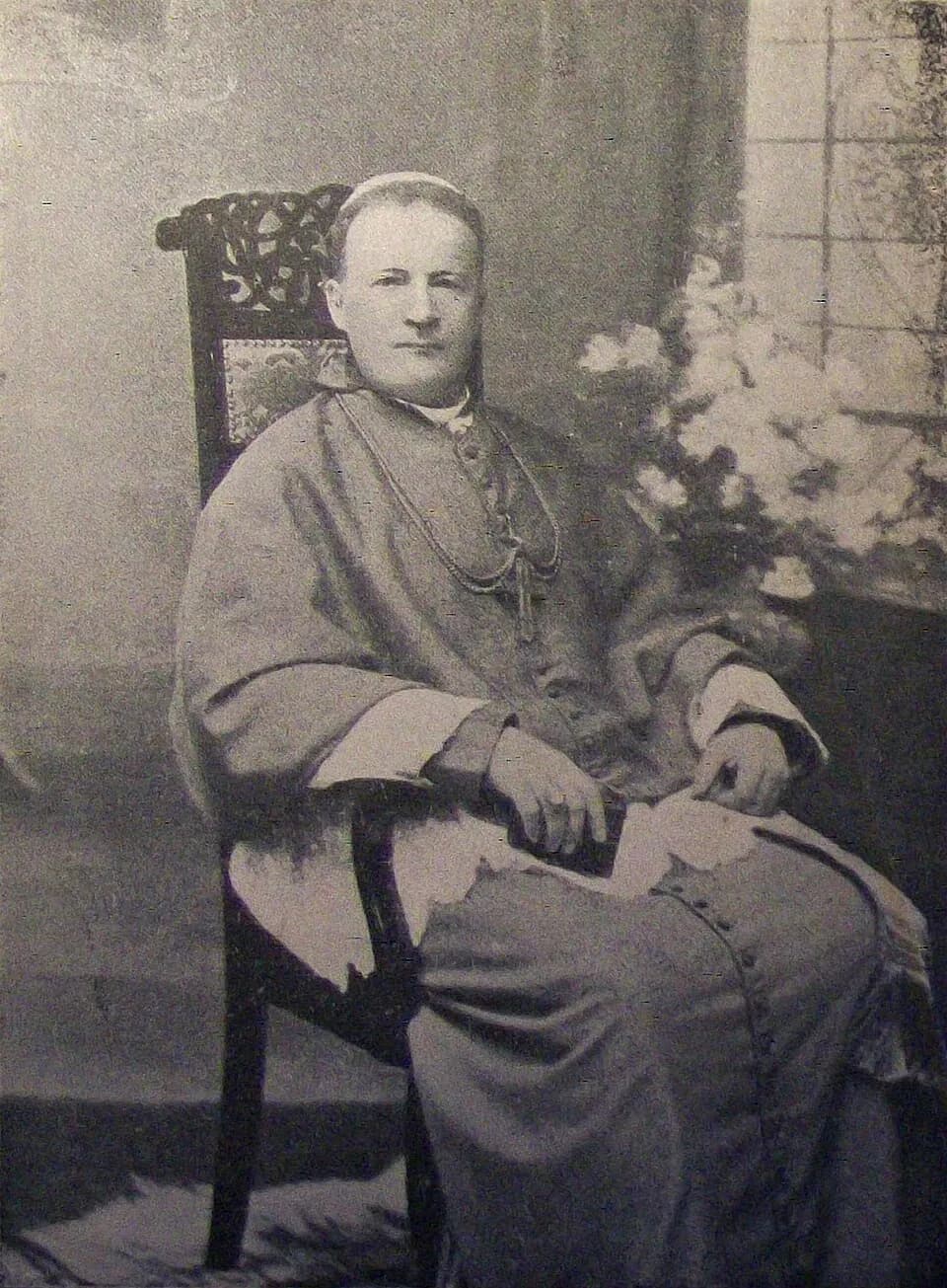
- Feast day
- March 20, as the National Shrine of Our Lady of Champion keeps it 6; October 23, the liturgical memorial kept at his birthplace and listed as an optional memorial in Krakow 7810
- Archbishop of Lviv (Latin rite)
- Named December 17, 1900 by the 2005 Holy See biography, December 18 by the 2001 biography 23
- Buried
- Janów cemetery, Lviv, where the poor were buried; his heart in the chapel of Blessed Jakub in Lviv cathedral 47
- Canonized
- October 23, 2005, in St. Peter's Square, by Benedict XVI 1
- Patron of
- Wilamowice, his hometown, as the Diocese of Bielsko-Żywiec states 9
Saint Józef Bilczewski was a professor of dogmatic theology who became the Latin-rite Archbishop of Lviv (Lwów) in 1900 and led the archdiocese for twenty-three years, through the First World War and the wars that followed it, until his death in 1923. 23 He asked to be buried in the city's cemetery for the poor. 24 Benedict XVI, canonizing him in 2005, said his "deep knowledge of theology, faith and Eucharistic devotion" made him "an example for priests and a witness for all the faithful." 1
From Wilamowice to Vienna
He was born on April 26, 1860, in Wilamowice, near Kęty, then in the Diocese of Krakow. 2 The 2001 Holy See biography says he came from a peasant family and was the eldest of nine children. 3 He went to elementary school in Wilamowice and Kęty, and to the high school at Wadowice, where he finished in 1880. 2 The Diocese of Bielsko-Żywiec, which now takes in his birthplace, notes that John Paul II was a pupil of the same school, and that it was he who set the date of the canonization. 9
He entered the seminary in Krakow in August 1880 and was ordained a priest there on July 6, 1884, by Cardinal Albin Dunajewski. 23 Two years later he took a doctorate in theology at the University of Vienna. 2 He went on to Rome and Paris, where, the 2001 biography says, he specialized in dogmatic theology and Christian archaeology. 3
Professor and rector in Lviv
In 1891 he became professor of dogmatic theology at the University of Lviv, the John Casimir University. 23 He served as dean of theology and then as rector of the university. 2 The 2005 biography says he "arduously dedicated himself to scientific work and, despite his young age, acquired notoriety as a learned man," and that his students and colleagues valued him. 2
John Paul II, beatifying him, described the scholarship as a form of charity: his "burning passion for revealed Truth" led him "to make theological research an original way of translating the command to love God into practical behaviour." 4 The same homily says he was especially concerned for the poor and kept warm relations with colleagues and students, who returned "esteem and affection." 4
Archbishop of Lviv
According to the 2005 biography, Emperor Francis Joseph of Austria proposed him to the Holy See for the vacant see, and Leo XIII named him Archbishop of Lviv of the Latin Rite on December 17, 1900, at forty. 2 The 2001 biography dates the appointment to December 18. 3 John Paul II recalled the consecration itself: he was consecrated by Cardinal Jan Puzyna of Krakow, with Józef Sebastian Pelczar, Bishop of Przemyśl, and Andrzej Szeptycki, the Greek Catholic Archbishop, as co-consecrators. 4 "Was this not an amazing event?" the pope asked. 4
The 2005 biography sums up his program as "totally sacrifice oneself for the Holy Church." 2 He wrote pastoral letters on faith, morals and the social questions of the day, pressed devotion to the Eucharist and frequent Communion, and urged his priests toward adoration of the Blessed Sacrament. 2 He promoted the building of churches, chapels, schools and day-care centers. 2 In Wilamowice he founded a kindergarten, and the diocese reports its children among those at his memorial there in 2017. 7 Preaching there in 2019, a priest of the diocese singled out his pastoral letter of 1903, drawn from Leo XIII's Rerum novarum, in defense of workers. 8 The 2005 biography says that on social questions "he always stood on the side of the people and of the poor." 2
Benedict XVI described the inner life behind it: "St Jozef Bilczewski was a man of prayer. The Holy Mass, the Liturgy of the Hours, meditation, the Rosary and other pious practices formed part of his daily life. A particularly long time was dedicated to Eucharistic adoration." 1 The diocese adds that he carried a relic of Blessed Jakub Strzemię, a Franciscan of the fourteenth century, in the inner pocket of his cassock whenever he went out. 7 John Paul II notes that Jakub had led the same Church from 1391 to 1409. 4
War years
The two Holy See biographies describe his wartime ministry differently. The 2001 biography says he faced "the conflicts of the First World War" and "often intervened with the civil authorities on behalf of Poles, Ukrainians and Jews." 3 It continues: "The Polish-Ukrainian War (1918-19) brought a new wave of violence to the people and many priests were killed or put in prison. Then the Bolshevik invasion (1919-20) was unleashed with all its fury against the Catholic Church. He stood firm to protect one and all without distinctions of race or religion." 3 It counts about 120 priests lost to the archdiocese between 1918 and 1921. 3
The 2005 biography stresses the peace within his own work: "No religious or nationalistic conflicts arose during the tenure of his pastoral work. He was a proponent of unity, harmony and peace." 2 During the First World War, it says, "when souls were overtaken with hate," he preached the love of God that forgives every sin, and the commandment of brotherly love. 2 The Krakow parish calendar says he eased national conflicts in the archdiocese. 10
John Paul II called him "a living icon of the Good Shepherd" in that period, and said he "was loved and esteemed by all his fellow citizens, regardless of their religious convictions, rite or nationality." 4 Beatifying him in Lviv in 2001, the pope turned that into an appeal to both Polish and Ukrainian Christians there: "It is time to leave behind the sorrowful past." 4
Death, burial and canonization
He died in Lviv on March 20, 1923. 23 The 2001 biography says he was seriously ill and "accepted sickness calmly and courageously." 3 He wanted to lie among the poor, and was buried in the Janów cemetery, which the 2005 biography calls "the cemetery of the poor." 24 His embalmed heart was placed in the chapel of Blessed Jakub in Lviv cathedral. 7
John Paul II declared his heroic virtue on December 17, 1997. 2 In June 2001 the Congregation for the Causes of Saints accepted as miraculous the healing of Marcin Gawlik, a nine-year-old boy with third-degree burns, and the beatification followed in Lviv on June 26, 2001, during the pope's visit to Ukraine. 2 John Paul II noted that he stood in the pope's own line of apostolic succession: he had consecrated Archbishop Bolesław Twardowski, who ordained Bishop Eugeniusz Baziak, from whom John Paul II received episcopal ordination. "Today, therefore, I too am receiving a new patron," he said. 4
Benedict XVI canonized him in St. Peter's Square on October 23, 2005, with Zygmunt Gorazdowski, Alberto Hurtado, Gaetano Catanoso and Felix of Nicosia. 1 In 2023, marking the centenary of his death, the Roman Catholic bishops of Ukraine gathered in Lviv cathedral, where his relics are kept, and Archbishop Mieczysław Mokrzycki asked for prayer for peace there, Vatican News reported. 11
What is Saint Józef Bilczewski the patron saint of?
The Diocese of Bielsko-Żywiec calls him the patron of Wilamowice, the town where he was born; his statue stands in its center and the town keeps the only sanctuary dedicated to him in Poland. 9 No source consulted names a wider patronage. Benedict XVI, greeting the pilgrims from Ukraine the day after the canonization, entrusted "the Church in Ukraine and all the Ukrainian People to the protection of these Patronal Saints," and in the same address entrusted the faithful of the Church in Poland to their protection. 5 That is a prayer of entrustment, and this page reports it as one rather than as a formal patronage.
Saint Józef Bilczewski's feast day
The sources give two dates. The National Shrine of Our Lady of Champion in Wisconsin, which holds a relic of him, gives his feast as March 20, the day he died. 6 In Poland, the Diocese of Bielsko-Żywiec reports the liturgical memorial kept at Wilamowice on October 23, the anniversary of the canonization, and the liturgical site of St. Casimir's parish in Krakow lists October 23 as an optional memorial. 7810 Both are given here.
Praying with Saint Józef Bilczewski
Benedict XVI put the scholarship and the devotion in one sentence, "deep knowledge of theology, faith and Eucharistic devotion," and the sources treat them as one life. 1 He spent long hours in adoration and also wrote about the rights of workers; he was a university rector and asked for a pauper's grave. 128 None of the sources treats any of these as being at odds with the others.
His years as archbishop took in a world war and the fighting that came after it. The 2001 biography records priests killed and imprisoned and about 120 lost to the archdiocese, and it records him intervening for Poles, Ukrainians and Jews alike. 3 The sources do not describe how the war years affected him inwardly, and this page does not guess.
John Paul II, beatifying him in the city where he served, used his memory to ask two peoples to forgive one another: "May pardon given and received spread like a healing balm in every heart." 4 That request was addressed to the living. A century after his death, Archbishop Mokrzycki asked the faithful gathered at his relics in Lviv to pray for peace in Ukraine. 411
Saint Józef Bilczewski, pray for us.
Sources
- 1.Benedict XVI, Homily for the Conclusion of the Synod of Bishops and the Year of the Eucharist, and the Canonization of Józef Bilczewski, Gaetano Catanoso, Zygmunt Gorazdowski, Alberto Hurtado Cruchaga and Felix of Nicosia, St. Peter's Square, October 23, 2005.
- 2."Joseph Bilczewski (1860-1923)," biography published by the Holy See for the canonization of October 23, 2005.
- 3."Jozef Bilczewski (1860-1923)," biography published by the Holy See for the beatification of June 26, 2001.
- 4.John Paul II, Homily at the Eucharistic Celebration in the Latin Rite and Beatifications, Lviv, June 26, 2001.
- 5.Benedict XVI, Address to Pilgrims Who Had Come to Rome for the Canonization of Five New Saints, Paul VI Audience Hall, October 24, 2005.
- 6."St. Joseph Bilczewski," events calendar, The National Shrine of Our Lady of Champion, Champion, Wisconsin.
- 7.Robert Karp, "Relikwie bł. Jakuba Strzemię na liturgiczne wspomnienie św. abp. Bilczewskiego," Diocese of Bielsko-Żywiec, October 23, 2017 (in Polish).
- 8.Robert Karp, "Uroczystości odpustowe ku czci św. abp. Józefa Bilczewskiego," Diocese of Bielsko-Żywiec, October 23, 2019 (in Polish).
- 9.Robert Karp, "Wtorkowe nabożeństwa przed 100. rocznicą śmierci św. abp. Józefa Bilczewskiego," Diocese of Bielsko-Żywiec, January 4, 2022 (in Polish).
- 10."23.10 - Wspomnienie św. Józefa Bilczewskiego," Kerygma, liturgical and catechetical service of St. Casimir's Parish, Krakow (in Polish).
- 11.Mariusz Krawiec, "Ukraina: modlitwa o pokój przez wstawiennictwo św. Józefa Bilczewskiego," Vatican News (Polish service), March 18, 2023.
Saints to turn to next
Others in this collection who are turned to for some of the same things.
- Saint Katharine DrexelNovember 26, 1858 - March 3, 1955Poverty and simplicityWork and vocationPrayerCourage
- Saint Nuno Álvares PereiraJune 24, 1360 - April 1, 1431CourageWork and vocationPoverty and simplicityPrayer
- Saint Peter Damian1007 - February 21, 1072Study and teachingPrayerCouragePoverty and simplicity
- Saint Rose Philippine DuchesneAugust 29, 1769 - November 18, 1852PrayerCourageWork and vocationStudy and teaching