Saint Nuno Álvares Pereira
June 24, 1360 - April 1, 1431
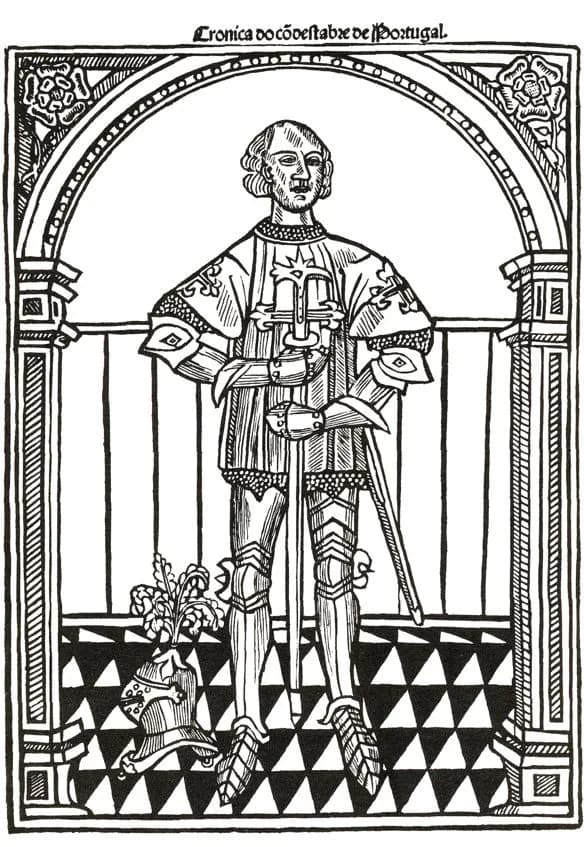
- Born
- June 24, 1360, most probably at Cernache do Bomjardin, Portugal 1; Bomjardin near Lisbon in other accounts 46
- Also known as
- Brother Nuno of Saint Mary; "O Santo Condestavel," the Holy Constable 1
- Beatified
- December 23, 1918, by the decree Clementissimus Deus of Benedict XV 1
Saint Nuno Álvares Pereira commanded the army that kept Portugal independent of Castile, and at the battle of Aljubarrota in 1385 he ended the war. 18 Thirty-eight years later he gave away what was left of his fortune and entered, as its lowest-ranking brother, the Carmelite convent he had paid for in Lisbon. 1 He died there on Easter Sunday, 1431, and the people at once acclaimed him a saint, calling him the Holy Constable. 1 Benedict XVI, canonizing him in 2009, called him "a hero and saint of Portugal." 2
A knight by royal decree
Nuno was born on June 24, 1360, according to the Holy See "most probably" at Cernache do Bomjardin; the Irish Carmelites and the Catholic News Herald place his birth at Bomjardin, near Lisbon. 146 He was illegitimate. His father, Álvaro Gonçalves Pereira, was a professed Knight Hospitaller of St. John of Jerusalem and prior of Crato, and his mother was Iria Gonçalves do Carvalhal. 1 The Herald, in a biography by a Lay Carmelite, adds that the prior fathered thirty-two children outside marriage and that Nuno's grandfather was archbishop of Braga. 6
About a year after his birth a royal decree made him legitimate, which opened a knight's education to him. 1 At thirteen he was a page to Queen Leonor and was knighted at court. At sixteen, because his father wished it, he married a rich young widow, Leonor de Alvim. 1 They had three children. The two boys died young; the girl, Beatriz, grew up to marry Afonso, the first Duke of Bragança and a son of King João I. 1 The Irish Carmelites point out what followed from that marriage: it connects Nuno with many of the royal houses of Europe. 4
The war for the crown
King Fernando of Portugal died without an heir on October 22, 1383. 1 His brother João claimed the crown, and so did the king of Castile, who had married the dead king's daughter (the Herald calls her João's sister). 16 Nuno took João's side. The Herald says he did so because he would not see Portugal absorbed into Castile, and that several of his own brothers backed the Castilian. 6
The Holy See has João choose him as constable, commander in chief of the army, and Nuno then lead it to a string of victories. 1 The Herald dates the appointment to after the battle of Atoleiros in 1384, when he was twenty-five; the Irish Carmelites have King João grant the title after both Atoleiros and Aljubarrota, with lands and properties to go with it, his chief castle at Ourém, close to present-day Fátima. 46 All of them agree on the end. At Aljubarrota, on August 14, 1385, the Portuguese won, and the war was over. 16
Benedict XVI set the battle in a longer story. Nuno's seventy years, he said, saw the nation "consolidate its independence from Castille and expand beyond the ocean," opening routes that would carry the Gospel "to the ends of the earth." 2
A soldier who prayed
The Holy See describes his military gifts as "tempered by a deep spirituality," and names two foundations of it: the Eucharist and the Blessed Virgin. 1 He fasted in Mary's honor on Wednesdays, Fridays and Saturdays and on the vigils of her feasts. 1 The banner he took as his own bore the cross, Mary, and the two knightly saints James and George. 16 Benedict XVI said that he "publicly attributed his victories" to Our Lady. 2
The Herald adds what this looked like in camp. He knelt to pray on the field of battle, urged his men to receive the sacraments as often as they could, and discouraged the vices that were common among soldiers of his day. 6 "Although he was an excellent soldier and a great leader," the pope said, "he never permitted these personal talents to prevail over the supreme action that comes from God." 2
His wife died in 1387. He did not marry again. 1 When peace came he gave most of his wealth to the veterans who had fought with him, and he built churches at his own expense, among them the Carmelite church in Lisbon and the church of Our Lady of Victories at Batalha. 14
Brother Nuno of Saint Mary
In 1423, aged sixty-three, he gave up the rest of what he owned and entered the Carmelite convent he had founded in Lisbon - on August 15, the Herald says. 146 He took the name Brother Nuno of Saint Mary. 1 The man who had been constable, commander of the army and founder of the house asked for no privileges, according to the Holy See, and chose "the humblest rank of a lay brother." 1 The Carmelite general curia calls his status that of a "semifrater," a sort of lay brother, and the Irish Carmelites say he took the humble post of porter. 34 In the Holy See's phrase, he left "the weapons of war and power in order to be vested in spiritual armor as the Rule of Carmel recommends." 1
Leaving the world turned out to be harder than entering a convent. He wanted to go to a community far from Portugal, and Duarte, the king's son, would not let him. 1 Former soldiers who had followed him into the Order could not bring themselves to treat their old commander as one more brother, and because he belonged to the royal family the king forbade, as unseemly, his habit of walking through the city in his Carmelite habit handing money to the poor. 3 For the poor he organized a daily distribution of food. 1 The curia notes that the Carmelite Province of Portugal, which first appears at the Order's general chapter of 1425, owes its existence to him. 3
He died on Easter Sunday, April 1, 1431. 1 The Herald says King João came to his bedside, and that Nuno asked to hear the Passion from the Gospel of John, dying as the reader reached the words "Behold thy Mother!" 6 His epitaph, as the curia gives it, called him "excellent general, blessed monk," a man who "was a great Prince, but he made himself a humble monk." 3
From the Holy Constable to the altar
The people acclaimed him a saint at once. 1 The road to canonization was slower. Portuguese kings and then the Carmelites took up his cause, and obstacles kept getting in the way; only in 1894 did the Carmelite postulator Anastasio Ronci open the process to recognize his cult as immemorial, which ended with Benedict XV's decree Clementissimus Deus on December 23, 1918. 1 His relics moved more than once, and after a pilgrimage in 1961 the silver reliquary that held them was stolen and never found. 1 In 1996 the site of his original tomb was rediscovered, with authenticated fragments of bone. 1
The Holy See says the cause was supported by an approved miracle "in the year 2000"; the curia says it was the cure of a blind woman. 13 Benedict XVI proclaimed it on July 3, 2008, and canonized him on April 26, 2009, the only one of the five saints raised that day who was not Italian. 18 The church he gave the Carmelites was mostly destroyed in the earthquake of 1755, and the old convent now houses Portugal's National Republican Guard. 3
What is Saint Nuno the patron saint of?
None of the sources read for this page names Saint Nuno patron of anything, and the page does not supply one. Benedict XVI called him "a hero and saint of Portugal," and Vatican Radio said he is regarded as a national hero there. 28 The Carmelites claim him as one of their own: the curia calls him "Portugal's greatest military hero and one of the Order's most dedicated sons." 3
Saint Nuno's feast day
Saint Nuno's feast day is November 6. The Carmelite general curia celebrates his memorial on that date, the Irish Carmelites list it, and the Discalced Carmelite friars keep it as an optional memorial in their proper calendar. 345 The Roman Martyrology, as quoted by Catholic.net, enters him instead on April 1, the day he died, as one who was first placed in charge of the defense of the kingdom and afterward received among the oblate brothers of the Carmelite Order. 7 Catholic.net adds that in Portugal he is remembered from November 1 to 6. 7
Praying with Saint Nuno
Benedict XVI chose him as an example for the whole Church for a stated reason: he lived his faith "in contexts apparently unfavourable to it," and showed that "in any situation, even military or in war time, it is possible to act and to put into practice the values and principles of Christian life." 2 The quality the pope picked out in him was "an intense life of prayer and absolute trust in divine help." 2
The war was not abstract to him. Several of his own brothers took the other side. 6 He won, was honored, was rich, and then gave the money to the men who had done the fighting, and later gave the rest away as well. 1 He grieved two sons and a wife and lived on for more than forty years after her. 1
A man used to command asked for the lowest place in a house he had built, and found that even that was hard to get: his old soldiers could not treat him as one more brother, a prince would not let him leave the country, and the king stopped him handing out alms in the street. 13 What remained to him was the daily food for the poor at the convent, and he kept it going. 1
He died on Easter, listening to Christ give his mother to the beloved disciple. 16 Benedict XVI put the secret of his life in a verse of the psalm read that day: "Know that the Lord has set apart the godly for himself; the Lord hears when I call to him." 2
Saint Nuno Álvares Pereira, pray for us.
Sources
- 1."Nuno de Santa Maria Álvares Pereira (1360-1431) - Biography," Office of the Liturgical Celebrations of the Supreme Pontiff, The Holy See, for the canonization of April 26, 2009.
- 2.Benedict XVI, Homily for the Canonization of Arcangelo Tadini, Bernardo Tolomei, Nuno de Santa Maria Álvares Pereira, Geltrude Comensoli and Caterina Volpicelli, St. Peter's Square, April 26, 2009.
- 3."Memorial of St. Nuno Alvares Pereira," CITOC announcements, Curia Generalizia dei Carmelitani (Carmelite General Curia), November 5, 2021.
- 4."Saint Nuno de Santa Maria Alvares Pereira," Irish Province of Carmelites.
- 5."November," Discalced Carmelite Proper Calendar, Discalced Carmelite Friars.
- 6.Penny Watkins, T.O.Carm., "St. Nuno Álvares Pereira, also known as St. Nuno of Saint Mary," Catholic News Herald (Diocese of Charlotte), November 4, 2019.
- 7."Nuño de Santa Maria Alvares Pereira, Santo," Santoral, Catholic.net, quoting the Roman Martyrology (in Spanish).
- 8."Pope Creates 5 New Saints for the Church," Vatican Radio, April 27, 2009.
Saints to turn to next
Others in this collection who are turned to for some of the same things.
- Saint Józef BilczewskiApril 26, 1860 - March 20, 1923Work and vocationCouragePrayerPoverty and simplicity
- Saint Katharine DrexelNovember 26, 1858 - March 3, 1955Poverty and simplicityWork and vocationPrayerCourage
- Saint André BessetteAugust 9, 1845 - January 6, 1937PrayerWork and vocationPoverty and simplicity
- Saint Anthony Mary ClaretDecember 23, 1807 - October 24, 1870Work and vocationCouragePrayer