Saint Marguerite Bourgeoys
April 17, 1620 - January 12, 1700
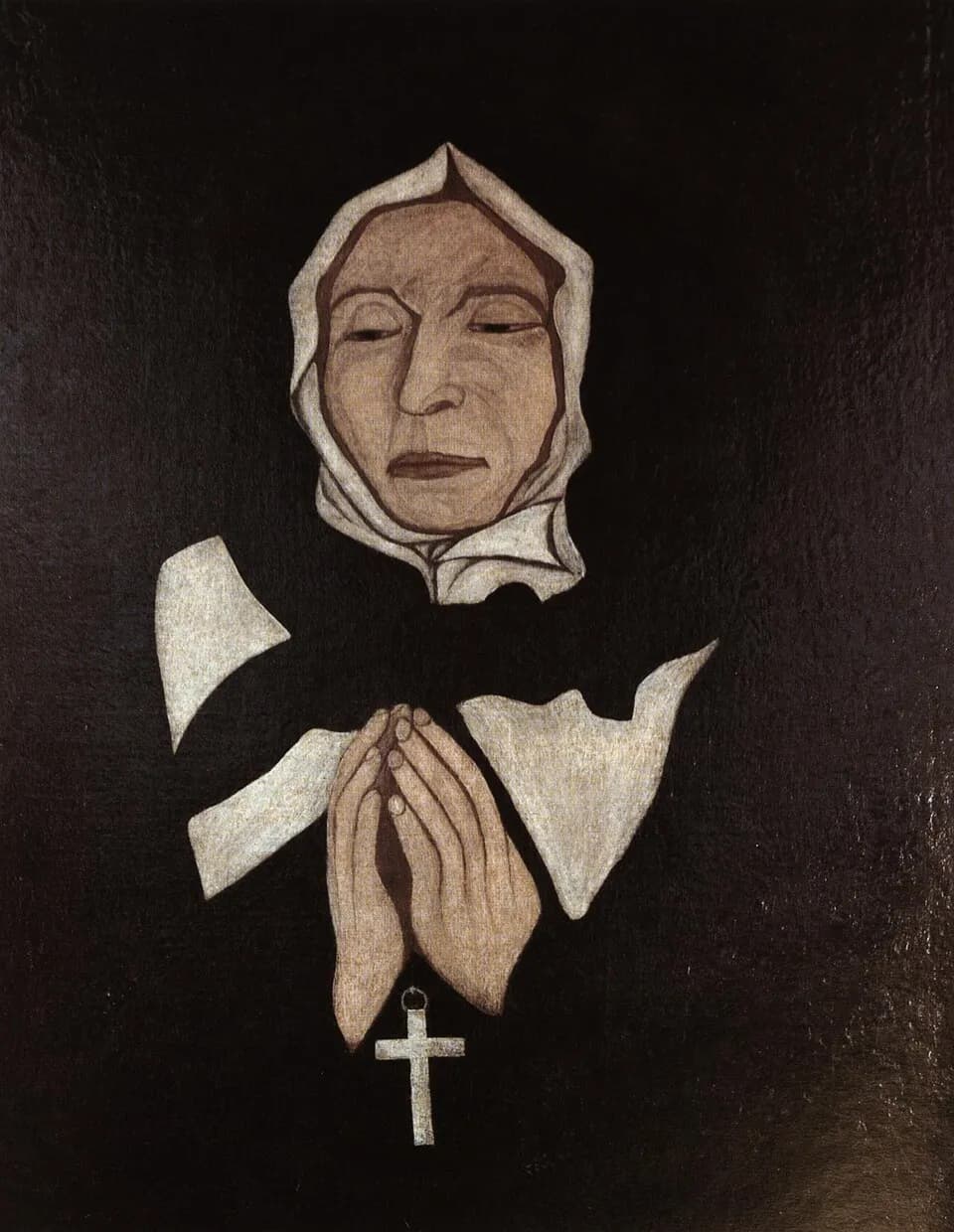
- Arrived in Montreal
- November 16, 1653 2
- First school
- Opened in a stable at Ville-Marie in 1658, or on April 30, 1657, by the encyclopedia's date 123
- Beatified
- November 12, 1950, by Pope Pius XII 2
Saint Marguerite Bourgeoys crossed the Atlantic in 1653 to teach the children of Ville-Marie, the settlement that became Montreal, and opened its first school in a stable. 23 The community of teaching women she gathered there, living without a cloister, became the Congrégation de Notre-Dame of Montreal, and the colonists came to call her the "Mother of the Colony". 23 John Paul II canonized her on October 31, 1982, and her feast is January 12. 23
Troyes
She was born at Troyes, in Champagne, on April 17, 1620, which the Vatican's canonization biography notes was Good Friday, and she was baptized the same day in the church of Saint-Jean. 12 Her father was Abraham Bourgeoys, whom the Catholic Encyclopedia calls a merchant, and her mother was Guillemette Garnier. 1 The sources count the children differently: the encyclopedia makes her the third child, while the Vatican biography and Franciscan Media make her the sixth of twelve. 124
Her mother died when Marguerite was nineteen. 2 The next year, on October 7, 1640, during a procession in honor of Our Lady of the Rosary, she looked at a statue of the Virgin and felt moved to give herself to the service of God. 2 The bishops of Canada quote her own words for what the sight did: it "touched and changed" her. 3
Franciscan Media reports that she applied to the Carmelites and to the Poor Clares without success, and that a priest suggested God might have other plans for her. 4 She joined the extern Congregation of Troyes, an association of young women who taught children in the poor districts of the town. 2 It was connected to a convent of Augustinian canonesses, and one of the canonesses was the sister of the governor of a French settlement in Canada. 4 At twenty-three Marguerite made a vow of chastity. 3
She was already thinking about a way of life that did not yet exist. The Canadian bishops' profile quotes her wish to honor "the life in the world of the Holy Virgin", in a community where "without a veil or a wimple, one would be a true religious." 3
Ville-Marie
Paul de Chomedey de Maisonneuve, the founder and governor of Ville-Marie, came to Troyes looking for someone to teach the children of his settlement. The Vatican biography and the Canadian bishops date their meeting to 1652, the encyclopedia to 1653 and Franciscan Media to 1654. 1234 She offered to go. 3 The Vatican biography says that Our Lady confirmed the call with the words "Go, I will not forsake you". 2
She left Troyes in February 1653 and reached Montreal on November 16. 2 She was thirty-three and, by the bishops' account, carried only a small bag, and on the voyage she nursed the sick. 3 The colony she found numbered two hundred people, with a hospital and a Jesuit mission chapel. 4 For four years she worked for the governor, helped Jeanne Mance at the Hôtel-Dieu hospital, and gave away her mattress and blankets to people who had less than she did. 3 She also arranged for the cross on Mount Royal to be put up again after it had been destroyed. 2
Maisonneuve gave her a stable, and in it she opened the first school in Montreal. 23 The Vatican biography and the bishops put this in 1658; the encyclopedia gives April 30, 1657. 123 She wanted a place of pilgrimage for the town as well, a chapel of Notre-Dame de Bon Secours. The bishops' profile says she organized its building in 1657 and that it was finished the following year, while the encyclopedia has her building it in 1675. 13
The Congregation of Notre-Dame
A school needed teachers, so she sailed back to France to find them, in 1659 by the bishops' dating. 13 The encyclopedia says four companions returned with her; Franciscan Media counts three, among them her friend Catherine Crolo. 14 A boarding school and what the encyclopedia calls an industrial school followed, and classes for Native children, with girls of the Iroquois nation among the pupils. 134 A second voyage, in 1670 by the encyclopedia and 1671 by the bishops, brought back six more women and letters from King Louis XIV authorizing the work. 134
From 1659 she also received the young women sent out from France to marry and settle in Montreal, some of them with dowries from the king, the "filles du roi". 23 The Vatican biography says she became a real mother to them. 2 Her companions housed them at the Saint-Gabriel farm while they became acquainted with the men of the colony. 3 In school and workshop the sisters taught catechism, the basics of literature, needlework and the household arts. 3
What made the community new was that it had no cloister. The Vatican biography says the women were inspired by the "vie voyagere" of Our Lady and wanted to remain uncloistered, which was an innovation at the time, and that the foundation brought its founder a good deal of suffering. 2 She sent her companions out in pairs to new parishes to open classes for the settlers' children. 3
Bishop François de Laval gave the congregation canonical approval in 1676. 23 Its character was not secure for a long time after that. The encyclopedia records attempts over several years to merge the sisters with the Ursulines, and a third voyage to France to have the uncloistered life and simple vows written into a rule. 1 On that journey, the bishops note, Laval refused to let her recruit any more companions in Europe, and on her return she began to admit Canadian women, two Iroquois among them. 3
Last years
In 1683 the sisters opened a mission on Mount Royal for Native girls, under the priests of Saint-Sulpice. 1 In 1689 Bishop de Saint-Vallier, who had succeeded Laval, wanted to talk to her about a new foundation, and at sixty-nine she walked from Montreal to Quebec through an April thaw. 14
She asked repeatedly to be relieved as superior, and in 1693 the bishop agreed. 1 On June 24, 1698, the sisters formally accepted their rule and constitutions, and the next day they made their vows. 1 She gave the rest of her life to writing advice for the guidance of the congregation. 1
She died in Montreal on January 12, 1700. 123 The Vatican biography says her last generous act was to offer herself in prayer for the recovery of a young sister, and that forty members of the congregation were there to carry on. 2 The encyclopedia counts fifty-four in 1701. 1
Rome declared her venerable on December 7, 1878, and proclaimed the heroism of her virtues on June 19, 1910. 1 Pius XII beatified her on November 12, 1950, and John Paul II canonized her on October 31, 1982, which, the Vatican biography says, gave the Canadian Church "its first woman saint." 2
What is Saint Marguerite Bourgeoys the patron saint of?
None of the four sources used for this page names Saint Marguerite Bourgeoys as the patron of anything, so the page claims no patronage for her. 1234 The title the sources do record is "Mother of the Colony", and the Vatican biography counts her a co-foundress of Montreal alongside Jeanne Mance and Maisonneuve. 23
Saint Marguerite Bourgeoys's feast day
Her feast is January 12, the day she died in 1700. The Canadian Conference of Catholic Bishops lists it on that date, and Franciscan Media has her as its saint of the day for January 12. 34 The encyclopedia, written while she was still Venerable, gives no feast for her and notes only that her sisters chose July 2 as the patronal feast of the congregation. 1
Praying with Saint Marguerite Bourgeoys
A year before she died she wrote the sentence that the Canadian bishops place at the center of her life: "It is true that what I have always wanted most, and most ardently desire, is for the great teaching of the love of God above all things and the love of one's neighbour as one would be loved, to be engraved on all hearts." 3
Her model was Mary as a woman who went out to people. "The Holy Virgin was not cloistered," she wrote, "but she maintained an interior solitude and only left it when it was necessary, to express love or to teach others, or to go to the temple." 3 Her sisters lived much the same way, in the parishes, and the encyclopedia adds that they supported themselves. 13
She was practical about all of it. A historian of the Hôtel-Dieu, quoted by the bishops, wrote that she had "the character of the strong woman of the Gospel", and their profile describes a good businesswoman and manager. 3 The doors that closed on her in Troyes belong to the story too: Franciscan Media observes that she was called to be a foundress and an educator, and that the cloister she first asked for was not her place. 4
None of this was easy for her. In the face of what the bishops call great spiritual struggle she wrote, "I have never doubted God's mercy and I shall hope in him when I see myself with one foot in perdition." 3
Saint Marguerite Bourgeoys, pray for us.
Sources
- 1.Sister St. Euphrosine, "Congregation of Notre Dame de Montreal," The Catholic Encyclopedia, vol. 11 (New York: Robert Appleton Company, 1911).
- 2."Marguerite Bourgeoys (1620-1700)," biography published by the Holy See for her canonization on October 31, 1982.
- 3."Saint Marguerite Bourgeoys (1620-1700)," Canada's Saints and Blesseds, Canadian Conference of Catholic Bishops.
- 4."Saint Marguerite Bourgeoys," Saint of the Day for January 12, Franciscan Media.
Saints to turn to next
Others in this collection who are turned to for some of the same things.
- Saints Cyril and MethodiusCyril c. 827 - 869; Methodius c. 826 - April 6, 885Study and teachingCourageWork and vocation
- Saint Gregory of Toursc. 538 - November 17, c. 594Study and teachingWork and vocationCourage
- Saint Józef BilczewskiApril 26, 1860 - March 20, 1923Study and teachingWork and vocationCourage
- Saint Rose Philippine DuchesneAugust 29, 1769 - November 18, 1852CourageWork and vocationStudy and teaching