Saint Thomas Garnet
c. 1575 - June 23, 1608
- Family
- Son of Richard Garnet; nephew of the Jesuit Henry Garnet, or in Challoner's words his "nephew or near kinsman" 123
- Educated
- Horsham grammar school, the English college at Saint-Omer, and the English College at Valladolid 123
- Canonized
- 1970, by Paul VI, among the Forty Martyrs of England and Wales; beatified in 1929 3
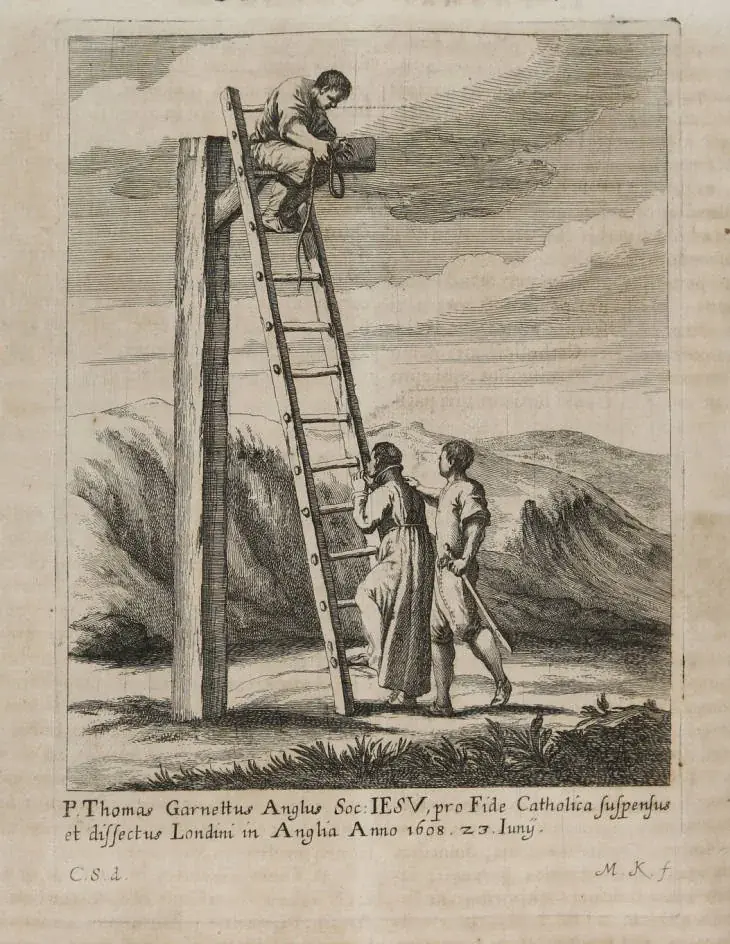
Saint Thomas Garnet was an English Jesuit priest who was hanged at Tyburn on June 23, 1608, for being a priest ordained abroad and refusing the new Oath of Allegiance of King James I. 12 He was the nephew of Henry Garnet, the Jesuit superior executed after the Gunpowder Plot, and the first martyr of the English college at Saint-Omer, which became Stonyhurst. 13 The Roman Martyrology keeps him on June 23. 4
A Catholic family in Elizabethan England
Thomas was born at Southwark about 1575. 13 His father, Richard Garnet, had been at Balliol College, Oxford, in 1569, and his constancy there, the Catholic Encyclopedia says, edified the generation that produced Edmund Campion and Robert Persons. 1 Challoner calls Richard "a constant professor and great sufferer for the Catholic faith," and says he had vowed his son to God and the Church from birth. 2 katolsk.no adds that he was imprisoned for his faith. 3
The boy went to the grammar school at Horsham and then served as a page to one of the half-brothers of Philip Howard, Earl of Arundel, men who had conformed to the established Church; katolsk.no names his master as Lord William Howard. 13 When the English college at Saint-Omer opened in 1592 under the Jesuits, he was sent there; Challoner puts his age at sixteen or seventeen. 12
His uncle, or in Challoner's phrase his "nephew or near kinsman," was Henry Garnet, superior of the English Jesuits. 12 The family connection would shape almost everything that happened to Thomas later.
Ten attempts to reach Spain
By 1595 he was judged ready for the English seminary at Valladolid and set out from Calais in January with five other students and a Jesuit, William Baldwin, traveling in disguise. 1 Storms drove the ship into the Downs, where the queen's ships searched it and found the young men in the hold. 1 Baldwin went to prison, and the students were handed to Archbishop Whitgift, who sent them one by one to Protestant bishops and doctors to be argued out of their faith; only the youngest conformed. 1
The encyclopedia says he fell ill in custody, was sent home on bond to return to Oxford by a set day, and escaped when his jailer failed to appear, after which he had to keep away even from his own father. 1 He reached Saint-Omer again and arrived at Valladolid on March 7, 1596, "having started on that journey no less than ten times." 1
He studied philosophy and theology there and was ordained priest in 1599. 123
On the English mission
Challoner says he was sent back to England in the company of Mark Barkworth, whose own martyrdom Challoner had already told. 2 His own account of the next years, as the encyclopedia quotes it, was simple: "returning to England I wandered from place to place, to reduce souls which went astray and were in error as to the knowledge of the true Catholic Church." 1 Challoner describes him as "remarkably industrious in endeavouring to bring the souls that were under his care to a thorough sense of solid piety." 2
He had long wanted to become a Jesuit, and his uncle admitted him to the Society; katolsk.no dates his entry to 1604. 123 Before he could cross to the Continent for his novitiate, the Gunpowder Plot was discovered, in 1605. 12
Thomas was arrested near Warwick under the name Thomas Rokewood. He was then chaplain to Ambrose Rokewood of Coldham Hall, who had been drawn into the plot. 1 He was held first in the Gatehouse and then in the Tower, where he was handled severely to make him give evidence against his uncle. 1 Challoner says Secretary Cecil examined him "not without severe threats of the rack," and that the questioning turned on a letter he had received from Henry Garnet. 2
Nothing tied him to the conspiracy. 12 The sources differ on how long he was held: seven months in the Tower, according to the encyclopedia, or eight or nine months of close confinement according to Challoner, who adds that lying on the bare ground through the winter left him with rheumatic pains and sciatica for the rest of his life. 12 Henry Garnet was executed in Saint Paul's Churchyard on May 3, 1606. 2
Banished, and back within the year
In the summer of 1606 he was put on a ship with forty-six other priests. A royal proclamation dated July 10, 1606, was read to them, threatening death if they returned, and they were set ashore in Flanders. 13 He went first to Saint-Omer and then to Brussels, where the Jesuit superior was the same William Baldwin who had been captured with him in 1595. 1 Baldwin sent him to the new English novitiate of Saint John at Louvain, where he was the first novice received. 12
In September 1607 he was sent back to England. 1 Six weeks later he was arrested again, betrayed by an apostate priest named Rouse. 12 Challoner says he was examined several times by Thomas Ravis, the Bishop of London, and by Sir William Wade. He neither admitted nor denied that he was a priest, and he refused the new oath. If any Catholics had taken it, he said, they had done so out of fear, and he hoped fear would never make him act against his conscience. 2
The trial at the Old Bailey
He was committed to Newgate and tried at the Old Bailey for high treason, under the Elizabethan statute against priests ordained by authority from Rome who remained in England. 23 Three witnesses testified that while he was a prisoner in the Tower he had written "Thomas Garnet, Priest" in several places. "Upon this slender evidence," Challoner writes, the jury found him guilty. 2
He received the sentence, Challoner says, "with great joy." When a chance to escape was suggested to him, he declined it, "choosing rather to obey a voice within, which said to him, Noli fugere. Don't run away." 2
The encyclopedia sets the case against the larger quarrel of those months, King James's controversy with Cardinal Bellarmine over the Oath of Allegiance. Garnet was offered his life if he would take the oath, and he refused. 1
Tyburn, June 23, 1608
He went out to the hurdle, Challoner says, "more like one that was going to his marriage-feast than to suffer a cruel and ignominious death." 2 At Tyburn the Earl of Exeter, a member of the Privy Council, urged him to save himself by taking the oath, since other priests had taken it and many thought it a disputable matter. Garnet answered: "My lord, if the case be so doubtful and disputable, how can I in conscience swear to what is doubtful as if it were certain? No, I will not take the oath, though I might have a thousand lives." 2
In the cart he kissed the gallows and said that he was a priest and a Jesuit, which he had not admitted at his trial so as not to be his own accuser, and that in nine years on the mission he had never been party to any treason. 2 A minister asked whether he was equivocating. "No, sir," he replied; "for if I had been minded to use equivocations, I might have taken the oath and saved my life." 2 He said he had offered at his trial to swear an oath of allegiance in the old form, and that the new oath contained matters foreign to allegiance. 2
He called it the happiest day of his life, prayed that God would not lay his death to the nation's charge, and asked forgiveness for all who had brought about his condemnation. 2 The encyclopedia records him protesting that he was "the happiest man this day alive." 1 He said the Lord's Prayer, the Hail Mary and the Creed, and began the Veni Creator; the cart was drawn away at the words "sermone ditans guttura." 2
The sources do not agree on what followed. Challoner says the crowd, and the Earl of Exeter in particular, would not let the rope be cut until he was dead. 2 katolsk.no says he was hanged, drawn and quartered. 3 Challoner gives his age as thirty-four. 2 His relics were kept at Saint-Omer and were lost in the French Revolution. 1
Beatification and canonization
What is Saint Thomas Garnet the patron saint of?
Saint Thomas Garnet's feast day
Saint Thomas Garnet's feast day is June 23, the day of his death. The current Roman Martyrology, as the Italian bishops print it, enters him on that day as a priest of the Society of Jesus, ordained at the English College of Valladolid, twice arrested, who went to the gallows at Tyburn under King James I. 4
katolsk.no gives October 25, the joint day of the Forty Martyrs of England and Wales, and notes that he was formerly remembered on June 23. 3 The note New Advent adds to the 1909 encyclopedia article also gives October 25 as the Forty Martyrs' joint feast. 1
Praying with Saint Thomas Garnet
He kept going back. He was captured on his way to the seminary, escaped, and set out again until he got there. 1 He was banished in 1606 and came home the next year, knowing the proclamation said he would die if he did. 1
His last argument was about the conscience. He offered to swear allegiance to the king in the form his forefathers had used, and would not swear to an oath he believed went beyond it. 2 When a lord told him the matter was doubtful, he answered that doubt was exactly why he could not swear. 2
He also refused to lie in order to live. Asked on the scaffold whether he was equivocating, he pointed out that a man willing to equivocate would have taken the oath and walked away. 2
Challoner's account ends with prayer rather than defiance: forgiveness for everyone who had a hand in his death, and the hope of seeing them in heaven. 2 He did not live to finish the hymn he had begun. 2
Saint Thomas Garnet, pray for us.
Sources
- 1.John Hungerford Pollen, "St. Thomas Garnet," The Catholic Encyclopedia, Vol. 6 (New York: Robert Appleton Company, 1909).
- 2.Richard Challoner, "Thomas Garnet, Priest, S.J.," in Memoirs of Missionary Priests, as well Secular as Regular, and of Other Catholics of Both Sexes, that Have Suffered Death in England on Religious Accounts from the Year of Our Lord 1577 to 1684 (London, 1924 edition), pp. 296-299.
- 3."Den hellige Thomas Garnet (~1575 - 1608)," Den katolske kirke, katolsk.no, the Catholic Church in Norway (in Norwegian).
- 4.Roman Martyrology, entries for June 23, Santo del giorno, Conferenza Episcopale Italiana (in Italian).
Saints to turn to next
Others in this collection who are turned to for some of the same things.