Saint Agapitus of Palestrina
d. 274, by tradition
- Died
- Under the emperor Aurelian 13456; on August 18, 274, says the Vatican City State 4; about 275, says Butler 5
- Patron of
- Palestrina and its diocese 148; of its cathedral, says the Catholic Encyclopedia 3; of the abbey of Kremsmünster, says the Metropolitan Museum 9
- Emblems
- A palm, a crown, burning coals, lions or dragons 1
Saint Agapitus is the martyr of Praeneste, the town near Rome now called Palestrina, and its patron. 14 By tradition he was fifteen when he was put to death under the emperor Aurelian, but the sources agree that only two things about him are certain: that he died a martyr, and that he was buried in his own town. 14 The rest is a legend written down two or three centuries later, around a cult that is much older. 1
What is known
The current Roman Martyrology gives him one line on August 18: at Palestrina in Lazio, Saint Agapitus, martyr. 2 The Vatican City State's saint of the day says that all that is known is that he died a martyr at Praeneste and that his cult is documented from very ancient times. 4 katolsk.no puts it the same way: what we know for certain is that he was a martyr and that he was buried at Palestrina. 1
That cult is early. katolsk.no says his name appears in the sacramentaries associated with Pope Gelasius I, at the end of the fifth century, and Pope Gregory the Great, at the end of the sixth, and in old calendars. 1 Alban Butler, writing in the eighteenth century, says the same: "His name is famous in the sacramentaries of St. Gelasius, and St. Gregory the Great, and in the ancient calendars of the church of Rome." 5 Umberto Benigni, in the 1911 Catholic Encyclopedia, writes that "the oldest Christian record of this city relates to the martyrdom of St. Agapitus," which he sets under Aurelian. 3
Butler's whole account is three sentences long. He places the martyrdom at Praeneste, "twenty-four miles from Rome," under Aurelian, "about the year 275," a year later than the 274 that katolsk.no and the Vatican City State give. 145
The legend
katolsk.no dates the written story to the fifth or sixth century. 1 In its telling Agapitus was born at Praeneste in 259, and in 274, at fifteen, he confessed Christ before Antiochus, governor of Palestrina under Aurelian. 1 He was whipped and put in a dungeon; burning coals were laid on his head and boiling water poured over him, and he came through unharmed, praising Christ aloud. 1 He was thrown to the lions, which lay down quietly at his feet. 1 He was hung head down over a fire. 1 At last he was beheaded. 1 The story adds that Antiochus suffered a stroke during the torture and died in front of his victim, and that a tribune named Anastasius was so struck by the boy that he was converted on the spot. 1
The Vatican City State tells a shorter version. Agapitus came from an influential family of Palestrina and was arrested at fifteen during Aurelian's persecution, carried out by the prefect Antiochus. 4 He was taken to the temple of the goddess Fortune in Palestrina to sacrifice to the gods and refused. 4 He was condemned to the beasts, which did not attack him, and was beheaded with a sword on August 18, 274. 4 His courage, so young, moved the people of the town to venerate him. 4
The 1897 English edition of the Roman Martyrology gives a third version on his day. Agapitus, "being only fifteen years of age, but fervent in the love of Christ," was arrested on the emperor's order and "first scourged a long time with raw sinews." 6 Under the prefect Antiochus he endured worse, was "delivered to the lions by the emperor's order without receiving any injury," and was "finally struck with the sword." 6
Two other figures of the story have their own days in that Martyrology. On August 20 it remembers "blessed Porphyry, a man of God, who instructed in the faith and doctrine of Christ the holy martyr Agapitus." 6 katolsk.no, by contrast, names a Porphyrius of Palestrina, along with Venantius, as a saint of whom much the same stories are told. 1 On August 21 the Martyrology places at Salona "St. Anastasius, secretary, who was converted to the faith by seeing the fortitude with which blessed Agapitus bore his torments," and was later put to death by order of Aurelian himself. 6 katolsk.no's Anastasius is a tribune. 1
Praeneste and its temple
The temple in the Vatican's version was real. Benigni describes Praeneste as an ancient town on the Via Labicana, an ally and then a rival of early Rome, and a summer resort for Romans who "ridiculed the language and the rough manners of its inhabitants." 3 He writes that the modern town "is built on the ruins of the famous temple of Fortuna Primigenia," and that remnants of the great temple still stand. 3
The Christian history of the place begins, in Benigni's account, with Agapitus. 3 A bishop of Palestrina named Secundus attended the Council of Rome in 313, and from the seventh century the bishop of Palestrina ranked among the cardinal bishops who served at the Lateran. 3
His church
katolsk.no says that as early as the fifth century Pope Felix III, reckoned by some as Felix II, consecrated a church to him at Palestrina. 1 Benigni and katolsk.no both say Pope Leo III restored it, and Benigni adds that he "enriched" it "with costly gifts." 13 The ruins of that church were found again in 1864 among some houses, and an epitaph bearing the saint's name survives. 1 The Vatican City State places the remains of the basilica about two kilometers from the town, together with an inscription naming him. 4
More churches followed. Butler knew of two at Palestrina and "others in other places." 5 katolsk.no counts several dedicated to him in the eighth and ninth centuries, and the Vatican City State says many were built in his honor in the ninth. 14 Benigni records that Cardinal Conon, bishop of Palestrina in 1111, "embellished the crypt of St. Agapitus." 3 The cathedral of Palestrina is dedicated to him and, according to the Vatican City State, keeps his relics. 34
His cult also traveled north. katolsk.no says that besides Palestrina it was centered at Bologna and at the Benedictine abbey of Kremsmünster in Upper Austria from 777, and that both places held considerable relics. 1 The Metropolitan Museum's catalogue of its German paintings goes further: the main relics of Agapitus are at Kremsmünster, taken there probably by the end of the ninth century, and he is the abbey's patron saint. 9
A pope on his feast
On August 18, 1983, John Paul II came to Palestrina for the day. 78 Greeting the town, he noted that his visit fell on the liturgical memorial of a very young martyr, a son of that land, who had given his witness to Christ there in the storm of persecution. 8 He called Agapitus the patron of the city and the diocese, and hoped his example would strengthen the town's resolve to hold to Christ and the Church, beginning with charity. 8
The readings at that Mass were the grain of wheat that must fall into the ground and die before it bears fruit, Peter's words on suffering as a Christian, and the souls of the just in the hand of God. 7 In his homily the Pope said that the tomb of Agapitus had been a constant point of reference for the Christians of Palestrina since the first centuries, and that the martyrdom showed the town had taken up the Gospel from the earliest days. 7 At the end of Mass he put it more plainly: Agapitus was a young man, and he gave witness to Christ with his life and with his death. 7
How he is shown
katolsk.no says he is always shown as a youth, and that his martyrdom is often painted. 1 His attributes are a palm, a crown, burning coals, and lions or dragons. 1
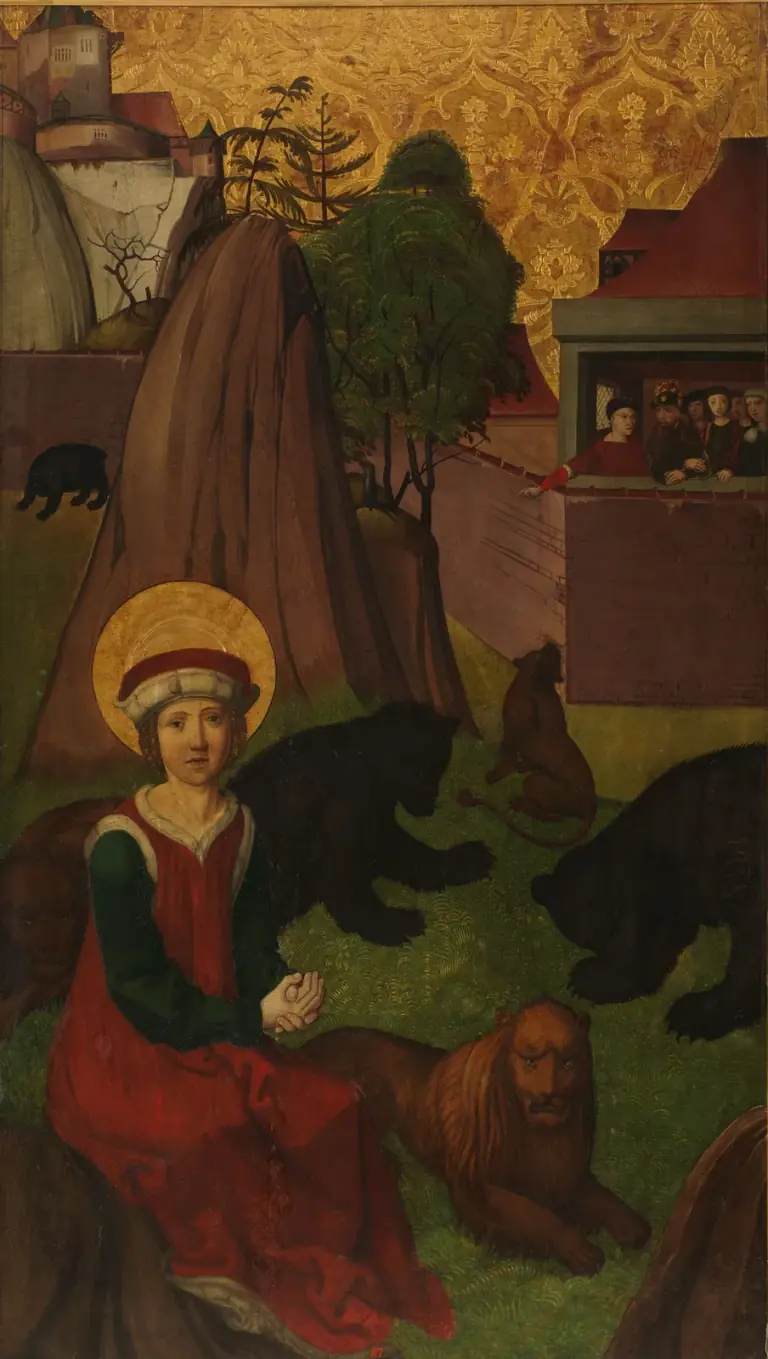
The panel at the top of this page is one wing of a lost altarpiece from northern Switzerland, painted about 1500-1505; the other side of the same wing shows his beheading. 9 The Metropolitan Museum's catalogue says the saint on it "long went unidentified" and was taken in the 1930s for Saint Thecla, a reading it calls "erroneous because female"; the youth, the ordeal in the arena and the beheading all fit Agapitus. 9 It adds that the bears are not in his story. 9 Because the other wing shows Saint Remigius of Rheims, whose great abbey was also Benedictine, the catalogue thinks the altarpiece was probably made for a Benedictine church. 9
What is Saint Agapitus the patron saint of?
Saint Agapitus is the patron saint of Palestrina. 1 The Vatican City State names him patron of the diocese of Palestrina, John Paul II called him patron of both the city and the diocese, and the 1911 Catholic Encyclopedia calls him "patron of the cathedral." 348 Far from Italy, the Metropolitan Museum's catalogue names him the patron saint of the abbey of Kremsmünster. 9 None of the sources consulted names any other patronage. 13456
Saint Agapitus's feast day
Saint Agapitus's feast day is August 18. 124 The current Roman Martyrology keeps him on that day, as did the 1897 edition, which calls it his "birthday," the old word for a martyr's day of death. 26 Butler gives his life under the same date. 5 katolsk.no notes that April 18 is also found, and that in the 1969 revision of the calendar his feast was taken out of the Church's universal calendar and left to local and particular calendars. 1 John Paul II's visit to Palestrina in 1983 fell on that day. 8
Praying with Saint Agapitus
Most of what is told about Agapitus cannot be checked, and the sources say so. 14 What can be checked is a burial at Praeneste, a name that had entered the Church's sacramentaries by the end of the fifth century, and a church built in his honor and restored more than once. 13
The legend makes him a boy of fifteen standing up to a governor. 14 His town had been famous for its temple of Fortune; the town built on its ruins dedicated its cathedral to him. 34 Three versions of his trial survive, and they disagree about the tortures and the titles of the men around him. 146 All three end the same way, with the sword. 146
When John Paul II preached on his feast, he chose the grain of wheat that dies in the ground. 7 He is one of the many early martyrs whose lives are lost and whose names the Church kept anyway. Praying with him means praying with someone of whom almost nothing is known except that he would not sacrifice, and that his neighbors remembered. 14
Saint Agapitus of Palestrina, pray for us.
Sources
- 1."Den hellige Agapetus av Palestrina (259-274)," Den katolske kirke (katolsk.no), Catholic Diocese of Oslo (in Norwegian).
- 2.Roman Martyrology, entry for August 18, "Sant'Agapito, martire," as printed in "Santo del giorno," Conferenza Episcopale Italiana (in Italian).
- 3.Umberto Benigni, "Diocese of Palestrina," The Catholic Encyclopedia, Vol. 11 (New York: Robert Appleton Company, 1911).
- 4."18 de agosto: San Agapito, mártir," Santo del día, Governorate of Vatican City State (in Spanish).
- 5.Alban Butler, "St. Agapetus, M.," August 18, The Lives of the Fathers, Martyrs, and Other Principal Saints, Vol. VIII.
- 6.The Roman Martyrology, August 18, 20 and 21 (Baltimore: John Murphy Company, 1897).
- 7.John Paul II, Homily at Mass in Palestrina, August 18, 1983 (read in the Holy See's Portuguese text).
- 8.John Paul II, Greeting to the people of Palestrina, August 18, 1983 (in Italian).
- 9.Maryan W. Ainsworth and Joshua P. Waterman, German Paintings in The Metropolitan Museum of Art, 1350-1600 (New York: The Metropolitan Museum of Art, 2013), cat. 60a, "Saint Agapitus of Praeneste in the Arena."
Saints to turn to next
Others in this collection who are turned to for some of the same things.