Saint Theophilus of Antioch
Second century; still living after 180
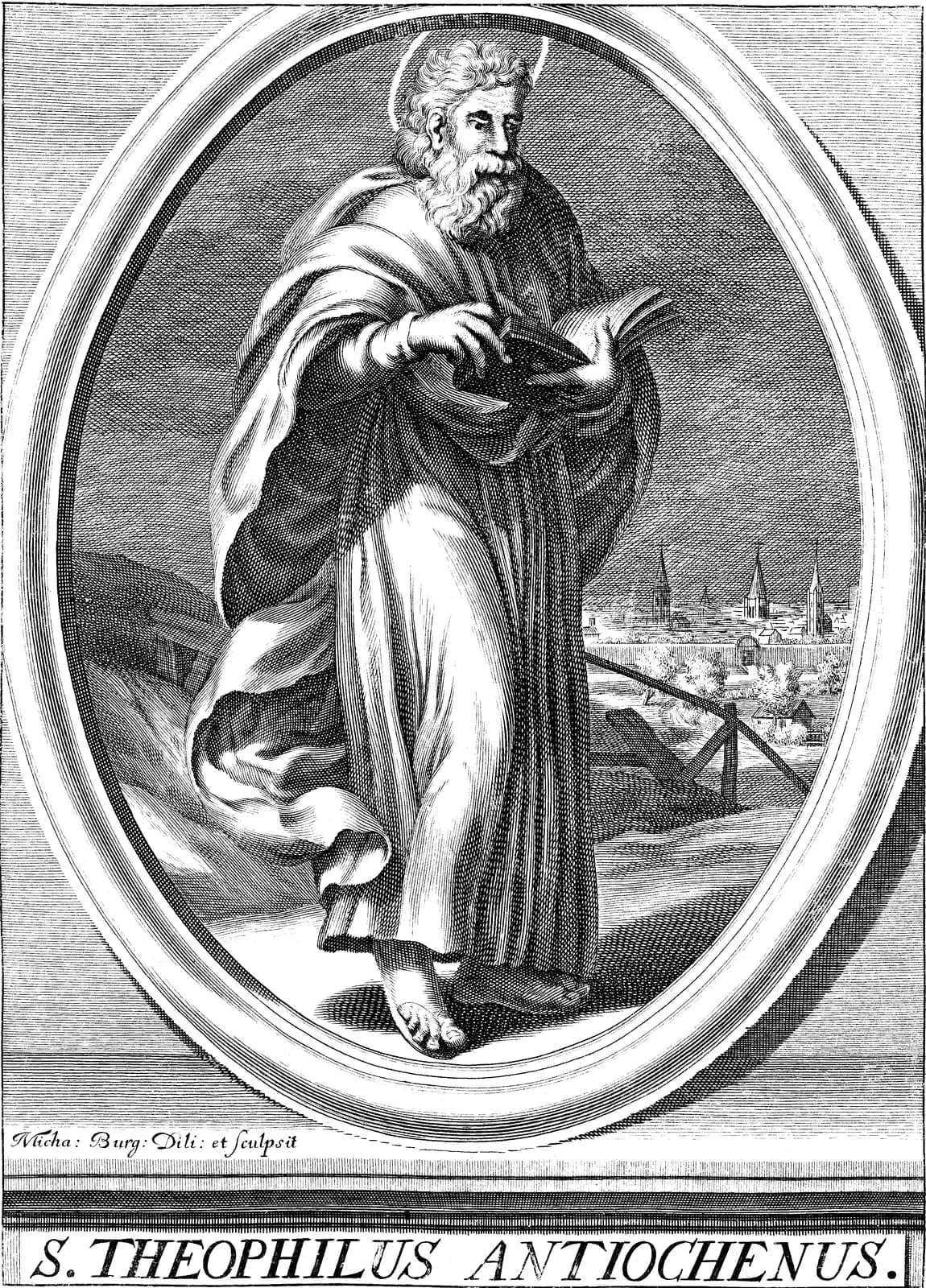
- As bishop
- In 169, according to Vatican News 6; the encyclopedia sets him in the time of Pope Soter (169-77) 2
- Feast day
- October 13 1
Saint Theophilus was bishop of Antioch in the second half of the second century, the sixth after the apostles, and a convert who came to the faith by reading the Hebrew prophets. 134 His three books To Autolycus, written to a pagan friend who mocked him, are the only one of his works to survive. 23 The Roman Martyrology remembers him as a man of very great learning who wrote against Marcion in defense of the true faith. 1
The sixth bishop after the apostles
Eusebius of Caesarea, in his Church History, says that in the time of Pope Soter "Theophilus was well known as the sixth from the apostles" at Antioch. 4 He names the two before him, Cornelius and Eros, and the one after, Maximinus, "the seventh from the apostles." 4 The Martyrology counts the same way, calling him the sixth after the blessed Apostle Peter to hold the see. 1
Fixing his dates is harder. Vatican News gives 169 as the year he was bishop. 6 Francis Bacchus, in the 1912 Catholic Encyclopedia, explains why the dates are loose. Eusebius had exact lists for Rome and Alexandria but not for Antioch, so in his Chronicle he set the Antiochene bishops beside the Roman bishops of their time: Theophilus against Soter (169-77), Maximinus against Eleutherus (177-93). 2 That shows when they flourished, not when one succeeded the other. 2
Theophilus himself supplies the last firm point. His third book runs a chronology of the Roman emperors "to the death of the Emperor Verus," meaning Marcus Aurelius, so he was alive and writing after 180. 23 Jerome dates his book against Marcion to "the reign of the emperor Marcus Antoninus Verus." 5 No source gives the year or manner of his death.
A convert who read the prophets
Theophilus was not raised a Christian, and he says so. The encyclopedia notes that "the author speaks of himself as a convert from heathenism." 2 In the first book he tells Autolycus that he too once doubted the resurrection: "for I myself also used to disbelieve that this would take place, but now, having taken these things into consideration, I believe." 3
What changed his mind, he says, was meeting "the sacred Scriptures of the holy prophets," who foretold events that later came to pass "just as they came to pass." 3 He took the fulfilled prophecies as proof and believed. 3 Vatican News adds that the example of believers also drew him to the faith. 6
He did not think himself a polished writer. Opening the second book, he tells Autolycus he is "not educated to the art of speaking." 3 The books are in fact learned, full of Greek poets, philosophers and historians, which may be why the Martyrology calls him a man of very great culture. 13
Three books to Autolycus
Autolycus was a pagan and a friend. The two had talked about God; Autolycus asked who the Christian God was, listened for a while, and then pressed Theophilus to put it in writing. 3 Theophilus says they parted "with much mutual friendliness," though Autolycus had thought the whole doctrine foolishness. 3 Eusebius calls the result "three elementary works addressed to Autolycus," and Bacchus observes that they are really three separate works written at different times. 24
The first book begins with a challenge Autolycus had made: show me your God. Theophilus turns it around. "Show me yourself, and I will show you my God," he replies, and explains that God is seen by "the eyes of the soul," which sin clouds the way rust clouds a mirror. 3 The cure, he says, is to entrust oneself to the Physician, "God, who heals and makes alive through His word and wisdom." 3 He even defends the name Autolycus had used as an insult: Christians are called so "because we are anointed with the oil of God." 3
The second book compares the pagan stories of the gods and of the world's beginning with the account in Genesis. 23 It is here that Theophilus speaks most fully of the Word of God, who was always "residing within the heart of God" and was uttered, "the first-born of all creation," when God willed to make the world. 3 Reading the days of creation, he says that the three days before the sun and moon "are types of the Trinity, of God, and His Word, and His wisdom." 3
The third book answers the slanders of the day. Autolycus had heard that Christians shared their wives, committed incest and ate human flesh. 3 Theophilus replies that Christians are forbidden even to watch the gladiators, and lists what they do practice: "temperance dwells, self-restraint is practiced, monogamy is observed, chastity is guarded." 3 To the charge that the faith was new, he answers with a long chronology from the creation of the world to his own day, adding up to 5,698 years. 3
The works that were lost
Theophilus wrote more than the books to Autolycus. Eusebius knew a work Against the Heresy of Hermogenes, "in which he makes use of testimonies from the Apocalypse of John," and "certain other catechetical books." 4 He also knew "a certain discourse of no common merit" against Marcion, still preserved in his day. 4 The Martyrology singles out that book against Marcion as the work it remembers him for. 1 Theophilus himself refers more than once to an earlier historical work of his own. 23
Jerome adds commentaries on the Gospel and on Proverbs, but in On Illustrious Men he says they "do not appear to me to correspond in style and language with the elegance and expressiveness" of the genuine works. 5 Bacchus notes that Jerome elsewhere quotes the Gospel commentary as Theophilus's own, and describes it as a commentary on a harmony of the four Gospels Theophilus had made himself. 2 Bacchus calls the books to Autolycus "the only extant writing of Theophilus"; of the Gospel commentary, that one quotation in Jerome is all that survives. 2
What is Saint Theophilus the patron saint of?
None of the sources consulted names a patronage for Saint Theophilus of Antioch. The Martyrology remembers him for his learning and his defense of the faith against Marcion. 1
He should not be confused with Saint Theophilus of Caesarea in Palestine, a bishop of the time of Septimius Severus, whom the Martyrology keeps on March 5. 7
Saint Theophilus's feast day
Praying with Saint Theophilus
Theophilus knew what it was to disbelieve. He tells Autolycus plainly that he once thought the resurrection could not happen, and that he believed only after reading the prophets and weighing what he found. 3 He writes to his friend as one who has stood where Autolycus stands.
He also kept the friendship. Autolycus had mocked him and called him a Christian as if it were an insult, yet they parted from their argument as friends, and Theophilus wrote three books for him at his request. 3 The books are sharp about pagan myths and kind to the man.
His answer to the demand to see God is not a proof. He says the eyes of the soul have to be cleared before they can see, and that the clearing is done by God, who heals. 3
Little else of him is known. The books survived, and they are the reason the Church still names him each October. 12
Saint Theophilus of Antioch, pray for us.
Sources
- 1.Roman Martyrology, entry for October 13, "San Teófilo, vescovo," as printed in "Santo del giorno," Conferenza Episcopale Italiana (in Italian).
- 2.Francis Joseph Bacchus, "Theophilus," The Catholic Encyclopedia, Vol. 14 (New York: Robert Appleton Company, 1912).
- 3.Theophilus of Antioch, To Autolycus, Books I-III, trans. Marcus Dods, Ante-Nicene Fathers, Vol. 2 (Buffalo: Christian Literature Publishing Co., 1885), at New Advent.
- 4.Eusebius of Caesarea, Church History, Book IV, chapters 20 and 24, trans. Arthur Cushman McGiffert, Nicene and Post-Nicene Fathers, Second Series, Vol. 1 (Buffalo: Christian Literature Publishing Co., 1890), at New Advent.
- 5.Jerome, On Illustrious Men, chapter 25, trans. Ernest Cushing Richardson, Nicene and Post-Nicene Fathers, Second Series, Vol. 3 (Buffalo: Christian Literature Publishing Co., 1892), at New Advent.
- 6."Santo del día: 13 de octubre," s. Teófilo, obispo de Antioquía, Vatican News (in Spanish).
- 7.Roman Martyrology, entry for March 5, "San Teofilo, vescovo," as printed in "Santo del giorno," Conferenza Episcopale Italiana (in Italian).
Saints to turn to next
Others in this collection who are turned to for some of the same things.
- Saint Augustine of HippoNovember 13, 354 - August 28, 430ConversionStudy and teaching
- Saint Cyril of AlexandriaBirth unknown - 444Study and teachingConversion
- Saint Dionysius the AreopagiteFirst centuryConversionStudy and teaching
- Saint Edmund CampionJanuary 25, 1540 - December 1, 1581Study and teachingConversion