Saint Edmund Campion
January 25, 1540 - December 1, 1581
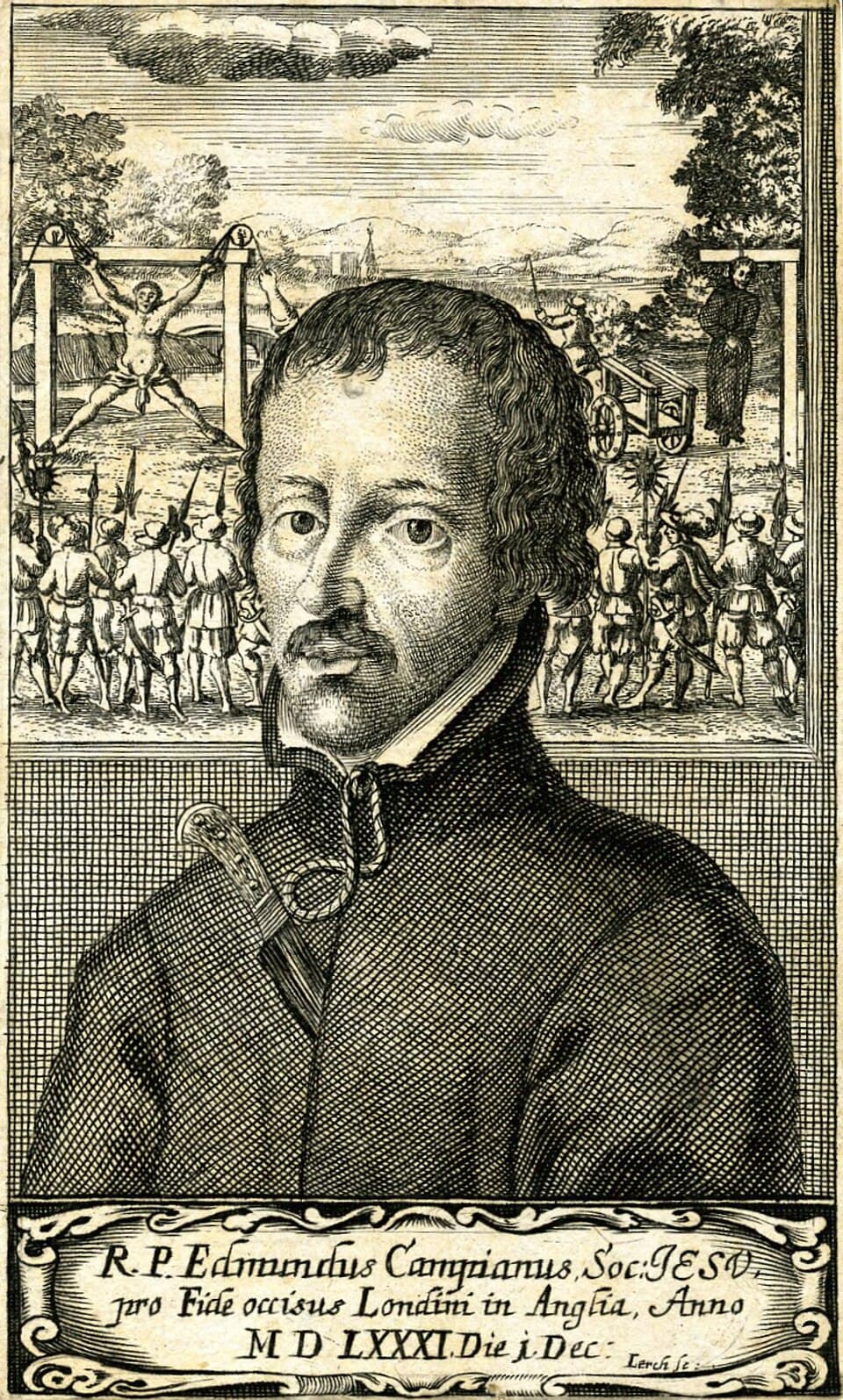
- Patron saint of
- No patronage is stated in the sources. Thinking Faith calls him the patron of the British Province of the Jesuits 4
- Born
- London, January 25, 1540 1
Saint Edmund Campion was the most admired young scholar at Oxford in the 1560s, a man Queen Elizabeth herself invited to ask for whatever he wanted, and he died at Tyburn on December 1, 1581, hanged, drawn and quartered as a traitor for being a Jesuit priest. 15 He was forty-one, and had been back in England, in disguise, since June 1580. 15 The Jesuits of Britain still call him their patron, and the Church keeps his feast on the day he died. 234
A bookseller's son at Oxford
He was born in London on January 25, 1540. 1 The sources do not agree about his family. The 1909 Catholic Encyclopedia makes him "the son and namesake of a Catholic bookseller"; the Jesuit curia's page says his parents were Catholics "who later became Protestant"; and Gerard Kilroy, writing for the British Jesuits, calls his father "an anti-Catholic publisher also called Edmund," working in Paul's Churchyard at the center of the London book trade. 145
A city company paid for his schooling, and when Mary Tudor entered London as queen he was the schoolboy chosen to greet her in Latin. 1 Sir Thomas White took him as one of the first scholars of the new St. John's College, Oxford, and made him a junior fellow at seventeen. 1 He gave orations at the reburial of Amy Robsart and at White's funeral, became a celebrated tutor and, by 1568, junior proctor; his students called themselves "Campionites." 15 The encyclopedia claims that no man in an English university was ever followed and imitated as he was, "except himself and Newman." 1
When Elizabeth visited Oxford he gave the Latin speech of welcome, and she and Dudley, the chancellor, told him to ask for what he would. 15 The Jesuit page adds that she and Lords Cecil and Leicester tried to recruit him into her service. 5
The oath, and the way out
Success came with a price. The encyclopedia says plainly that he took the Oath of Supremacy and was ordained a deacon by the new rite; the Jesuit page says he "probably" took the oath. 15 Then came "afterthoughts developing into scruples, scruples into anguish," and when his proctorship ended he left Oxford for Ireland, hoping for a post at a revived university in Dublin that never opened. 1 He wrote a history of Ireland there while hiding in friendly houses. 1
Back in London in disguise, he saw the trial of Dr. John Storey, one of the first Oxford men to die for the old faith. 1 He went on to the English College at Douai, in June 1571 by the Jesuit page's account, and Cecil lamented the loss of "one of the diamonds of England." 15 From Douai he walked to Rome as a barefoot pilgrim to join the Jesuits, and in April 1573 he was received into the Society. 1 With no English province yet, he was sent to make his novitiate in central Europe: in the province of Bohemia, according to the encyclopedia, or of Austria, according to the Jesuit curia. 15 He taught rhetoric at Prague, wrote plays for his students, and was ordained there in 1578. 145
Called back to England
William Allen, who was organizing the English mission, wanted Campion and Robert Persons as its first Jesuits. 1 Kilroy argues from the archive that Campion was in no hurry to go. He took months to leave Prague, agreed to come only on condition that he was not in charge, and twice asked for relief from the papal bull against Elizabeth. 4 His first words to Allen at Rheims survive in Persons's notes: "Well Sir heer now I am: you haue desired my going to England and I am come a long iourny as you see from Praga to Rome." 4
Asked why he wore such a rough coat for the journey, he said any clothes were good enough for a man going to be hanged. 4 He landed in June 1580 posing as a jewel merchant called "Mr. Edmonds." 25
Within days, at a meeting of Catholics in Hoxton, he was asked to write a statement of the mission's purpose in case he was taken. Persons recorded how it was done: "he arose from the company with whome he was & taking a penne in his hand wrote presently upon the end of a table that stood by in lesse I suppose then half an houre this declaration following." 4 That was the Challenge to the Privy Council, soon known as "Campion's Brag." 24 He came, it said, "to preach the gospel, to minister the sacraments, to instruct the simple, to reform sinners, to confute errors—in brief to cry a spiritual alarm against foul vice and proud ignorance, wherewith many of my dear countrymen are abused." 2 It was meant as a last testament, but copies spread fast, and Kilroy judges that it made him "public enemy number one." 4
Ten Reasons, and Lyford Grange
His work, as the encyclopedia puts it, was "chiefly to reclaim Catholics who were wavering or temporizing." 1 The Jesuit page describes the pattern: arrive at a house by day, preach and hear confessions in the evening, say Mass in the morning, move on. 5 He also wrote the Rationes Decem, a Latin case for the Catholic faith addressed to the universities, printed on a secret press at Stonor Park; copies were left on the benches of St. Mary's, the university church at Oxford, on June 27, 1581. 45
He was taken at Lyford Grange in Berkshire. 14 Kilroy tells how it happened. Campion had promised to stay one night and kept the promise, but Oxford scholars who had missed him sent a priest riding after him, found him arguing with academics at an inn, and talked him into coming back. 4 On the Sunday morning a priest-hunter, George Eliot, arrived at the house; the Jesuit page says he sat through Mass pretending to be a Catholic before slipping out to fetch the authorities. 145 The encyclopedia dates the capture to July 17, 1581; Loyola Press says only that he was arrested "in the fall." 12
The Tower, the trial, Tyburn
He was paraded through London bound hand and foot and riding backwards, with a paper in his hat naming him a "seditious Jesuit," and put in a cell called Little Ease. 1 Taken to the Earl of Leicester's house, he met the queen, who offered him liberty and advancement if he would give up his faith. He refused. 15 He was racked, and a report was put out that he had betrayed those who had sheltered him, which the encyclopedia calls a lie. 1 He held four disputations with Anglican divines in the Tower without notes or a chair, the first soon after torture. 15
His trial, on treason charges the encyclopedia calls "wholesale sham," came in Westminster Hall on November 20, 1581, by its account; the Jesuit page has charges read on November 14 and the trial six days later, and Loyola Press has him condemned on November 14. 125 He could not raise his right hand to plead, and a fellow prisoner kissed it and lifted it for him. 1 The condemned men answered the sentence with the Te Deum. 15
On December 1 he was dragged to Tyburn with Ralph Sherwin and Alexander Briant. 15 Asked on the scaffold about the papal bull against Elizabeth, he answered with a prayer for her, "your Queen and my Queen." 1 Kilroy notes that his last words from Saint Paul, "Spectaculum facti sumus Deo, angelis, hominibus" ("We have been made a spectacle to God, angels and men"), are in the passive voice. 4 The Jesuit page says he forgave those who condemned him and was then hanged and butchered; Kilroy says Lord Charles Howard intervened so that he was spared disemboweling while alive. 45 Henry Walpole, standing close by, was spattered with his blood and later became a Jesuit and a martyr himself. 1
What is Saint Edmund Campion the patron saint of?
None of the sources consulted names a patronage for him. Thinking Faith, the journal of the Jesuits in Britain, calls him "the patron of the British Province," meaning the Jesuits' own province, and Our Sunday Visitor records that he is known as "the pope's champion." 34 This page leaves it there rather than supply one.
Saint Edmund Campion's feast day
His feast is December 1, the day of his execution in 1581. 123 Thinking Faith notes that the Society of Jesus keeps it as the feast of "St Edmund Campion and companions." 4 He was beatified by Leo XIII on December 9, 1886, and canonized by Paul VI on October 25, 1970, as one of the Forty Martyrs of England and Wales. 136 In the English part of that homily the pope spoke of "men who had, at the same time, spiritual faith and loyal respect for the sovereignty of civil society," and in the Italian part he named Campion among them. 6
Praying with Saint Edmund Campion
For more than a decade at Oxford he did what was expected of a brilliant young man under Elizabeth, and that included the oath. 1 The encyclopedia does not soften it, and neither does it make much of it; the turn came slowly, through scruple and anguish, and it took him to Ireland, to Douai and to Rome before it took him back to London. 1
Kilroy's Campion is not eager to die. He hesitated over leaving Prague, refused to lead the mission, and was taken because he gave in to friends who begged him to stay two more days. 4 In Kilroy's reading of the archive, what moved him was affection for other people more than any plan of his own. 4
The Brag, for all its fame, was dashed off at the end of a table in under half an hour and was meant to be read only if he was caught. 4 What it asks for is ordinary priestly work: preaching, the sacraments, teaching the simple. 2 Most of his year in England was spent doing exactly that, a night or two at a time. 5
At the end, asked about the bull that had made every English Catholic a suspect, he prayed for the queen. 1 Paul VI asked that the blood of these martyrs might help heal the division between the Anglican and Catholic churches. 6
Saint Edmund Campion, pray for us.
Sources
- 1.Louise Imogen Guiney, "St. Edmund Campion," The Catholic Encyclopedia, Vol. 5 (New York: Robert Appleton Company, 1909).
- 2."Saint Edmund Campion," Saints Stories for All Ages, Loyola Press, from Bert Ghezzi, Voices of the Saints.
- 3.Our Sunday Visitor Staff, "St. Edmund Campion," Our Sunday Visitor, December 1, 2023.
- 4.Gerard Kilroy, "'Edmundus Campianus Oxoniensis'," Thinking Faith: The Online Journal of the Jesuits in Britain, November 30, 2011.
- 5."Saint Edmund Campion," Saints and Blessed, Society of Jesus (General Curia), collected and edited by Tom Rochford, SJ.
- 6.Paul VI, Homily for the Canonization of Forty Martyrs of England and Wales, October 25, 1970 (English and Italian text), vatican.va.
Saints to turn to next
Others in this collection who are turned to for some of the same things.
- Saint Hilary of Poitiersc. 315 - 368Study and teachingCourageConversion
- Saint Justin Martyrc. 100 - c. 165Study and teachingConversionCourage
- Saint Teresa Benedicta of the CrossOctober 12, 1891 - August 9, 1942ConversionStudy and teachingCourage
- Saint Adalbert of Prague956 - April 23, 997CourageConversion