Saint Dionysius the Areopagite
First century
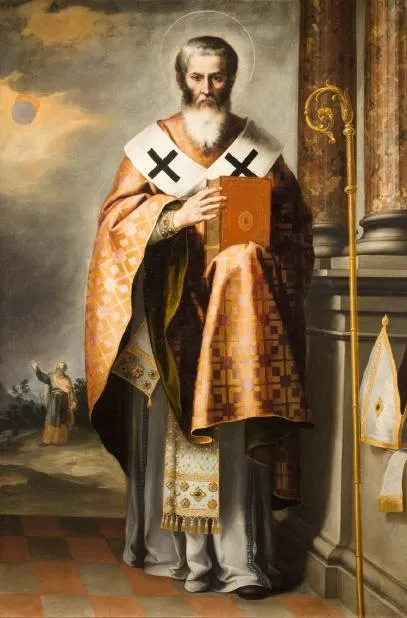
- Known for
- Believing when Saint Paul preached at the Areopagus in Athens 11
- Position
- A member of the Court of the Areopagus 11
Saint Dionysius the Areopagite was a member of the Court of the Areopagus in Athens who became a Christian when Saint Paul preached there, as the Acts of the Apostles records in a single verse. 11 An early report makes him the first bishop of the city. 9 For centuries he was also believed to be the martyr Saint Denis of Paris and the author of a famous set of mystical books, and he was neither. 12 The Roman Martyrology commemorates him on October 3. 6
Paul at the Areopagus
Paul came to Athens alone, waiting for Silas and Timothy, and was exasperated at a city full of idols. 11 He argued in the synagogue and in the public square with anyone who happened to be there, philosophers included. Some of them asked, "What is this scavenger trying to say?" 11 They brought him to the Areopagus and asked to hear the new teaching. 11
The note in the bishops' Bible explains that the name can mean two things: "the Hill of Ares west of the Acropolis," or the Council of Athens, which had once met on the hill and by this time sat in the Royal Colonnade. 11 Paul's speech there began from an altar he had seen inscribed "To an Unknown God" and ended with the resurrection of the dead. 11
That was the point at which he lost most of the room. "When they heard about resurrection of the dead, some began to scoff, but others said, 'We should like to hear you on this some other time.'" 11 Then comes the one verse about Dionysius: "But some did join him, and became believers. Among them were Dionysius, a member of the Court of the Areopagus, a woman named Damaris, and others with them." 11
Acts never mentions him again. Benedict XVI, summarizing the scene, noted that the listeners were "an elite group of the important Greek intellectual world," that most of them went away jeering, and that Luke gives only two names. 4
First bishop of Athens
The next information comes at second hand. Eusebius, in his Church History, reports a letter of Dionysius, bishop of Corinth, to the Athenians. 10 The Areopagite who believed after Paul's address, Eusebius writes, "is mentioned by another Dionysius, an ancient writer and pastor of the parish in Corinth, as the first bishop of the church at Athens." 9 He repeats the statement when he describes the letter itself. 10
Joseph Stiglmayr opens his Catholic Encyclopedia article with exactly these two facts, the conversion from Acts and the bishopric from Dionysius of Corinth, and offers nothing more about the man. 1 The Roman Martyrology says the same two things in its entry for him. 6 Daniel Quinn, in the encyclopedia's article on Christian Athens, is a little more guarded: "The commoner tradition names the Areopagite as the first head and bishop of the Christian Athenians," he writes, while another tradition gives that honor to a certain Hierotheos. 3
How he lived as a Christian, and how and when he died, the sources used for this page do not say. 136
Mistaken for Denis of Paris
Stiglmayr writes that "two errors of far-reaching import" grew up around the name. 1 The first joined the Athenian to a martyr of Gaul. Saint Denis, whose name in Latin is Dionysius, was the first bishop of Paris, sent as a missionary by Pope Fabian in the middle of the third century and beheaded about 275. 12 Two centuries separate him from Paul's convert.
Even so, Stiglmayr says, an error prevailed throughout the Middle Ages that identified Denis of Paris with the Areopagite. 2 The merging "was doubtless effected as early as the eighth or perhaps the seventh century," and it took deep root through a book called the Areopagitica, written in 836 by Hilduin, abbot of Saint-Denis, at the request of the emperor Louis the Pious. 2 In Hilduin's hands the idea that the Parisian martyr was the Athenian convert "rose to an undoubted certainty." 1
It was undone by historical criticism. Stiglmayr credits the investigations of Launoy with first throwing doubt on the story, and says that the Bollandist de Bye "entirely rejected it." 2 The Church now keeps the two as separate saints on separate days. 67
The writer who borrowed his name
The second error was literary. Around the year 500 a collection of four treatises and ten letters appeared under the name of Dionysius the Areopagite: on the divine names, on the heavenly hierarchy of the angels, on the hierarchy of the Church, and on mystical theology. 1 Their author wrote as if he lived among the apostles. He addresses letters to Polycarp, to Titus and to the apostle John, and he claims to have seen the eclipse at the Crucifixion and to have looked on the body of the Virgin Mary in the company of Peter and James. 1
He was not the Areopagite. Benedict XVI called him "a sixth-century theologian whose name is unknown and who wrote under the pseudonym of Dionysius the Areopagite." 4 Stiglmayr dates the writings no earlier than the close of the fifth century, because they borrow heavily from the philosopher Proclus, who died in 485, and he thinks the author was probably a Syrian. 14 Stiglmayr was one of the two scholars who, working independently, demonstrated the dependence on Proclus in 1895. 1
The books were doubted when they first surfaced. At a debate in Constantinople in 533 the bishop Hypatius of Ephesus rejected them as spurious, asking why Cyril and Athanasius had never quoted them. 1 Within little more than a century they were accepted anyway, and cited at the Lateran Council of 649. 1 From then until the Renaissance nobody questioned them, and Aquinas, Bonaventure and Dante all drew on them. 1 Laurentius Valla and then Erasmus reopened the question, and the argument ran until Stiglmayr's own day. 1
On the author's motive the two main sources disagree. Stiglmayr says of the eclipse story that "it is plainly for the purpose of deceiving." 1 Benedict XVI finds deliberate falsification "barely credible" and prefers another reading, that the writer "desired to make an act of humility" and to serve the Gospel without building "a monument to himself." 4 In choosing the name, Benedict thought, he was announcing a program: "to make Greek thought converge with St Paul's proclamation." 4
What is Saint Dionysius the Areopagite the patron saint of?
No source consulted for this page names Saint Dionysius the Areopagite as the patron saint of anything, and the page does not supply a patronage. 16 The Catholic cathedral of Athens is dedicated to him; Pope Francis spoke there in 2021 and reminded his hearers that it is Dionysius "after whom this Cathedral is named." 5
Saint Dionysius the Areopagite's feast day
Saint Dionysius the Areopagite's feast day is October 3. The current Roman Martyrology, as the Italian bishops' conference publishes it, commemorates him on that day as the man converted to Christ by Paul's preaching before the Areopagus and made first bishop of Athens. 6 A writer for the National Catholic Register states it in English: "The Catholic Church honors St. Dionysius on Oct. 3." 8
Saint Denis of Paris is kept on October 9, the date the Catholic Encyclopedia gives for him and the date of his entry, with his companions, in the Martyrology. 27
Praying with Saint Dionysius the Areopagite
What Scripture records of him is a decision made in public, while others in the same audience were scoffing. 11 Pope Francis, standing in the Athens cathedral, described the result of Paul's speech plainly: "The majority left; a small remnant joined Paul, including Dionysius." 5 He told the clergy and religious of Greece in front of him that this "is how God weaves the threads of history." 5
Paul did not win him by attacking Athens. The note in the bishops' Bible says the speech "reflects sympathy with pagan religiosity" and "handles the subject of idol worship gently." 11 Francis made the same observation, that Paul's manner made him "open and accepting towards the Areopagites who were suspicious of him." 5
The centuries of mistaken identity are an odd inheritance for a man with one verse to his name. A stranger's books were read as his by the greatest theologians of the Middle Ages, and a stranger's martyrdom was told as his in Paris. 12 Benedict XVI found something fitting in the borrowed name all the same, since the writer wanted to do what the first Dionysius had done: "being a Greek, he wanted to become a disciple of St Paul, hence a disciple of Christ." 4
Saint Dionysius the Areopagite, pray for us.
Sources
- 1.Joseph Stiglmayr, "Dionysius the Pseudo-Areopagite," The Catholic Encyclopedia, vol. 5 (New York: Robert Appleton Company, 1909).
- 2.Joseph Stiglmayr, "St. Denis," The Catholic Encyclopedia, vol. 4 (New York: Robert Appleton Company, 1908).
- 3.Daniel Quinn, "Christian Athens," The Catholic Encyclopedia, vol. 2 (New York: Robert Appleton Company, 1907).
- 4.Benedict XVI, General Audience, "Pseudo-Dionysius, the Areopagite," May 14, 2008.
- 5.Pope Francis, Address to bishops, priests, religious, seminarians and catechists, Cathedral of Saint Dionysius, Athens, December 4, 2021.
- 6.Roman Martyrology, entry for October 3, "San Dionigi l'Areopagita," Santo del giorno, Conferenza Episcopale Italiana (in Italian).
- 7.Roman Martyrology, entry for October 9, "Santi Dionigi e compagni martiri," Santo del giorno, Conferenza Episcopale Italiana (in Italian).
- 8.Theresa Doyle-Nelson, "St. Dionysius Had an Open Heart to the Truth of Christ," National Catholic Register (blog), October 3, 2018.
- 9.Eusebius of Caesarea, Church History, book III, chapter 4, trans. Arthur Cushman McGiffert, Nicene and Post-Nicene Fathers, Second Series, vol. 1 (1890), at New Advent.
- 10.Eusebius of Caesarea, Church History, book IV, chapter 23, trans. Arthur Cushman McGiffert, Nicene and Post-Nicene Fathers, Second Series, vol. 1 (1890), at New Advent.
- 11.Acts of the Apostles 17. Bible, United States Conference of Catholic Bishops.
Saints to turn to next
Others in this collection who are turned to for some of the same things.
- Saint Augustine of HippoNovember 13, 354 - August 28, 430ConversionStudy and teaching
- Saint Cyril of AlexandriaBirth unknown - 444Study and teachingConversion
- Saint Edmund CampionJanuary 25, 1540 - December 1, 1581Study and teachingConversion
- Saint Gregory Thaumaturgusc. 213 - between 270 and 275ConversionStudy and teaching