Saint Gregory Thaumaturgus
c. 213 - between 270 and 275
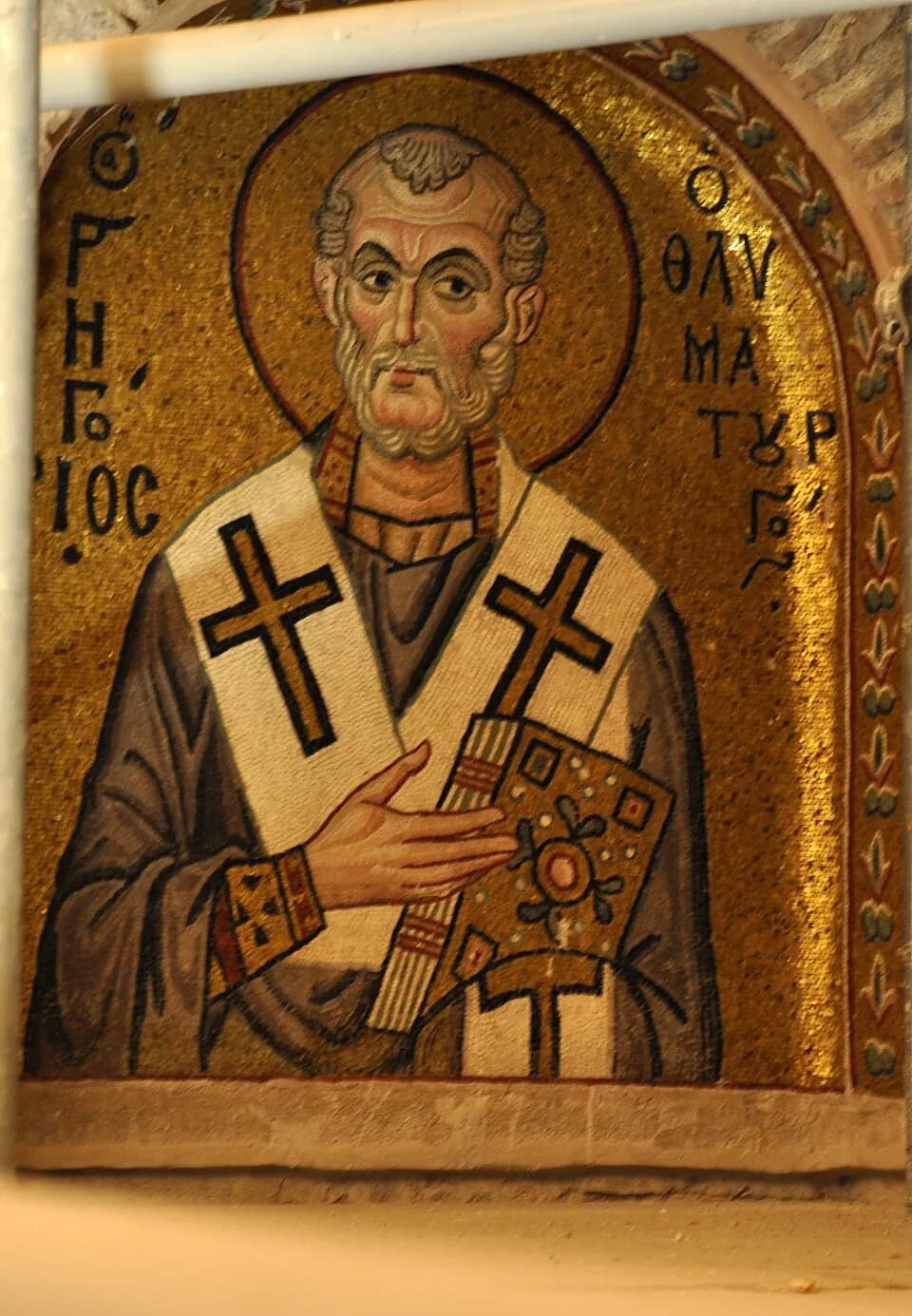
Saint Gregory Thaumaturgus was a pagan law student from Pontus who stopped in Caesarea on his way to law school in Beirut, heard Origen, and never went on to Beirut. 12 He became bishop of his home town of Neocaesarea when, by the oldest count, it had seventeen Christians, and his reputation for miracles earned him the name Thaumaturgus, the wonderworker. 158 His feast is November 17. 8
Theodore, a pagan boy from Pontus
He was born at Neocaesarea in Pontus, in what is now Turkey, around 213, and his name was Theodore. 18 His family was pagan. In his own words "the manner of life in my father's house was one of error," and he grew up "under a superstitious father." 2 His father died when he was fourteen, and Gregory dated his first contact with Christianity to that year, "in what manner I cannot tell, by constraint rather than by voluntary choice. For what power of decision had I then, who was but fourteen years of age?" 2
His mother, the surviving parent, sent him to a teacher of public speaking so that he could become an orator. 2 One of his teachers, hired to give him some Latin, happened to know Roman law, and set him to learn it thoroughly. 2 That is what pointed him toward Berytus, modern Beirut, which had one of the famous law schools of the Greek-speaking world. 12
The sources tell the timing differently. Vatican News has Theodore and his brother Athenodorus leaving for Palestine at fourteen, shortly after their father died. 8 In the oration the rhetoric and the law come first, and the journey after. 2
The detour to Origen
The occasion for the trip was family business. Their sister's husband had been given a post under the Roman governor of Palestine, and a soldier arrived with instructions for the two brothers to escort her to him at Caesarea. 12 The plan was to go on to Berytus afterward. 2 At Caesarea they found that Origen, the head of the catechetical school of Alexandria, was living in the city, and they went to hear him out of curiosity. 18
Gregory's description of what happened next is unusually frank. Origen, he says, set about keeping them there from the first day, while they behaved "like some wild creatures of the fields, or like fish, or some sort of birds that had fallen into the toils or nets, and were endeavouring to slip out again and escape," still meaning to leave for Berytus or for home. 2 Origen persisted, "putting every rope in motion (as the proverb goes)." 2 What finally held them was not the argument alone: "like some spark lighting upon our inmost soul, love was kindled and burst into flame within us," a love for the Word and for "this man, His friend and advocate." 2
Leclercq sums up Origen's method from the same speech: persuasion more than bare reasoning, "evident sincerity and an ardent conviction." 1 Gregory studied with him for seven years, which Leclercq dates from 231 to 238 or 239, beginning with philosophy and moving on to theology. 1 Origen had them read all the old philosophers and poets, "rejecting nothing," except the atheists who denied God and providence. 2 Vatican News says the brothers were baptized and Theodore became Gregory. 8
A farewell speech and a bishop of seventeen
When the brothers left for Pontus, Gregory gave a public farewell oration in Origen's presence. 1 He compared leaving to Adam's exile from paradise: "I am like a second Adam and have begun to talk, outside of paradise." 2 He closed by asking Origen to pray for them, and to pray that God would "turn our course" and "bring us back to you again." 2 Leclercq calls it "the first attempt at autobiography in Christian literature." 1
He went home intending to practice law. 18 Instead he was soon made bishop of Neocaesarea, at about forty. 1 Leclercq says he was consecrated by Phoedimus, Bishop of Amasea and metropolitan of Pontus; Vatican News says he was elected. 18 The Christian community he took over numbered seventeen people. 158
He was bishop for thirty years. 18 Leclercq has it "from an ancient source," which he calls "a curious coincidence," that where Gregory began with seventeen Christians, at his death there were only seventeen pagans left in the town. 1 Vatican News reports the same "tradition." 8 Basil the Great says simply that Gregory was handed seventeen Christians and "brought the whole people alike in town and country through knowledge to God." 5 According to Vatican News he led his people through the Decian persecution. 8 Leclercq adds that he organized festivals in honor of the martyrs with entertainments attached, so that pagans would come. 1
Why he is called the Wonderworker
Thaumaturgus is Greek for wonderworker, and Leclercq calls it his "immemorial title." 1 Basil the Great, writing in the next century, said that "by Christ's mighty name" Gregory "commanded even rivers to change their course, and caused a lake, which afforded a ground of quarrel to some covetous brethren, to dry up." 5 His power over demons was "tremendous," Basil says, and his enemies called him "a second Moses." 5
Leclercq is careful in both directions. The fullest account of the miracles is the Life written by Gregory of Nyssa, who got its facts from his grandmother, Saint Macrina the Elder, and in it, Leclercq writes, "the imaginative element is very active." 1 Yet "if ever the title of 'wonder-worker' was deserved, Gregory had a right to it," and his "miraculous power" was "undoubted." 1 The same Life tells that before he became bishop he saw the Virgin Mary and the Apostle John, and that John dictated a creed to him, of which the handwritten original was still kept at Neocaesarea when the Life was written. 1
A bishop in a time of invasion
His Canonical Epistle, written to a fellow churchman he addresses as "most holy father," comes from the years when Goths and Boradi had overrun Pontus. 13 It deals with what is left after a raid. A woman of chaste life who had been raped in captivity was not to be treated as a sinner, and he cites the law of Deuteronomy for the girl who "cried, and there was none to help her." 3 People who had looted their neighbors' houses, or kept what they found, or held escaped captives by force, were to be excluded or put among the penitents until they made restitution. 3 Those who took plunder to make up for their own losses, he wrote, "make themselves Boradi and Goths to others." 3
His Declaration of Faith states the Trinity plainly: "neither was the Son ever wanting to the Father, nor the Spirit to the Son; but without variation and without change, the same Trinity abides ever." 4 Leclercq dates it between 260 and 270 and sees in it "a marked advance on the theories of Origen." 1 He died at Neocaesarea between 270 and 275. 1
The family that kept his memory
His teaching reached the next century through one family. Writing to the people of Neocaesarea, Basil the Great offered his own upbringing as proof of his faith: he was brought up "by my grandmother, blessed woman, who came from you," and she was "the celebrated Macrina who taught me the words of the blessed Gregory." 6 Gregory of Nyssa, whose Life of the Wonderworker drew its facts from the same grandmother, Macrina the Elder, came from that household too. 16
Neocaesarea held to his customs so firmly that Basil found them used against him. 57 The clergy there objected to the way his churches sang the psalms at night, and Basil answered that they had kept none of Gregory's practices anyway: "Gregory did not cover his head at prayer," and "Oaths were shunned by Gregory, that pure soul." 7 In De Spiritu Sancto Basil says that "not a practice, not a word, not a mystic rite" had been added at Neocaesarea beyond what Gregory left. 5
What is Saint Gregory Thaumaturgus the patron saint of?
None of the sources used for this page, the Catholic Encyclopedia, Vatican News or Basil's writings, names a patronage for Saint Gregory Thaumaturgus. 158 Popular lists sometimes call him a patron of desperate causes, or invoke him against earthquakes and floods. This page could not find any of those in an authoritative source, and so does not claim them.
Saint Gregory Thaumaturgus's feast day
Praying with Saint Gregory Thaumaturgus
His own story of his conversion has no single moment in it. He was escorting a sister, meaning to go on to law school, and found himself trying to get away from a teacher who would not let him go. 2 When he later looked back, he attributed it to "a certain divine companion and beneficent conductor and guardian" who had carried them "past other places, and Berytus in special." 2 He tells the detour as something done to him.
He also says plainly that what held him was a person. The spark he describes was love for the Word and for Origen together, and he did not try to separate them. 2 At the end of seven years he asked Origen to pray that he might be brought back, and then went home meaning to practice law, and was made a bishop instead. 12
The bishop who appears in the Canonical Epistle is dealing with ordinary people after a disaster: raped women whose neighbors may shun them, Christians who looted, others who held escaped captives by force. 3 His answers are specific, and for a woman who had lived chastely he would not count what was done to her as her sin. 3
And his memory was kept by a grandmother. 16 Basil learned the words of Gregory from Macrina as a child, before he could judge them himself, and later defended Gregory's orthodoxy against the Sabellians, who claimed him for their side. 16
Saint Gregory Thaumaturgus, pray for us.
Sources
- 1.Henri Leclercq, "St. Gregory of Neocaesarea," The Catholic Encyclopedia, Vol. 7 (New York: Robert Appleton Company, 1910).
- 2.Gregory Thaumaturgus, The Oration and Panegyric Addressed to Origen, translated by S.D.F. Salmond, Ante-Nicene Fathers, Vol. 6 (Buffalo, NY: Christian Literature Publishing Co., 1886).
- 3.Gregory Thaumaturgus, Canonical Epistle, translated by S.D.F. Salmond, Ante-Nicene Fathers, Vol. 6 (Buffalo, NY: Christian Literature Publishing Co., 1886).
- 4.Gregory Thaumaturgus, A Declaration of Faith, translated by S.D.F. Salmond, Ante-Nicene Fathers, Vol. 6 (Buffalo, NY: Christian Literature Publishing Co., 1886).
- 5.Basil the Great, De Spiritu Sancto, chapter 29, translated by Blomfield Jackson, Nicene and Post-Nicene Fathers, Second Series, Vol. 8 (Buffalo, NY: Christian Literature Publishing Co., 1895).
- 6.Basil the Great, Letter 204, "To the Neocaesareans," translated by Blomfield Jackson, Nicene and Post-Nicene Fathers, Second Series, Vol. 8 (Buffalo, NY: Christian Literature Publishing Co., 1895).
- 7.Basil the Great, Letter 207, "To the clergy of Neocaesarea," translated by Blomfield Jackson, Nicene and Post-Nicene Fathers, Second Series, Vol. 8 (Buffalo, NY: Christian Literature Publishing Co., 1895).
- 8."St. Gregory Thaumaturgus, Bishop of Neocesarea," Saint of the Day, Vatican News.
Saints to turn to next
Others in this collection who are turned to for some of the same things.
- Saint Edmund CampionJanuary 25, 1540 - December 1, 1581CourageStudy and teachingConversion
- Saint Hilary of Poitiersc. 315 - 368Study and teachingCourageConversion
- Saint Justin Martyrc. 100 - c. 165Study and teachingConversionCourage
- Saint Teresa Benedicta of the CrossOctober 12, 1891 - August 9, 1942ConversionStudy and teachingCourage