Saint Theophanes the Confessor
Born at Constantinople about 758; died on Samothrace, 817 or 818
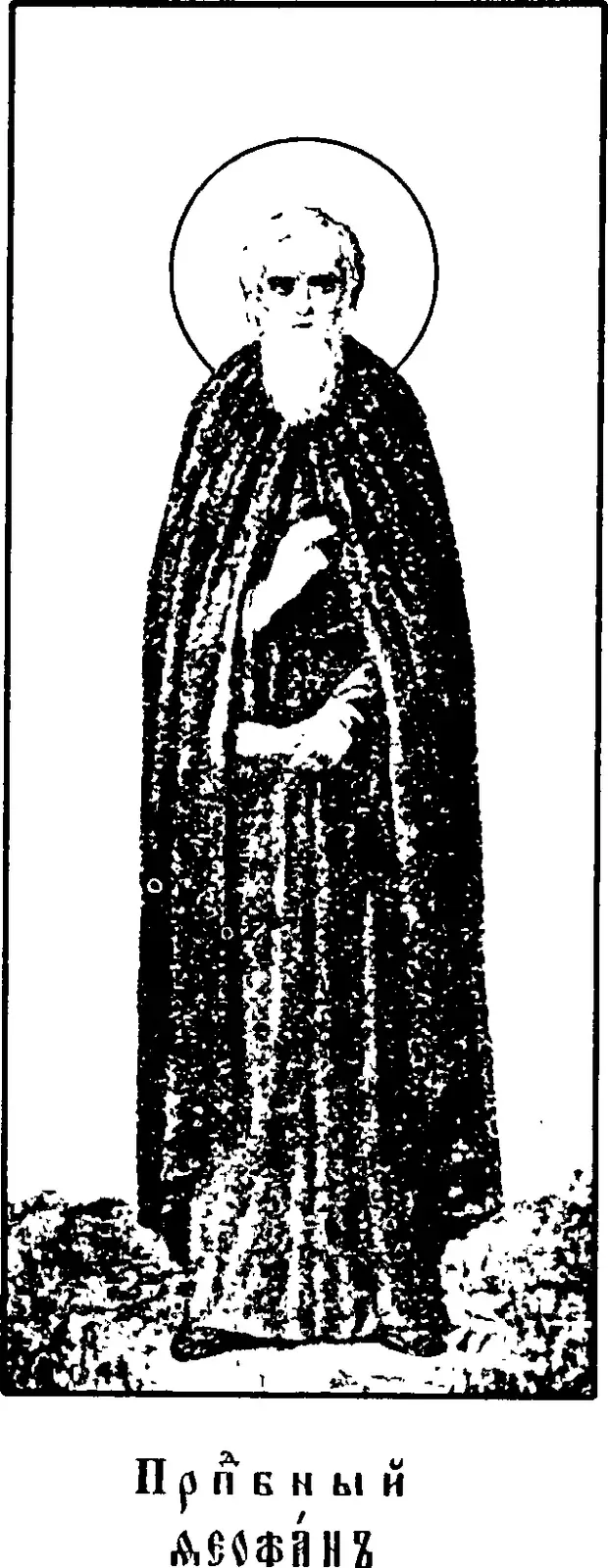
Saint Theophanes was a wealthy young man of the Byzantine court who, with his wife's agreement, gave up marriage and fortune to become a monk, and founded an abbey in Bithynia known as "the great acre." 123 He wrote the chronicle that gave him the name the Chronographer, and when the emperor Leo the Armenian revived the war on holy images, he refused to support it, spent two years in prison, and died in exile on the island of Samothrace. 124 His feast is March 12. 34
An heir at an Iconoclast court
Theophanes was born at Constantinople about 758, Francis Mershman writes in the Catholic Encyclopedia, the son of Isaac, an imperial governor of the islands of the Aegean, and of Theodora. 1 Butler says his father died when he was three and left him "heir to a very great estate," under the guardianship of the Iconoclast emperor Constantine Copronymus. 2 Mershman says that after his parents died young he came to that emperor's court. 1
It was not a promising place for a boy to learn piety. Butler credits "a faithful pious servant" with forming him in virtue all the same. 2 The Byzantine Catholic Menaion sums up his life in a phrase: "Having been a very wealthy man, he became a poor monk." 3
A marriage given back
He married young. Mershman says he was married at the age of twelve, and that he persuaded his wife to live with him in virginity. 1 Butler says his friends pressed him into marriage, and that on the wedding day he spoke so movingly to his bride "on the shortness and uncertainty of this life, that they made a mutual vow of perpetual chastity." 2
In time they parted to enter religious life. Mershman dates it to 799, after the death of his father-in-law, and says she chose a convent on an island near Constantinople. 1 Butler says only that she became a nun. 2 The kontakion of his day in the Byzantine Catholic Menaion remembers it: "Afterwards you gave up a wife and wealth, O venerable father." 3
The two accounts of his monasteries differ. Mershman says he entered the monastery called Polychronius near Cyzicus, built another on his own island of Calonymus, and after six years returned to Sigriano to found an abbey "of the great acre," which he governed as abbot. 1 Butler says he built two monasteries in Mysia, one of them, called Megal-Agre, near the Propontis, and governed it himself. 2 The Menaion and the current Roman Martyrology both place him in the monastery of Ager Magnus, the Great Field, on the mountain of Sigriana in Bithynia. 34
At the Second Council of Nicaea
Both sources put him at the Second Council of Nicaea in 787, which restored the veneration of images. Mershman says he was there as abbot and signed its decrees. 1 That sits awkwardly with Mershman's own date of 799 for his entry into religious life, and the page records both without trying to reconcile them. 1
Butler tells what the council fathers noticed: men who had known him "in so much worldly grandeur" saw him "now so meanly clad, so modest, and so full of self-contempt." 2 He wore a hair shirt, slept on a mat with a stone for a pillow, and lived on coarse bread and water. 2 From about the age of fifty he suffered from kidney stones, and Butler says he bore the pain "with cheerfulness." 2
The Chronicle
His friend George Syncellus had begun a chronicle of the world and did not live to finish it. At his urgent request, Mershman says, Theophanes took up the work in the years 810 to 815 and carried it from 284, the first year of Diocletian, to 813. 12 He used material Syncellus had already gathered, and probably the city chronicle of Constantinople. 1
Mershman is honest about it. The chronological tables, he says, are "full of inaccuracies," and the history lacks critical precision, "which could scarcely be expected from a man of such ascetical disposition"; but it "greatly surpasses the majority of Byzantine chronicles." 1 Butler adds that his imprisonment did not leave him time to polish the style. 2
Before Leo the Armenian
In 814 the emperor Leo V, the Armenian, renewed the campaign against images. 2 Knowing the old abbot's reputation, he tried to win him with courtesy and letters, and summoned him to Constantinople. 12 Theophanes went, though he was so ill with the stone that he could not walk. 2
Butler gives the emperor's message: comply, and riches and honors would follow for him, his monastery and his family; refuse, and "misery and disgrace" would fall on them all. 2 Theophanes answered that he had despised such things for Christ in his youth, when he could have enjoyed them, and had no taste for them now. "As to my monastery and my friends, I recommend them to God," he said, and added that if the emperor hoped to frighten him "as a child is awed by the rod," he was wasting his effort. 2
He was thrown into prison for two years. 123 Butler describes a close, foul dungeon, illness without care, and a scourging of three hundred stripes. 2 Then he was banished to Samothrace. 12 He lived seventeen days there. 12 The Menaion says he died "consumed by his tribulations." 3 Mershman puts his death probably on March 12, 817, and the Menaion gives 817; Butler says he was taken out of the dungeon in 818. 123 Both Mershman and Butler say that miracles followed his death. 12
What is Saint Theophanes the patron saint of?
Saint Theophanes's feast day
Saint Theophanes's feast day is March 12. The current Roman Martyrology enters him on that day, at Sigriana in Bithynia, as the Chronographer, a very rich man turned poor monk, imprisoned for two years by Leo the Armenian for honoring holy images and deported to Samothrace, where he died of hardship. 4 Mershman says the Roman Martyrology of his day commemorated him on March 12, the probable day of his death, and the Byzantine Catholic Menaion keeps him on March 12 with a full service. 13
Butler also says he died on March 12, but enters him among the saints of March 13. 2
Praying with Saint Theophanes
Theophanes had everything a young man at that court could want, and he and his wife gave it back together. 12 The hymn of his feast in the Byzantine Catholic Menaion puts it simply: he gave up "a wife and wealth." 3
He was old and sick when the emperor sent for him, and the emperor counted on that. 2 His answer was that he had already given these things up once, when giving them up cost more. 2 A second hymn of the day has the same picture: he "cared more for the holy icons than for the condition of your body." 3
He also left a book. Its tables are inaccurate and its style unpolished, by the admission of the same writers who praise it, and it still outdoes most chronicles of its kind. 12 He wrote it as a favor to a friend. 1
Saint Theophanes the Confessor, pray for us.
Sources
- 1.Francis Mershman, "St. Theophanes," The Catholic Encyclopedia, Vol. 14 (New York: Robert Appleton Company, 1912).
- 2.Alban Butler, "St. Theophanes, Abbot, C.," March 13, in The Lives of the Fathers, Martyrs, and Other Principal Saints, Vol. I (New York, 1895), Project Gutenberg eBook #20450.
- 3."Menaion - March 12," Metropolitan Cantor Institute, Byzantine Catholic Archeparchy of Pittsburgh.
- 4.Roman Martyrology, entries for March 12, Santo del giorno, Conferenza Episcopale Italiana (in Italian).
Saints to turn to next
Others in this collection who are turned to for some of the same things.
- Saint Catherine of AlexandriaDied c. 310Study and teachingCourageSuffering and illness
- Saint John Fisher1469 - June 22, 1535CourageStudy and teachingSuffering and illness
- Saint José de AnchietaMarch 19, 1534 - June 9, 1597Study and teachingCourageSuffering and illness
- Saint Maximus the Confessorc. 580 - August 13, 662CourageSuffering and illnessStudy and teaching