Saint José de Anchieta
March 19, 1534 - June 9, 1597
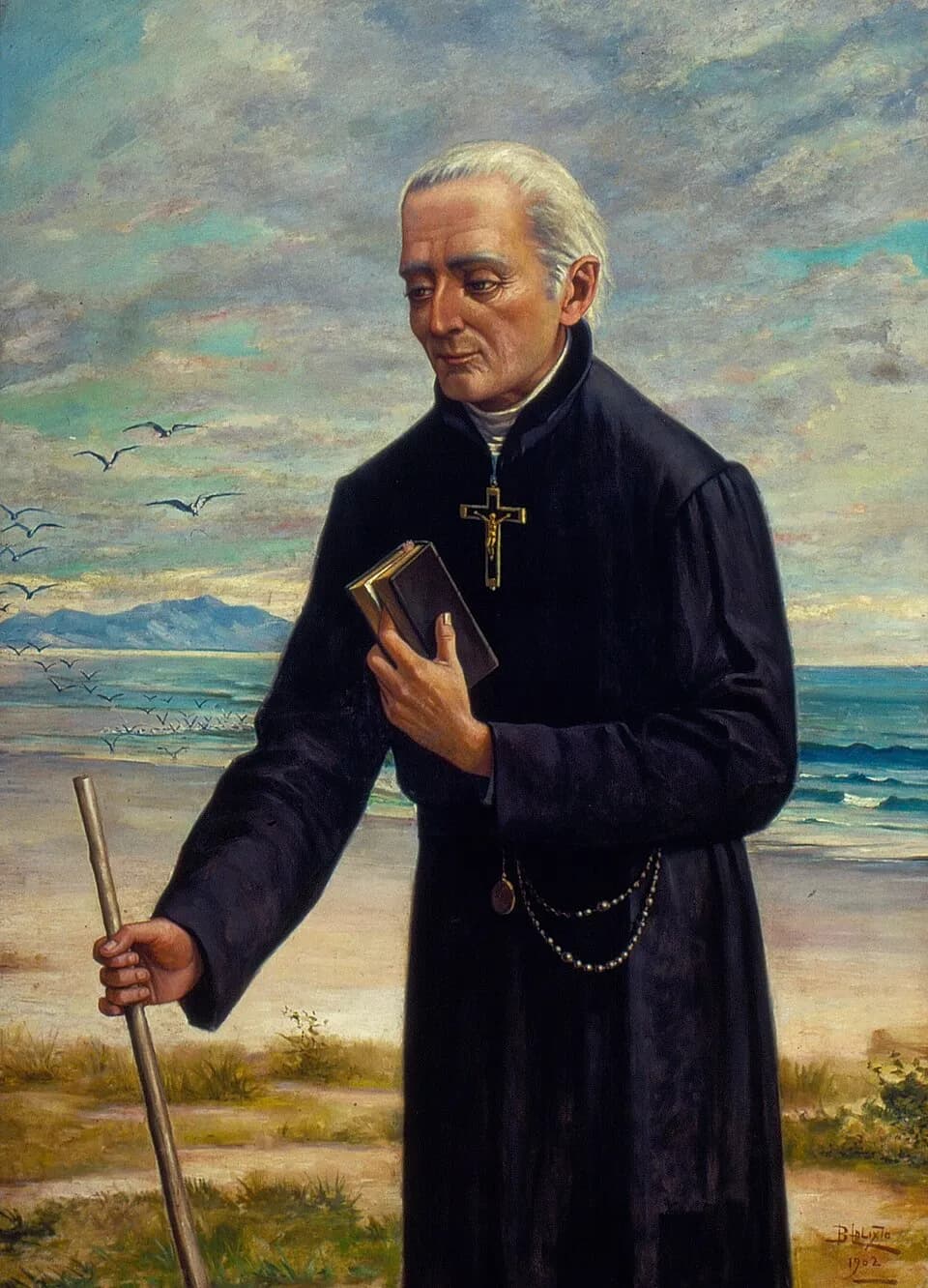
- Born
- March 19, 1534, at San Cristóbal de La Laguna, Tenerife, in the Canary Islands 3
- Arrived in Brazil
- July 13, 1553, at Salvador 3
- Patron saint of
- Brazil, in the title Vatican News gives him, "apóstolo e padroeiro do Brasil" 3
- Feast day
- June 9 3
Saint José de Anchieta was a Jesuit from Tenerife who sailed for Brazil at nineteen, in bad health and before he had studied philosophy or theology, and spent forty-four years there as a teacher, linguist, poet, playwright and missionary among the Native peoples. 234 He wrote a grammar of the Tupi language, composed a long Latin poem to the Virgin Mary while held hostage, and is known as the Apostle of Brazil. 12 Pope Francis canonized him on April 3, 2014, and his feast is June 9. 23
Tenerife and Coimbra
He was born on March 19, 1534, at San Cristóbal de La Laguna on the island of Tenerife. 3 Vatican News names his parents as Juan López and Mência Dias; the Jesuit Superior General Adolfo Nicolás, in the letter he wrote for the canonization, makes him the third of ten children, a relative of the Loyola family on his father's side, and the grandson of converted Jews. 23
At twelve his parents sent him to Portugal, to the College of Arts at Coimbra. 3 Vatican News says he served every Mass he could in the Jesuit church there, as many as eight in a day. 3 At seventeen, John Paul II recalled, he made a vow of perpetual virginity before an image of the Virgin Mary in the cathedral of Coimbra and decided to give himself to the service of God. 5 He was admitted to the Jesuit novitiate on May 1, 1551. 2
Almost at once his health broke. The Catholic Encyclopedia says that as a novice he nearly ruined himself by excessive austerity and injured his spine, which left him "almost a hunchback". 1 Father Nicolás and Vatican News say the cause was a tuberculosis of the bone that visibly curved his back at seventeen. 23 He was afraid he would be useless. The provincial, Simão Rodrigues, told him, in the words Father Nicolás records, "Do not be sad about that deformation. God loves you that way." 2
Letters were arriving from Father Manuel da Nóbrega in Brazil praising the climate there as good for any illness. 2 The encyclopedia says plainly that Anchieta was sent to the New World "with no idea of making him a missionary, but in the hope of restoring his shattered health." 1 He sailed in 1553, at nineteen, with the third party of Jesuits bound for Brazil, and landed at Salvador on July 13. 23
Schoolmaster and linguist
His first work was teaching Latin to the younger Jesuits and to some outside pupils, in what the encyclopedia thinks was very likely the first classical school in America. 1 From 1554 to 1564 he was in the region of São Vicente and Piratininga, where the city of São Paulo was founded and passed its first years. 25
He was a master of Latin, Castilian and Portuguese, and he learned Tupi, the language most used along the coast, quickly enough to write its grammar. 123 In Tupi he composed a catechism, the "Dialogues of the faith", and short texts to prepare people for baptism and confession. 2 John Paul II said the catechism was adapted to the way its hearers thought and did much to make them Christians. 5
He wrote songs that became popular with Native people and Portuguese alike. 1 He also wrote plays. The encyclopedia describes a drama staged in the open air at Bahia, with interludes in the Native language so that everyone could follow it, and calls it possibly the first attempt at dramatic art in the New World. 1 Father Nicolás names a religious play, the "Pregação universal", with which Anchieta brought the verse forms of the Portuguese theater into Tupi. 2 Vatican News calls him the father of Brazilian theater and literature. 3
Hostage among the Tamoyos
He was not yet a priest when he went with the missionaries on their journeys. 1 During a war between the Tamoyo people and the settlers he stayed among the Tamoyos as a hostage for the sake of a peace treaty. 123 Vatican News places it at Iperuí, today Ubatuba, when he was twenty-nine, and Father Nicolás says the captivity lasted five months. 23 His life was threatened more than once. 13
There he promised the Virgin a poem. 3 Having no paper, he wrote the couplets in the sand, according to Father Nicolás, and committed them to memory, and he wrote the whole poem out after he was freed and had returned to São Vicente. 12 The sources count its length differently: nearly five thousand verses in the encyclopedia, more than 5,800 in Father Nicolás's letter, almost six thousand in Vatican News. 123
He was recalled from the last campaign of that war to be ordained a priest by the first bishop to arrive in Brazil. 1 With Nóbrega he took part in the first founding of Rio de Janeiro, and when the governor Mem de Sá carried out the definitive founding two years later, Anchieta wrote his first Latin work about it. 2
Provincial and traveler
Even before his ordination he had been trusted to inspect the houses of the Society. He became rector of the college at São Vicente and then provincial of Brazil. 1 Father Nicolás dates his appointment as provincial to 1577 and says he was not freed from the duties of government until 1595. 2
One criticism made of him before the Jesuit Visitor was that "he had too much charity" and governed too leniently. 2 The Visitor, a Father Gouveia, disagreed and reported him "a man faithful, prudent, and humble in Christ, very well liked by all". 2
Of his forty-four years in Brazil, at least forty were spent on the move. 2 He went barefoot on his missionary journeys and owned almost nothing. 1 John Paul II said he drew a more than human strength from prayer when he had to defend the Native people against the injustices of the colonizers. 5 "I feel for the Indians," Anchieta wrote from his last village, "who are closer than the Portuguese, because it is for them that I came searching in Brazil and not to these." 2
Stories of wonders gathered around him. The encyclopedia introduces them with the words "It is narrated of him": that the birds of the forest let him handle them, that the waters of the sea formed a wall around him while he prayed, that the touch of his clothes healed the sick. 1 Vatican News speaks of numberless testimonies of the same kind and of cures in 1588 and 1591. 3
Death at Reritiba
His last assignment was the village of Reritiba, now the town of Anchieta in the state of Espírito Santo. 23 He began a history of the Society of Jesus in Brazil there, of which only fragments survive. 2 In his last hours, Vatican News relates, he got out of bed to prepare a medicine for a sick companion, and on the way he suffered the attack that killed him. He was sixty-three, and it was June 9, 1597. 3 The encyclopedia gives the year as 1596. 1
His body was carried to Vitória for burial, and at his funeral he was proclaimed the Apostle of Brazil. 23 When the encyclopedia was written in 1907 he had been declared Venerable. 1 John Paul II beatified him on June 22, 1980. 35 Pope Francis, the first Jesuit pope, canonized him on April 3, 2014, more than four centuries after his death. 23
On April 24, 2014, Francis celebrated a Mass of thanksgiving at the Church of Saint Ignatius in Rome. The Pope said of him in the homily, "He had so much joy, so much joy that he founded a nation: he laid the cultural foundations of a nation in Jesus Christ." 4
What is Saint José de Anchieta the patron saint of?
Vatican News titles its page on him "São José de Anchieta, apóstolo e padroeiro do Brasil", apostle and patron of Brazil. 3 That is the only patronage stated in the sources used for this page. The older and commoner title is Apostle of Brazil, which the encyclopedia, the Jesuit Superior General and John Paul II all use. 125
Saint José de Anchieta's feast day
Praying with Saint José de Anchieta
He was sent away because he was ill. Nobody chose a bent nineteen-year-old as the man to evangelize a continent; the hope, the encyclopedia says, was that the climate might mend him. 12 Father Nicolás calls it the first paradox of his life, the contrast between his physical fragility and an apostolic energy that did not let up for forty-four years. 2
What he did with his gifts was put them at the service of other people's understanding. A man who loved the Latin classics learned the language of the coast and wrote its grammar, its catechism and its plays. 2 The poem he composed as a hostage, with his life under threat, was a promise kept to the Virgin Mary. 23
He knew what the work would take. "It is necessary to have the saddlebags full to last till the end of the day," he told the sick Jesuits he left behind at Coimbra, and of himself he wrote, "My physical condition is weak, but the strength of grace is enough for me". 2
Pope Francis found the key to him in joy. "He did not fear the joy," the Pope said, and he described a holiness that began when a boy felt the gaze of Christ resting on him and let himself be filled with it. 4 Then he asked himself aloud whether he could sit beside a brother and slowly explain the gift of the Word he had received. 4
Saint José de Anchieta, pray for us.
Sources
- 1.Thomas Campbell, "Joseph Anchieta," The Catholic Encyclopedia, vol. 1 (New York: Robert Appleton Company, 1907).
- 2.Adolfo Nicolás, SJ, Superior General, letter on the canonization of José de Anchieta, Rome, April 3, 2014, published as "Saint José de Anchieta," The Society of Jesus.
- 3."São José de Anchieta, apóstolo e padroeiro do Brasil," Santo do dia, 9 June, Vatican News (in Portuguese).
- 4.Pope Francis, Homily at the Thanksgiving Mass for the canonization of Saint José de Anchieta, Church of Saint Ignatius of Loyola in Campo Marzio, Rome, April 24, 2014.
- 5.Pope John Paul II, Homily at the beatification of five Servants of God, June 22, 1980 (the paragraph on Anchieta is in Portuguese).
Saints to turn to next
Others in this collection who are turned to for some of the same things.
- Saint Catherine of AlexandriaDied c. 310Study and teachingCourageSuffering and illness
- Saint John Fisher1469 - June 22, 1535CourageStudy and teachingSuffering and illness
- Saint Maximus the Confessorc. 580 - August 13, 662CourageSuffering and illnessStudy and teaching
- Saint Pier Giorgio FrassatiApril 6, 1901 - July 4, 1925CourageStudy and teachingSuffering and illness