Saint Maximus the Confessor
c. 580 - August 13, 662
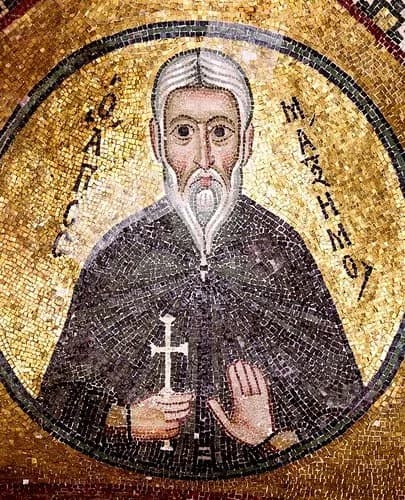
Saint Maximus the Confessor was a Byzantine monk and theologian who would not agree that Christ had only a divine will, and who at over eighty had his tongue and right hand cut off for saying so. 13 Benedict XVI calls him "one of the great Fathers of the Eastern Church in later times," and says his title of Confessor was earned by his "fearless courage" in suffering for the faith. 1 He died in exile on the Black Sea on August 13, 662, and his feast is kept on August 13. 123
Secretary, monk and abbot
He was born about 580. 12 Where is less certain: Benedict XVI says Palestine, "the land of the Lord," while the 1911 Catholic Encyclopedia says Constantinople, into a noble family. 12 Benedict adds that as a boy he was started on the monastic life and the study of Scripture through the works of Origen. 1
The encyclopedia and Vatican News both say he became first secretary to the Emperor Heraclius, who valued him highly. 23 Vatican News describes it as one of the best civil service posts in the empire. 3 He gave it up to become a monk at Chrysopolis, across the water from Constantinople, and rose to be abbot there. 23
He did not stay. Vatican News says Persian invasions drove him to a monastery at Carthage; the encyclopedia says only that he seems to have left Chrysopolis because it was exposed to attack. 23 Benedict XVI describes a longer road, from Jerusalem to Constantinople and then to Africa as a refugee from "the barbarian invasions." 1 The encyclopedia names Sophronius, later Patriarch of Jerusalem, as the man Maximus called his master, father and teacher, and puts the two of them together in Africa. 2
One will or two
The quarrel that shaped the rest of his life was about the will of Christ. 13 A teaching had grown up, Benedict XVI explains, that held there was only one will in Christ, the divine will, as a way of protecting the oneness of his person. 1 Maximus saw that this would leave Christ less than human: "a man without a will," in Benedict's summary, "is not a real man but an amputated man." 1
Vatican News puts his argument in a sentence: the will belongs to a nature, and since Christ has a human nature and a divine one, he has a human will and a divine one. 3 Both Benedict XVI and Vatican News say Maximus found the proof in the agony in Gethsemane, where Christ's human will is set against the death in front of him and then joined to the Father's. 13 For Benedict, this is where Maximus shows that human freedom is fulfilled in saying "yes" to God rather than "no." 1
In July 645 he argued the question in public, at Carthage, against Pyrrhus, a former Patriarch of Constantinople, before the imperial governor. 2 The encyclopedia summarizes the minutes: Pyrrhus said two wills meant two persons willing, and Maximus answered that in that case the Trinity would have three wills. 2 Pyrrhus gave way and went to Rome to retract. 2 Benedict XVI quotes the end of the debate, in which Pyrrhus asks forgiveness "for myself and for those who have preceded me." 1 Vatican News adds that Pyrrhus had been Maximus's friend. 3
Rome and the Lateran Council
The emperor had by then forbidden discussion of the matter altogether, by an edict the encyclopedia calls the Type. 12 Maximus went to Rome and took an active part in the Lateran Council of 649, which Pope Martin I called to defend the two wills of Christ. 123 The encyclopedia says he stayed in Rome for some years afterward. 2
Martin paid first. 13 He was arrested, taken to Constantinople, condemned, and sent into exile in the Crimea. 1 Benedict XVI says he died there on September 16, 655; the 1911 encyclopedia gives March 655, at Inkerman. 12
Trial, exile and mutilation
The encyclopedia says Maximus was brought to Constantinople at the end of 655, when he was about seventy-five, and "not, as is commonly stated, at the same time as St. Martin." 2 He was accused of conspiring with Gregory, the governor of Africa who had rebelled and made himself emperor, and he refused to receive communion from the see of Constantinople. 2 He was sent into exile at Byzia in Thrace, and his two disciples, both named Anastasius, to other places. 2
In 656 a bishop came to him with the emperor's authority to try to bring him round. 2 The encyclopedia gives the exchange in detail. When an official asked whether the emperor would really humble himself before Rome, Maximus answered, "Yes, if he will humble himself as God has humbled Himself." 2 The talks failed. He was struck and spat upon, stripped of his money and clothes, and sent on into further exile. 2
In 662 he and the two Anastasii were tried again in Constantinople. 123 Benedict XVI quotes him at that trial: "It cannot be said that Christ has a single will!" 1 He was condemned as a heretic, and his tongue and right hand were cut off, the two instruments, Benedict notes, with which he had fought the teaching of a single will. 13 The encyclopedia adds that the three were beaten and shown mutilated through the city. 2
He was sent to Colchis, on the Black Sea in what Vatican News calls present-day Georgia, and died there on August 13, 662, at the age of eighty-two, worn out by what had been done to him. 123 The encyclopedia records that the Roman Anastasius, who survived him, wrote that Maximus had foreseen the day of his death in a vision and that lights were seen at his tomb at night. 2
His writings
Maximus wrote a great deal, and the 1911 encyclopedia admits his style "is unfortunately very obscure," while calling him accurate in thought and deeply learned in the Fathers. 2 It lists commentaries on Scripture and on the Lord's Prayer, explanations of difficult passages in Pseudo-Dionysius and Gregory Nazianzen, works against the Monothelites, and many ascetical writings for monks, of which the best known is a dialogue between an abbot and a young monk on the spiritual life. 2
Benedict XVI singles out the Mystagogia, which he calls one of his most important works, and recalls that Hans Urs von Balthasar described his thought as a "cosmic liturgy": Christ unifying the whole created world and offering it to God. 1 The encyclopedia sums up his teaching under two heads, the union of God with humanity in the Incarnation and the union of the human person with God through prayer and the practice of virtue. 2
The Third Council of Constantinople, in 680 and 681, condemned the teaching of a single will and vindicated both Maximus and Pope Martin, Vatican News says. 3 It adds that he is the last person both Catholics and Orthodox recognize as a Father of the Church. 3
What is Saint Maximus the Confessor the patron saint of?
Saint Maximus the Confessor's feast day
Praying with Saint Maximus the Confessor
His argument began in Gethsemane. 13 He read the agony in the garden as the place where a real human will, afraid of death, was joined to the will of God, and Benedict XVI draws from it the line at the center of the audience: "The height of freedom is the 'yes', in conformity with God's will." 1 Anyone who has prayed "not my will but yours" through gritted teeth is standing where he looked.
The encyclopedia says one passage of his letters shows his view "that the smallest point of faith is to be held at the risk of one's life." 2 To most of his contemporaries the question of one will or two must have looked like a scholar's fine distinction. He held to it through two trials, years of exile, beating, and the loss of his tongue and his hand. 12
He was also an abbot and a writer for monks, and the works the encyclopedia says monasteries have always honored are the ascetical ones, a dialogue on the spiritual life and collections of short sayings for the cloister. 2 Vatican News says that once they had silenced him, his silence spoke more powerfully than anything he had written. 3
Benedict XVI closed his audience with a doxology of Maximus's: "We adore one Son together with the Father and the Holy Spirit, as it was in the beginning before all time, is now and ever shall be." 1
Saint Maximus the Confessor, pray for us.
Sources
Saints to turn to next
Others in this collection who are turned to for some of the same things.
- Saint Teresa Benedicta of the CrossOctober 12, 1891 - August 9, 1942Suffering and illnessStudy and teachingCouragePrayer
- Saint Titus BrandsmaFebruary 23, 1881 - July 26, 1942CourageSuffering and illnessPrayerStudy and teaching
- Saint Aelred of Rievaulx1109 - January 12, 1166 (or 1167)PrayerSuffering and illnessStudy and teaching
- Saint Ambrosec. 340 - April 4, 397PrayerStudy and teachingCourage