Saint Théophane Vénard
November 21, 1829 - February 2, 1861
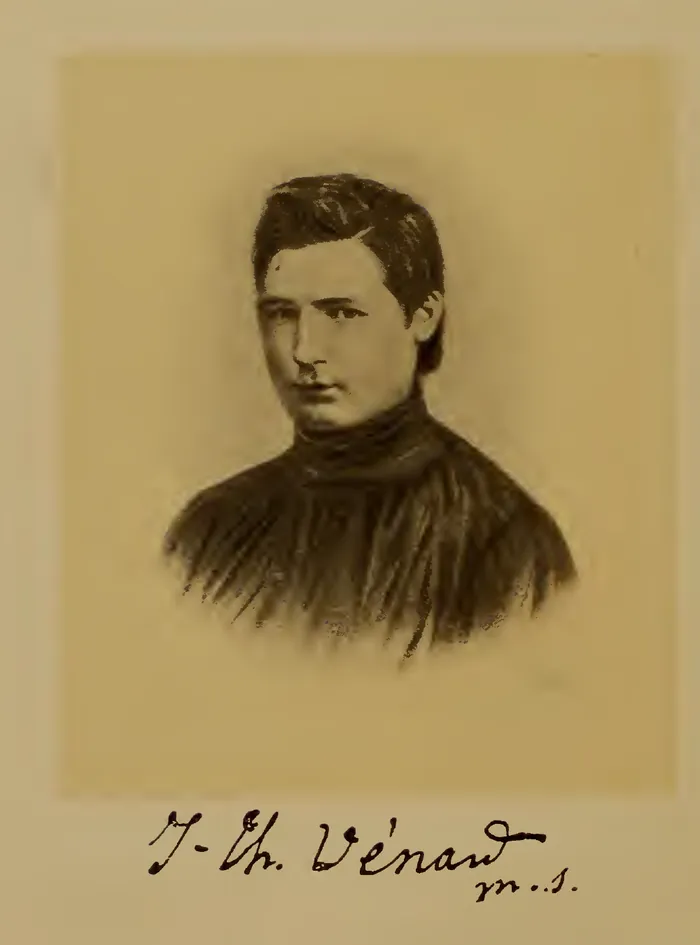
- Patron of
- No patronage is stated in the sources
Saint Théophane Vénard was a French priest of the Paris Foreign Missions Society who ministered in secret for six years in Tonkin, now northern Vietnam, and was beheaded at Hanoi on February 2, 1861, at the age of thirty-one. 127 The letters he wrote to his family from a cage in his last weeks were published, and a generation later they made him the favorite saint of Thérèse of Lisieux. 126 John Paul II canonized him in 1988 among the 117 Martyrs of Vietnam, whose feast is November 24. 238
A goat, a hillside and a pamphlet
He was born on November 21, 1829, at Saint-Loup-sur-Thouet, a small town in the Diocese of Poitiers in western France. 23 His father, Jean Vénard, was the town schoolmaster and farmed a little land besides. 34 There were six children. Two died within days of their birth, and four grew up: Mélanie, Théophane, Henri and Eusèbe. 4
The story of his vocation comes from his own pen. Writing to Eusèbe from prison at the end of his life, he remembered being nine years old (the Norwegian Church's katolsk.no says eight), minding his goat on the hillside of Bel-Air above the town, and reading a pamphlet about Charles Cornay, a missionary beheaded in Tonkin in 1837. 34 He told himself then that he too would go to Tonkin and he too would be a martyr. 4
His mother died in January 1843, while he was away at school at Doué-la-Fontaine. He was thirteen. 34 It was to his older sister Mélanie that he first confided, as a seminarian, that he was thinking of the foreign missions. 3
Paris, Antwerp, Hong Kong
From Doué he went to the minor seminary at Montmorillon and then to the major seminary at Poitiers. 123 He entered the seminary of the Paris Foreign Missions as a subdeacon on March 3, 1851, and was ordained a priest on June 5, 1852. 12 Loyola Press says the decision caused his family great pain, since the society "was a factory for martyrs." 9
On September 19, 1852, he left Paris without knowing exactly which mission he was meant for, sailed from Antwerp, and waited fifteen months at Hong Kong. 123 He had expected China. Instead he was assigned to West Tonkin, and reached it in 1854. 39
Six years in hiding
He arrived in a church under sentence. The encyclopedia says that soon after he came "a new royal edict was issued against Christians, and bishops and priests were obliged to seek refuge in caves, dense woods, and elsewhere." 1 The Roman Martyrology names the emperor as Tu Duc. 7
He was also ill nearly all the time. Katolsk.no lists asthma, typhus and tuberculosis in his first two and a half years. 3 His bishop, Retord, remarked in 1857 that Vénard seemed to have chosen suffering as his specialty. 4
In 1857 he was given charge of the district of Hoang-nguyen, which he described to Mélanie as more than twelve thousand Christians in four large parishes, with six or seven Vietnamese priests under him. 23 With the help of his catechists he also translated into Vietnamese a harmony of the Gospels, the Acts of the Apostles, the Epistles and the Apocalypse. Frightened Christians burned some of the manuscripts, but the Gospel harmony and Acts were printed by the mission press in 1878. 2
In June 1858 the settlement at Hoang-nguyen was destroyed, and he went back into hiding, first in a convent of the Lovers of the Cross and then, in 1859, in the house of an old Christian woman. 239 From there he described his quarters to a friend: "Three missionaries, one of whom is a bishop, lying side by side, day and night, in a space a yard-and-a-half square, getting a dim light from three holes the size of a little finger, made in the mud wall." 9
The cage
He was denounced and arrested at Ke-beo on November 30, 1860; Loyola Press prints 1859. 1239 He was shut in a cage and carried to Hanoi, where he refused to trample on a cross and was sentenced to be beheaded for having come to Tonkin to preach the Catholic faith. 123
He was never beaten. The judges came to see him privately, and one mandarin had the cage enlarged and the chains lightened. 3 "All those around me are civil and respectful, and a good number love me," he told his father. "From the great mandarin down to the last soldier, they all regret that the laws of the country condemn me to death." 9 A bishop forwarding one of his letters (Retord, says the encyclopedia; the Bishop of Acanthus, says the biography) added: "Though in chains, he is as gay as a little bird." 14
He wrote eleven letters to his family from prison. 3 The one to his father, dated January 20, 1861, holds the sentence by which he is remembered: 2 "A slight sabre-cut will separate my head from my body, like the spring flower which the Master of the garden gathers for His pleasure. We are all flowers planted on this earth, which God plucks in His own good time: some a little sooner, some a little later." 1
February 2, 1861
For the day itself he had two garments made, one of white cotton and one of silk, and he wore them only then. 2 An attempt to bring him Communion that morning failed. 3 He chanted psalms and hymns on the way. 1 The executioner, whose only pay was the clothes of the men he killed, asked what he would pay to be killed quickly, and received the answer, "The longer it lasts the better it will be." 123 It took several blows. His society's notice says the man struck that way out of spite, and katolsk.no says the blade was dull. 23
The accounts of his head differ. The encyclopedia says it was exposed on a pole and then secured by the Christians. 1 The society's notice says it was thrown into the Red River, recovered on February 15 and brought to Bishop Theurel, who kept it in the sacristy of the church at Ke-tru. 2 His body was buried where he died, exhumed in 1864 and sent the next year to the seminary in Paris, where it rests in the crypt under the altar of Saint Joseph. 12
News of his death reached France at the end of December 1861, and on the first anniversary the bishop of Poitiers preached on him at Saint-Loup. 23 Leo XIII declared him Venerable in 1879, Pius X beatified him in 1909 with his only surviving brother present, and John Paul II canonized him on June 19, 1988. 12
Thérèse of Lisieux and Théophane
In 1896 the prioress of the Carmel of Lisieux gave Sister Thérèse of the Child Jesus a young missionary, Adolphe Roulland, to pray for. He set her reading missionary lives, and that November she came upon Vénard's letters and made him, in the words of his society's archive, her "favourite saint." 6 For the anniversary of his death in 1897 she wrote him a poem. 3
She was dying of tuberculosis that year. His portrait was pinned to the curtain of her bed, and she wept with joy when she was given a relic of him. 3 John Paul II, speaking to French pilgrims the day after the canonization, said she had lived in a kind of intimacy with Saint Théophane, whose picture did not leave her during her agony, and that she recognized her own experience in a farewell letter where he says he leans on the strength of the one who overcame hell and the world on the Cross, and not on his own. 5
What is Saint Théophane Vénard the patron saint of?
None of the sources read for this page names Saint Théophane Vénard the patron saint of anything. The encyclopedia, his own society, the Roman Martyrology and John Paul II all describe a missionary and a martyr. 1257
The nearest thing is a friendship. Thérèse, whom John Paul II calls in that speech the future patroness of the missions, took him for her own. 5
Saint Théophane Vénard's feast day
Saint Théophane Vénard is celebrated on November 24 with the other Martyrs of Vietnam. 3 Vatican News explains that one priest, Andrew Dung-Lac, gives his name to that feast and stands for 117 people, 96 of them Vietnamese and 21 Spanish or French missionaries. 8
The Roman Martyrology also enters him by name on February 2, the day he died, and katolsk.no notes that he may be commemorated then as well. 37 Loyola Press gives a third date, November 6, without saying where it comes from. 9
Praying with Saint Théophane Vénard
The word every source reaches for is some form of cheerful. A bishop compared him in his chains to a little bird. 1 Loyola Press settles on "happy." 9 The crowd that came to stare at the prisoner in Hanoi said he looked like a man on his way to a feast. 3
The letters do not let that pass for temperament. He was sick for years, hunted from one hole to the next, and for long stretches unable to do the work he had crossed the world to do, which he said was the worst of it. 23 The farewell letter John Paul II quoted says outright that the strength he was leaning on was not his. 5
His death was not gentle either, whatever he had written about a slight cut. The man with the sword needed several strokes, and Vénard went to it without the Communion that someone had tried to bring him. 23
Less than two weeks before he died he told Eusèbe that he had loved the people of Annam and loved them still, and that with more years he would have given himself entirely to building up the Church in Tonkin. 3 He had six years, most of them underground. What they left was a few translated books, a district served for a year, and a bundle of letters that a Carmelite in Normandy read on her deathbed. 236
Saint Théophane Vénard, pray for us.
Sources
- 1.James Anthony Walsh, "Bl. Théophane Vénard," The Catholic Encyclopedia, Vol. 14 (New York: Robert Appleton Company, 1912).
- 2."0635 - Vénard, Théophane (1829-1861)," biographical notice and bibliography in the missionary database of the Institut de recherche France-Asie (IRFA), the archives of the Paris Foreign Missions Society (in French).
- 3.Per Einar Odden, "Den hellige Théophane Vénard (1829-1861)," Den katolske kirke (the Catholic Church in Norway), last updated November 5, 1999 (in Norwegian).
- 4."Life and correspondence of Théophane Vénard, Priest of the Society of Foreign Missions," 7th edition (Paris: H. Oudin, 1888), as published by the Archives of the Carmel of Lisieux.
- 5.John Paul II, Address to the French and Spanish pilgrims in Rome for the canonization of the 117 Martyrs of Vietnam, June 20, 1988 (in French and Spanish).
- 6."Exhibition: Thérèse, woman, intellectual, seeker of meaning," Institut de recherche France-Asie (IRFA), Paris Foreign Missions Society, 2023.
- 7.Roman Martyrology, entry for February 2, "San Giovanni Teofane Vénard, sacerdote," as printed in "Santo del giorno," Conferenza Episcopale Italiana (in Italian).
- 8."Sts. Andrew Dung-Lac, and his companions, Martyrs," Saint of the Day for November 24, Vatican News.
- 9."Saint Théophane Vénard," Saints Stories for All Ages, Loyola Press, from Bert Ghezzi, Voices of the Saints.
Saints to turn to next
Others in this collection who are turned to for some of the same things.