Saint Theodore of Canterbury
c. 602 - September 19, 690
- Synods
- Hertford, September 24, 673; Heathfield, September 17, 680 1
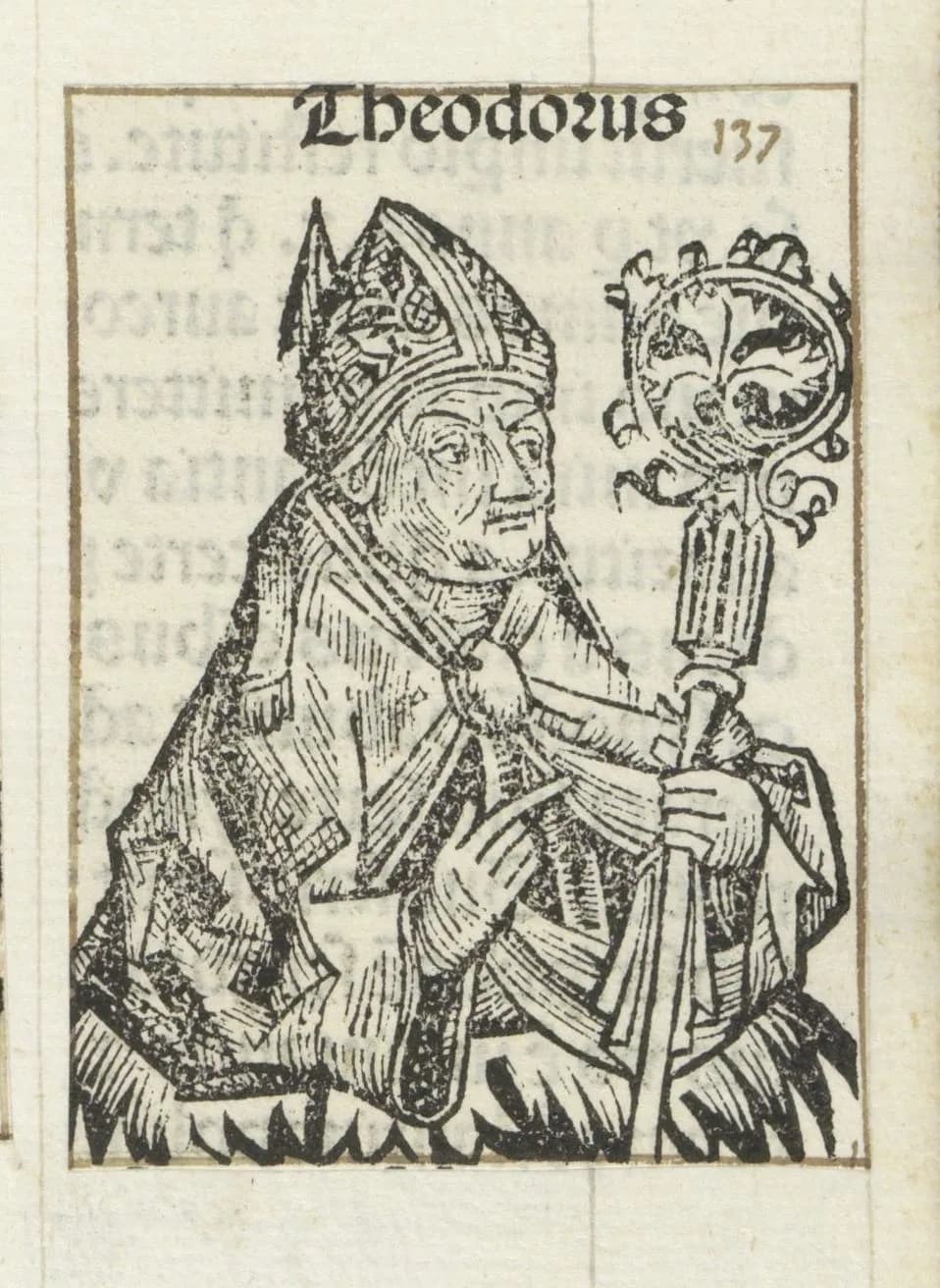
Saint Theodore of Canterbury was a Greek monk from Tarsus whom Pope Vitalian made Archbishop of Canterbury in 668, when he was already in his sixties. 14 He reached England the next year and governed its Church for twenty-one years, and Bede calls him "the first archbishop whom all the English church obeyed." 1 He held the first synod of the whole English province, founded a school at Canterbury, and died on September 19, 690, the day his feast is kept. 234
The third choice
He was not the man anyone had in mind. Archbishop Deusdedit died in 664, and the kings of Kent and Northumbria sent an English priest, Wighard, to Rome to be consecrated in his place. 1 Wighard died there of the plague with almost all his companions. 1 Pope Vitalian then turned to Hadrian, abbot of a monastery near Naples, whom Bede describes as "by nation an African" and learned in both Greek and Latin. 1 Hadrian said he was unworthy and proposed a monk named Andrew, who was too ill to go. Pressed again, he asked for time to find someone else. 1
The someone else was Theodore, a monk then living in Rome, born at Tarsus in Cilicia. 13 Bede calls him "a man well instructed in worldly and Divine literature, as also in Greek and Latin," and says he was sixty-six years old. 1 The encyclopedia adds that he was a monk "(probably of the Basilian Order)" and was not yet in holy orders. 3 The pope agreed, on condition that Hadrian go with him, partly because Hadrian knew the road through France, and partly, Bede says frankly, to see that Theodore did not "according to the custom of the Greeks, introduce anything contrary to the true faith" into his new church. 1
The sources do not quite agree on his age. Bede's figures make him sixty-six at his appointment and eighty-eight at his death in 690. 12 The encyclopedia gives his birth as about 602 and has the pope choose him in 667. 3 The Liturgy Office of the bishops of England and Wales says he was born about 601 and appointed in 666 at sixty-five. 4 All of them agree that Vitalian himself consecrated him on March 26, 668. 13
The road to Canterbury
He and Hadrian left Rome on May 27, 668, sailed to Marseilles and went on by land to Arles, where the archbishop kept them until Ebrin, the king's mayor of the palace, sent a pass. 1 Theodore spent a long stay with Agilbert, the bishop of Paris, while a hard winter held them where they were. 1 King Egbert of Kent sent his prefect Redfrid to fetch him, and after an illness at the port of Quentavic he sailed over to Britain. 1 Hadrian was held back a while longer on suspicion of carrying messages from the emperor. 1
Theodore arrived at his church on Sunday, May 27, 669, a year to the day after setting out. 1 Bede counts his time as archbishop precisely: twenty-one years, three months and twenty-six days. 1
One Church out of many
The Church he found was divided. The encyclopedia describes it as still sore from the long quarrel over the date of Easter, with dioceses as large as kingdoms and many of them empty. 3 Theodore began by going to see it. He "visited all the island, wherever the tribes of the Angles inhabited," Bede writes, with Hadrian beside him, teaching "the right rule of life, and the canonical custom of celebrating Easter." 1
He filled the vacant sees and put right what he found irregular. 13 The best known case is Chad, whose consecration as bishop had not been properly done. Told so, Chad answered, "If you know I have not duly received episcopal ordination, I willingly resign the office, for I never thought myself worthy of it." 1 Theodore would not let him resign, completed the ordination himself, and later had him made bishop of the Mercians. 1 Chad liked to make his rounds on foot. Theodore ordered him to ride on long journeys, and when Chad hesitated, Bede says, "he himself, with his hands, lifted him on the horse." 1
On September 24, 673, he gathered the bishops at Hertford, the first synod of the whole English province. 13 He introduced himself in its acts as "the unworthy bishop of the see of Canterbury, appointed by the Apostolic See," and laid before the bishops ten chapters he had marked in a book of canons. 1 They cover the keeping of Easter, bishops staying out of one another's dioceses, monks and clergy not wandering from place to place, a yearly synod on August 1, and marriage. 1 The ninth proposed that "more bishops should be made, as the number of believers increased," and the acts record that it "for the present was passed over." 1 The encyclopedia calls Hertford "the forerunner and prototype of future English witenagemotes and parliaments." 3
A second synod met at Heathfield on September 17, 680. Theodore had heard that the Church at Constantinople was troubled by heresy, and he had the English bishops set down in writing their agreement with the faith of the five general councils and of the Roman synod held under Pope Martin. 1
The school at Canterbury
Bede dwells on the teaching, and the Liturgy Office credits Theodore with "a great school at Canterbury." 4 He and Hadrian were both learned in sacred and secular letters, and "they gathered a crowd of disciples, and there daily flowed from them rivers of knowledge to water the hearts of their hearers." 1 Along with Scripture they taught "the arts of ecclesiastical poetry, astronomy, and arithmetic." 1 Bede, writing some forty years after Theodore's death, says some of their pupils were still alive and knew Greek and Latin as well as their own language. 12
Church music, until then known only in Kent, began to be learned in all the English churches. 1 Bede's judgment on those years: "Nor were there ever happier times since the English came into Britain." 1
A hard hand
He could be severe. He deposed Winfrid, bishop of the Mercians, for what Bede calls "some disobedience." 1 In 678, when King Egfrid of Northumbria quarreled with Wilfrid and drove him from his see, Theodore consecrated at York the two bishops put in his place and a third for Lindsey, and added two more three years later. 1 The encyclopedia says he divided the Northumbrian diocese against Wilfrid's will, that Wilfrid appealed to Pope Agatho, and that the pope's decision "did not acquit Theodore of arbitrary and irregular action," although the division stood. 3 It also says the two men were fully reconciled before Theodore died and Wilfrid was restored. 3 Its own summary of his character is "inclined to be autocratic, but possessed of great ideas." 3
The same authority could stop a war. In 679 Egfrid fought Ethelred of Mercia near the Trent, and Egfrid's brother Elfwin, about eighteen and loved in both kingdoms, was killed. 1 A longer and bloodier war looked likely. Theodore, Bede says, "by his wholesome admonitions extinguished the dangerous fire that was breaking out," so that no one was put to death and only the customary payment was made for the dead prince. 1
He presided, too, at the synod at Twyford that chose the hermit Cuthbert as a bishop, and he was primate among the seven bishops at Cuthbert's consecration in York the following Easter. 1
Death and burial
Theodore died in 690, "old and full of days," at eighty-eight, an age Bede says he had long told his friends he would reach, having learned it in a dream. 2 He was buried in St. Peter's church at Canterbury with the archbishops before him; the encyclopedia names the place as St. Augustine's Monastery. 23 His epitaph ran to thirty-four verses, of which Bede copied the first four and the last four. One of them gives the day: "And now it was September's nineteenth day." 2
Bede's verdict is short: "the English churches received more advantage during the time of his pontificate than ever they had done before." 2 The encyclopedia notes that almost the only writing he left is the collection of his decisions on matters of discipline known as the Penitential of Theodore, first published complete in 1851. 3
What is Saint Theodore of Canterbury the patron saint of?
Saint Theodore of Canterbury's feast day
Saint Theodore of Canterbury's feast is September 19, the day he died in 690. The National Calendar for England lists him on that day as a bishop, and the Roman Martyrology enters him at Canterbury on the same date, recalling that he was a monk of Tarsus sent to England when he was nearly seventy. 45
Praying with Saint Theodore of Canterbury
He was given the work of his life at an age when most people have finished theirs. He was a foreigner in Rome and then a foreigner among the English, and he was sent with a companion charged to watch what he taught. 1 Bede records no resentment. What he shows is the two of them going around the country together and teaching side by side. 1
His first act was to travel. Before the synods and the new dioceses, he went around the whole country and let people hear him, and Bede says he "was willingly entertained and heard by all persons." 1
The story of Chad shows him well. He told a holy man plainly that his ordination was defective, refused to let him step down over it, mended the defect himself, and then picked him up bodily and put him on a horse, because, Bede says, he thought him a holy man. 1 The sources also show him overreaching with Wilfrid, and the encyclopedia does not hide that Rome said so. 3
Bede remembered him chiefly as a teacher, and the epitaph he copied says the same thing, that Theodore taught "wholesome precepts to his scholars." 2 A man who arrived in his late sixties spent twenty-one years handing on what he knew. 1
Saint Theodore of Canterbury, pray for us.
Sources
- 1.Bede, The Ecclesiastical History of the English Nation (731), Book IV, chapters 1-3, 5, 6, 12, 17, 21 and 28 (London: J. M. Dent, 1910; translator not named, probably L. C. Jane), in the Internet Medieval Sourcebook (Fordham University).
- 2.Bede, The Ecclesiastical History of the English Nation (731), Book V, chapter 8 (London: J. M. Dent, 1910; translator not named, probably L. C. Jane), in the Internet Medieval Sourcebook (Fordham University).
- 3.Oswald Hunter-Blair, "Theodore, Archbishop of Canterbury," The Catholic Encyclopedia, Vol. 14 (New York: Robert Appleton Company, 1912).
- 4."National Calendar for England," entry for 19 September, Liturgy Office of the Catholic Bishops' Conference of England and Wales.
- 5.Roman Martyrology, entry for September 19, "San Teodoro, vescovo," as printed in "Santo del giorno," Conferenza Episcopale Italiana (in Italian).
Saints to turn to next
Others in this collection who are turned to for some of the same things.
- Saints Cyril and MethodiusCyril c. 827 - 869; Methodius c. 826 - April 6, 885Study and teachingCourageWork and vocation
- Saint Gregory of Toursc. 538 - November 17, c. 594Study and teachingWork and vocationCourage
- Saint Józef BilczewskiApril 26, 1860 - March 20, 1923Study and teachingWork and vocationCourage
- Saint Marguerite BourgeoysApril 17, 1620 - January 12, 1700Study and teachingWork and vocationCourage