Saint Tarsilla
Sixth century
- Life
- Virginity, fasting and prayer in her own home on the Clivus Scauri in Rome 3
- Relics
- By tradition in the Oratory of Saint Andrew on the Caelian Hill 3
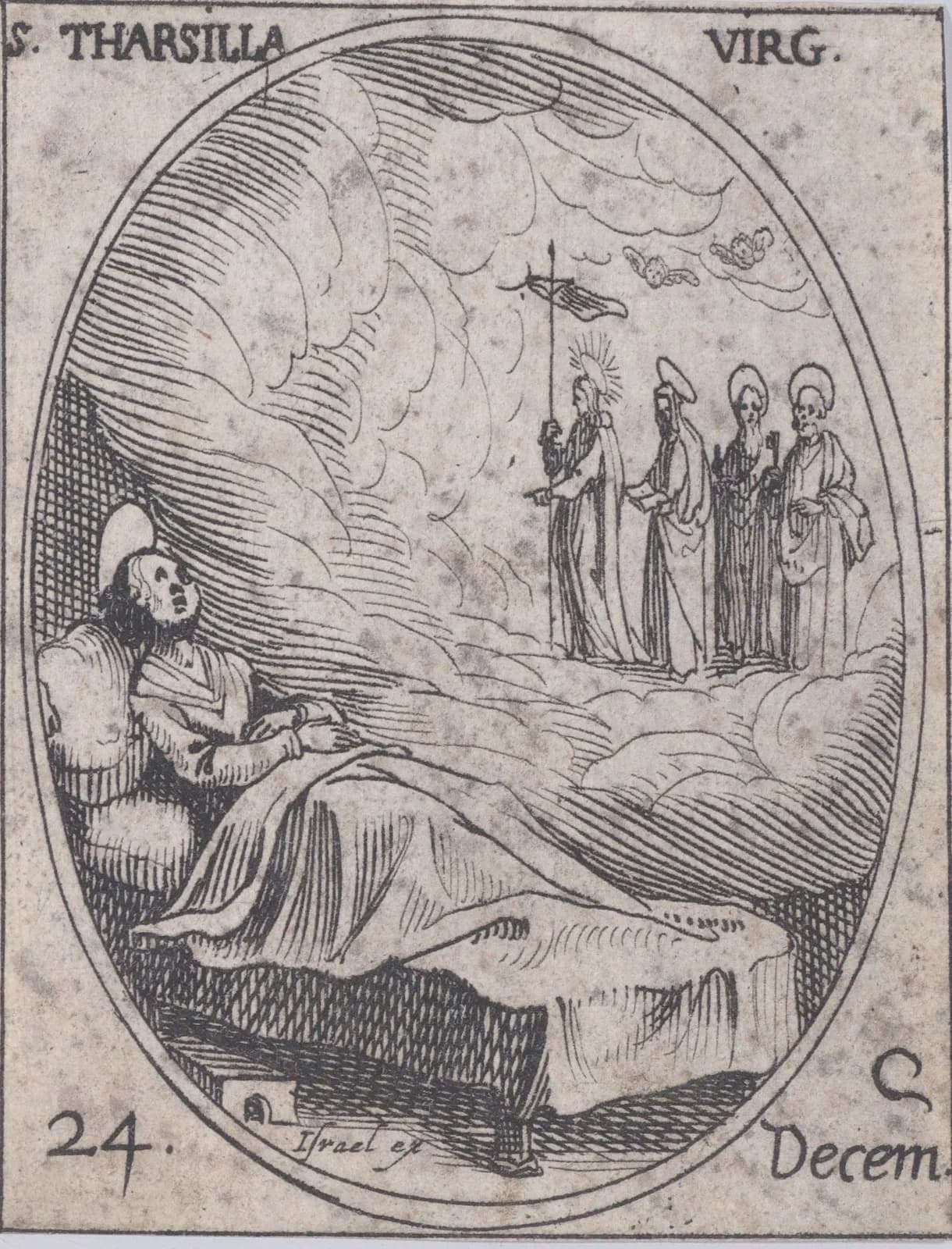
Saint Tarsilla was an aunt of Pope Gregory the Great, one of three sisters of his father who gave themselves to God and lived a life of prayer in their own house in Rome. 13 Gregory told the story of her death twice, once in a homily on the Gospels and again in his Dialogues: she saw Jesus coming for her and cried out to the people around her bed to make way. 13 The Roman Martyrology remembers her on December 24, the day she died. 23
Gregory's aunt
Gregory's father was Gordianus, a wealthy patrician who owned estates in Sicily and a house on the Caelian Hill in Rome. 4 Gilbert Huddleston, in the 1909 Catholic Encyclopedia, notes how unusually holy the family was. Gregory's mother, Silvia, is honored as a saint, and "two of Gregory's aunts have been canonised, Gordianus's two sisters, Tarsilla and Æmiliana, so that John the Deacon speaks of his education as being that of a saint among saints." 4
Gregory calls her "mine aunt Tarsilla" in the Dialogues. 1 Edmund Gardner, who edited the English translation in 1911, gives the three sisters of Gordianus as Tharsilla, Gordiana and Emiliana. 1 The spelling of her name varies; Francis Mershman's encyclopedia article lists Trasilla, Tarsilla, Tharsilla and Thrasilla. 3
Three sisters at home
Mershman, summarizing Gregory, says the three sisters "vowed themselves to God and led a life of virginity, fasting, and prayer in their own home on the Clivus Scauri in Rome." 3 They did not enter a monastery. 3 Catholic.net describes them living in the house as though it were one, each encouraging the others by word and example. 6
Gregory's own words in the Dialogues are brief. Tarsilla, "in the company of two others of her sisters, had for continuance in prayer, gravity of life, singularity in abstinence, arrived to the top of perfection." 1 The Martyrology uses the same three things to remember her: her constant prayer, the seriousness of her life and her unusual spirit of penance. 2
Not all three persevered. Gordiana, Mershman writes, was "led on at first by the words and example of her sisters," but "did not persevere but returned to the vanities of the world." 3 Gardner says simply that she "returned to the world and married," and Catholic.net that she married her guardian. 16 Gregory told the story of all three sisters at greater length in his thirty-eighth homily on the Gospels. 13
Pope Felix and the house of light
After many years in the service of God, Tarsilla had a vision. 3 In the Dialogues, Gregory says that "Felix, my great-grandfather, sometime Bishop of this see of Rome, appeared in vision, and shewed her the habitation of everlasting light, speaking thus: 'Come with me, and I will entertain you in this dwelling place of light.'" 1
The relationship is less certain than the English makes it sound. Gardner notes that Gregory's Latin calls Felix "atavus meus," that he "was probably the third Pope of that name," bishop of Rome from 483 to 492, and that "his exact relationship with St. Gregory is uncertain." 1 Ambrose Coleman's encyclopedia article on Felix III says he was born of a Roman senatorial family "and said to have been an ancestor of Saint Gregory the Great." 5 Gardner adds that Felix had been married before he became a priest. 1 Catholic.net calls him her great-grandfather. 6
Christmas Eve
Soon after the vision Tarsilla fell ill with a fever. 1 Gregory describes the scene at her bed: as was the custom when noble men and women lay dying, many people came, "both men and women," and stood around her. 1 Then, he says, "she, suddenly casting her eyes upward, beheld our Saviour coming: whereupon, looking earnestly upon him, she cried out to them that were present: 'Away, away: my Saviour Jesus is come.'" 1 With her eyes fixed on him, she died. 1
Gregory says a wonderful fragrance filled the room, which he took as a sign that "the author of all sweetness was there present." 1 Mershman and Catholic.net both give the day as the eve of Christmas. 36
One detail Gregory includes is plain and physical. When her body was made ready to be washed, "they found that, with long custom of prayer, the skin of her arms and knees was, like a camel's, become hard." 1 Catholic.net places the calluses on her knees and elbows. 6 Gregory's conclusion is that "her dead body gave sufficient testimony, what her living spirit had continually practised." 1
Her sister Emiliana did not long outlive her. Mershman writes that a few days later Tarsilla appeared to Emiliana "and invited her to the celebration of Epiphany in heaven," and Emiliana is kept in the Martyrology on January 5. 3 Tradition, he adds, places the relics of the sisters, with those of Saint Silvia, in the Oratory of Saint Andrew on the Caelian Hill. 3 Silvia was Gregory's mother. 4
What is Saint Tarsilla the patron saint of?
None of the sources consulted names a patronage for Saint Tarsilla. The Martyrology remembers her for her prayer, her serious life and her penance, as her nephew praised them. 2
Saint Tarsilla's feast day
Praying with Saint Tarsilla
Gregory records no miracle in Tarsilla's life and no public work. She stayed at home in Rome with her sisters and prayed, for years. 13 What Gregory recorded was the result, found on her body after her death. 1
Her life was also not a guarantee for those around her. The same house, the same example and the same vows produced two saints and one sister who went back to the world. 3 Gregory did not leave Gordiana out of the story. 13
Gregory told her story in a homily, and later wrote it down again, because he believed what she saw at the end. 1 In the Dialogues it is one of a series of deaths in which, he says, "the author himself of life" comes for the soul that is departing. 1
She died on the night before Christmas, looking for the Savior and telling the room to make way. 13
Saint Tarsilla, pray for us.
Sources
- 1.Gregory the Great, Dialogues, Book IV, chapter 16, "Of the departure of the holy virgin Tarsilla," with the editor's note, translated by "P. W." (Paris, 1608), re-edited by Edmund G. Gardner (London: Philip Lee Warner, 1911); transcribed by Roger Pearse.
- 2.Roman Martyrology, entry for December 24, "Santa Tarsilla, vergine," as printed in "Santo del giorno," Conferenza Episcopale Italiana (in Italian).
- 3.Francis Mershman, "Sts. Trasilla and Emiliana," The Catholic Encyclopedia, Vol. 15 (New York: Robert Appleton Company, 1912).
- 4.Gilbert Huddleston, "Pope St. Gregory I ('the Great')," The Catholic Encyclopedia, Vol. 6 (New York: Robert Appleton Company, 1909).
- 5.Ambrose Coleman, "Pope St. Felix III," The Catholic Encyclopedia, Vol. 6 (New York: Robert Appleton Company, 1909).
- 6."Tarsila, Santa," Santoral, Catholic.net, with the Roman Martyrology entry in Spanish (in Spanish).
Saints to turn to next
Others in this collection who are turned to for some of the same things.