Saint Catherine of Sweden
1331 or 1332 - March 24, 1381
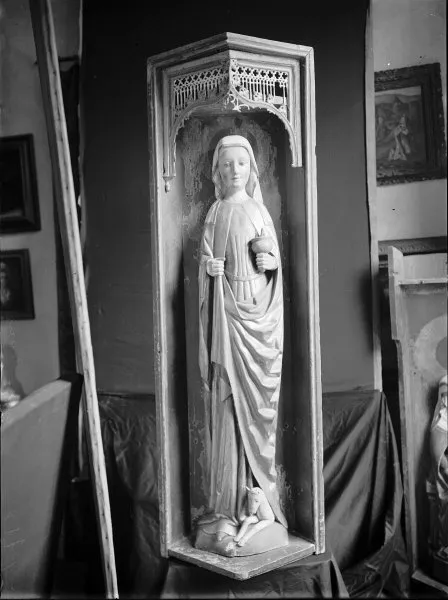
- Born
- 1331 or 1332, a daughter of Saint Bridget of Sweden and Ulf Gudmarsson 1
- Married
- Eggart von Kürnen, at thirteen or fourteen, under a shared vow of chastity 1
- Veneration
- Permitted by Pope Innocent VIII in 1484 1
- Patron saint of
- Vadstena, Sweden; invoked against abortion and for healing and protection from miscarriage 3
Saint Catherine of Sweden was the daughter of Saint Bridget, and she gave most of her adult life to her mother's work: more than twenty years beside her in Rome, then the long journey north with her body, then the charge of the monastery at Vadstena that Bridget had founded. 126 She died there on March 24, 1381. 1 Her feast is kept on that day, and she is invoked for protection from miscarriage. 23
Bridget's daughter
She was born in 1331 or 1332 to Bridget and her husband, Ulf Gudmarsson, a nobleman who governed a district of Sweden. 16 The couple had eight children. 56 The Catholic Encyclopedia calls Catherine the fourth of them; Benedict XVI, in his 2010 catechesis on her mother, calls her the second, using her Swedish name, Karin. 16 He took her as proof of how seriously Bridget raised her children. 6
At seven she was sent to the abbess of the convent of Riseberg to be educated, and the encyclopedia says she soon showed the same pull toward self-denial and prayer that her mother had. 1 At thirteen or fourteen, on her father's orders, she was married to Eggart von Kürnen, a nobleman of German descent. 1 She persuaded him, "a very religious man," to join her in a vow of chastity, and the two lived in virginity, given to prayer and to works of charity. 1 Catholic Culture's summary puts it in a phrase: she married at fourteen "with a mutual vow of chastity." 3
Rome
Ulf died in 1344, and in 1349 Bridget left Sweden for Rome, to keep the jubilee of 1350 and to seek papal approval for the religious order she meant to found. 56 Catherine went too. The encyclopedia says she went with her mother in spite of "her deep love for her husband." 1 Clifford Stevens tells it as a visit that turned into a life: she followed Bridget with her husband's consent, her mother begged her to stay, and "Catherine reluctantly agreed." 2 Soon afterward word came from Sweden that Eggart had died. 12
She was a young widow of rank, and the encyclopedia says she was beautiful and surrounded by suitors. She refused every proposal. 12 From then on she lived with her mother, shared in her work, and took up the same austere way of living. 1 Benedict XVI describes the two in Rome as given over to "a life of intense apostolate and prayer," with pilgrimages to the shrines of Italy. 6 Catholic Culture reckons she was her mother's constant companion for twenty-five years. 3
Near the end they went to the Holy Land, Catherine and her brother Birger traveling with their mother. 1 The sources give three years for the journey: 1372 in the encyclopedia's article on Catherine, 1373 in its article on Bridget, and 1371 in Benedict XVI's account. 156 They returned to Rome, and Catherine was with Bridget through her last illness and at her death on July 23, 1373. 15
Vadstena
In 1374, as her mother had wished, Catherine and Birger carried the body home to Sweden and buried it at Vadstena. 16 Bridget had founded the monastery there in 1346, on her own estate and with the help of King Magnus, as the first house of the Order of the Holy Savior, the Brigittines; from 1349 she had lived in Rome. 57 Catherine now became its head. The encyclopedia on the order calls her its first abbess. 17
It was an unusual house to govern. A Brigittine monastery held nuns and monks in separate wings under the authority of the abbess, with the monks there to give the nuns the priests they needed. 7 Stevens calls it a "mammoth task" to form the community in the rule Bridget had written, since the order "had not been fully established and approved." 2 The encyclopedia says she managed the convent with great skill. 1
Back to Rome
She did not stay long. The encyclopedia says she set out for Rome again the following year, and Stevens says it was some years later, to work for her mother's canonization and to obtain a fresh confirmation of the order. 12 She secured the confirmation twice, from Gregory XI in 1377 and from Urban VI in 1379. 1 The canonization she could not get. The Western Schism broke out while she was there, and the confusion delayed the process; Bridget was not canonized until 1391, ten years after Catherine's death. 15
In the schism she stood with Urban VI, the pope in Rome, and gave evidence for him before a judicial commission. The encyclopedia compares her in this to Catherine of Siena. 1 Stevens says the two Catherines became close friends, and that the Swede almost went with the Sienese on a journey to the court of Queen Joanna of Naples. She drew back because Joanna had led her brother Charles into disgrace, and she "could not bring herself to face the woman who had endangered her brother's soul." 2
After five years in Italy she went home with a letter of commendation from the pope. 1 Not long after reaching Sweden she fell ill, and she died at Vadstena on March 24, 1381, "peacefully," Stevens says, "after a painful illness." 12 The encyclopedia mentions a devotional book of hers, "Consolation of the Soul," made up largely of passages from Scripture and older religious writers, and adds that no copy is known to exist. 1
The hind
In art she usually has a hind at her side. The encyclopedia explains it carefully: the animal "is said to have come to her aid when unchaste youths sought to ensnare her." 1 It offers no more of the story than that, and neither does this page. Catholic Culture lists other ways she is shown: holding a lily, dressing a poor man's wounds, and being brought Communion on her deathbed. 3
What is Saint Catherine of Sweden the patron saint of?
Catholic Culture lists Saint Catherine of Sweden as patron of Vadstena, the Swedish town where she governed her mother's monastery and died, and says she is invoked "against abortion" and "for healing and protection from miscarriage." 3 It does not say where those patronages come from, and the other sources consulted, the encyclopedia among them, name none. 12
Saint Catherine of Sweden's feast day
Saint Catherine of Sweden's feast day is March 24, the anniversary of her death. EWTN prints the date with Stevens's account, Vatican News lists her on 24 March as "St. Catherine of Sweden, Virgin, Daughter of St. Bridget," and Catholic Culture gives her as that day's commemoration from the Roman Martyrology. 234 The encyclopedia, in 1908, said her feast "was assigned to 22 March in the Roman martyrology." 1
Her standing is described in two ways. The encyclopedia says that in 1484 Innocent VIII "gave permission for her veneration as a saint." 1 Stevens says she "was never formally canonized," but that her name was added to the Roman Martyrology and her feast is observed in Sweden and in the Brigittine Order. 2
Praying with Saint Catherine of Sweden
Almost everything she did was begun by someone else. The marriage was her father's decision, the move to Rome her mother's, the order her mother's, and even the errand that filled her last years, the canonization, was for her mother and failed in her lifetime. 12 Stevens says she stayed in Rome reluctantly. What the encyclopedia records is the skill with which she then did the work. 12
Stevens draws the obvious lesson and then complicates it. A holy mother shaped a holy daughter, he writes, but the same mother had a son, Charles, who went another way: "Living with a saint does not necessarily make one holy." 2 Catherine's holiness was her own work as well as her inheritance.
She was also the one who made the vision practical. Bridget wrote a rule; Catherine went to Vadstena and ran the house, then went back to Rome and dealt with two popes and a commission until the order was confirmed. 12 Then she went home, with a letter and without the canonization, and died within a short time. 1
Saint Catherine of Sweden, pray for us.
Sources
- 1.Johann Peter Kirsch, "St. Catherine of Sweden," The Catholic Encyclopedia, vol. 3 (New York: Robert Appleton Company, 1908).
- 2.Clifford Stevens, "St. Catherine of Vadstena," from The One Year Book of Saints (Huntington, IN: Our Sunday Visitor), EWTN Library.
- 3."St. Catherine of Sweden, Virgin (RM)," Liturgical Year, March 24, Catholic Culture.
- 4."St. Catherine of Sweden, Virgin, Daughter of St. Bridget," Saint of the Day, 24 March, Vatican News.
- 5.Johann Peter Kirsch, "St. Bridget of Sweden," The Catholic Encyclopedia, vol. 2 (New York: Robert Appleton Company, 1907).
- 6.Benedict XVI, General Audience, "Saint Bridget of Sweden," October 27, 2010, vatican.va.
- 7.Francesca Steele, "Brigittines," The Catholic Encyclopedia, vol. 2 (New York: Robert Appleton Company, 1907).
Saints to turn to next
Others in this collection who are turned to for some of the same things.
- Saint Nicholas of FlüeMarch 21, 1417 - March 21, 1487PrayerDiscernmentMarriage and family
- Saint Dominic of Silosc. 1000 - December 20, 1073PrayerMarriage and family
- Saint Agnes of Bohemiac. 1200-1205 - March 1281 or 1282PrayerDiscernment
- Saint Agnes of Montepulcianoc. 1268 - April 1317PrayerDiscernment