Saint Nicholas of Flüe
March 21, 1417 - March 21, 1487
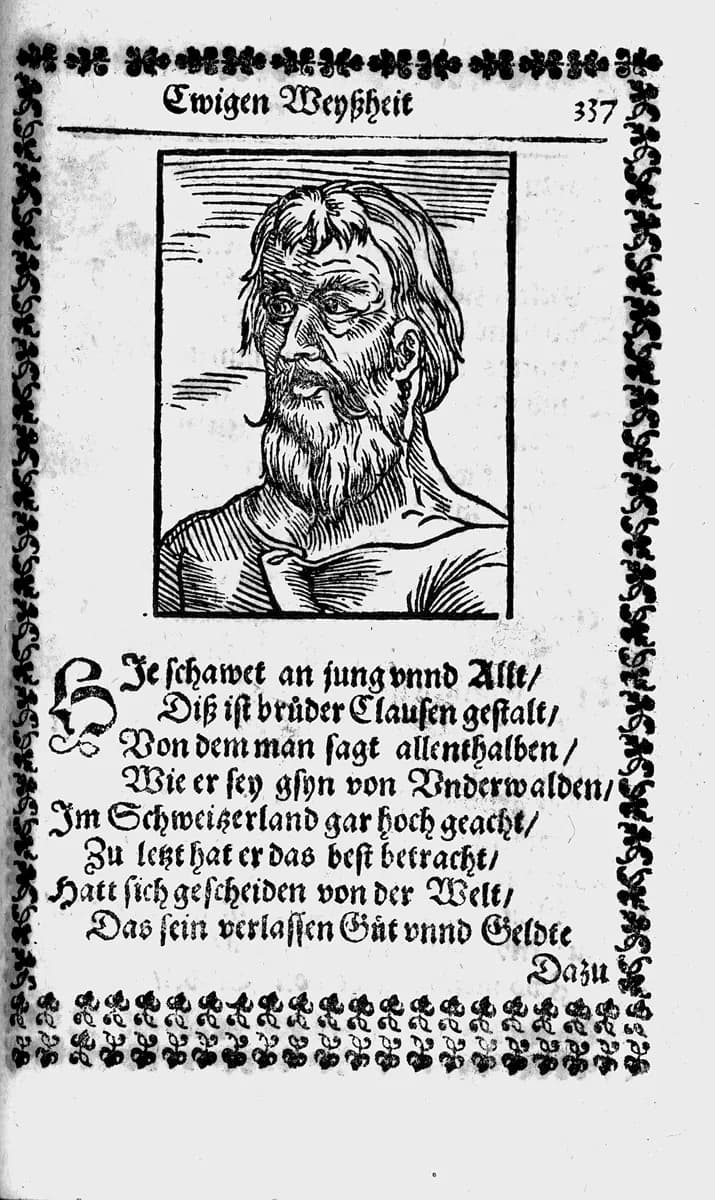
- Born
- March 21, 1417, on the Flüeli near Sachseln, in Obwalden, Switzerland 1
- Left home
- October 16, 1467, for the Ranft, a ravine near Sachseln 1
- Beatified
- 1669, by Clement IX 1
Saint Nicholas of Flüe was a Swiss farmer, soldier, judge and father of ten who, at about fifty, left his house with his wife's consent and spent his last twenty years as a hermit in a ravine an hour's walk from home. 14 The Swiss call him Brother Klaus, and the counsel he sent down from that ravine in 1480 or 1481 is credited with keeping the Confederation out of a civil war. 12 John Paul II called him the "tutelary father of the concord of the Confederation." 5
A farmer from Obwalden
He was born on March 21, 1417, on the Flüeli, a fertile plateau near Sachseln in what is now the canton of Obwalden. 1 The 1913 Catholic Encyclopedia calls him the oldest son of pious, well-to-do peasants, and says that from his youth he was fond of prayer, practiced mortification and did a farm boy's work conscientiously. 1 Vatican News adds that he never learned to read, and still counts him among the greatest mystics of the universal Church. 2
At 21 he went into the army. 1 The encyclopedia places him at the battle of Ragaz in 1446, and probably at the Etzel, at Baar and at the taking of Zürich in the years before it; Vatican News says he served as a soldier and then an officer from 1440 to 1444, in the Confederates' wars against the Habsburgs. 12 He took up arms again in the Thurgau war of 1460, and the encyclopedia credits him with saving the Dominican convent of St. Katharinental, where Austrians had taken refuge, from destruction by the Swiss. 1
Husband, father and judge
He married on his parents' advice. The encyclopedia says he was about 25 and names his wife as Dorothy Wyssling, a pious girl from Sachseln; U.S. Catholic and Angelus put his age at 30, and Vatican News and U.S. Catholic call her Dorothea. 121011 They had five sons and five daughters. 110 The youngest son, also Nicholas, was born in 1467 and became a priest and a doctor of theology. 1
He was elected a cantonal councilor and a judge, though the encyclopedia says he was averse to worldly dignities. 1 In 1462 he was one of five arbiters chosen to settle a dispute between the parish of Stans and the monastery of Engelberg, which the encyclopedia takes as a measure of the esteem he had. 1
Leaving Dorothea
This is the part of his life that is hard to read, and the sources do not all tell it the same way. The encyclopedia says that after about twenty-five years of marriage "he listened to an inspiration of God and with the consent of his wife left his family on 16 October, 1467, to live as a hermit." 1 Vatican News, reporting from Switzerland in 2021, says he left at fifty with the consent of his wife and of his eldest sons. 4
The Vatican News Saint of the Day tells it as a long struggle. For twenty years, it says, the call grew stronger rather than quieter, and he described it as a file that scours and a goad that drives on. 2 In the end he received three graces he had asked for: the consent of his wife and children, freedom from the temptation to go back, and the ability to live without food and drink. 2 It also records that his youngest child was only a few weeks old when he went. 2
U.S. Catholic does not soften this. It calls his choice shocking then and unpalatable now, and says that Dorothea and the children surely bore costs that history barely records, while contemporary accounts stress that he had her full support. 10 It notes that the household still had three grown men in it, a twenty-year-old son, his father and his brother, and that he stayed close by and saw the family on Sundays. 10 Angelus says simply that his wife and children approved. 11 The page leaves these accounts as they are.
Brother Klaus in the Ranft
He did not mean to stay near home. Vatican News says he set out for religious communities in Alsace and got no farther than Liestal, near Basel; the encyclopedia says that near Basel a divine inspiration ordered him to settle in the Ranft, a ravine along the Melcha about an hour's walk from Sachseln. 12 At first he lived in a hut of branches and leaves he built himself and walked to Mass at Sachseln or Kerns. 1 Early in 1469 the civil authorities built him a cell and a chapel, and from 1479, when a chaplain was put in charge of it, he stayed in the Ranft. 1
The encyclopedia states that he lived there over twenty years "without taking any bodily food or drink, as was established through a careful investigation, made by the civil as well as the ecclesiastical authorities of his times." 1 Vatican News says he lived on the Eucharist alone, barefoot and in rough cloth, with a rosary in his hand. 2 The encyclopedia also reports that in 1468 he saved the town of Sarnen from a fire by his prayers and the sign of the cross. 1
He was not left alone. People came for advice, Vatican News says, and called him Brother Klaus because he spoke plainly and without learned references; one saying it keeps is that in all things mercy is greater than justice. 2 The encyclopedia says distinguished visitors came from nearly every country in Europe, and U.S. Catholic that pilgrims sometimes waited weeks and that he counseled visitors from sunup to sundown. 110
Stans and the peace of the Confederation
The sources date the crisis a year apart. The encyclopedia says that in 1480 delegates of the Swiss confederates met at Stans to settle their differences, civil war seemed inevitable, and Henry Imgrund, the pastor of Stans, hurried to the Ranft to beg the hermit to prevent bloodshed. 1 "The priest returned to the delegates with the hermit's counsels and propositions, and civil war was averted," it says. 1 Vatican News and Angelus date it to 1481. 211 U.S. Catholic says he sent a letter whose exact words are unrecorded, and Angelus that he drafted several proposals until agreement was reached. 1011
Vatican News says he is remembered for it as father of the homeland, and that in 1482 he was called on again, in a dispute between Constance and the Confederation over rights in the Thurgau, and again restored peace. 2 Addressing the Swiss Federal Council in 1984, John Paul II said the Swiss had learned tolerance early and that "the greatest instruction in which was received from St Nicholas of Flue." 5
He died in his cell on his seventieth birthday, March 21, 1487. 12 Angelus says his wife and children were with him. 11 He was buried in the parish church at Sachseln, and the encyclopedia says pilgrims visit the chapel near the church where his relics are kept. 14 Clement IX beatified him in 1669, and Pius XII canonized him in 1947. 1210
What is Saint Nicholas of Flüe the patron saint of?
He is the patron of Switzerland: Vatican News titles its page for him "St. Nicholas of Flüe, Patron of Switzerland," and Francis, speaking to the Swiss Guard in 2022, called him "the guardian of the Swiss Federation." 37 Benedict XVI in 2006 and Leo XIV in 2026 named him, with Saint Martin and Saint Sebastian, among the patrons of the Pontifical Swiss Guard. 68
His prayer reaches further than his country. The Catechism of the Catholic Church quotes it in its paragraph on making good use of created things, using only what brings a person closer to God, and Leo XIV commended it to the Guard for their night watches. 89
Saint Nicholas of Flüe's feast day
His feast is March 21, the day he died. 1 The 1913 Catholic Encyclopedia says plainly that "his feast is celebrated on 21 March," and the Vatican News Saint of the Day keeps him on that date. 13
Switzerland keeps him on September 25. Vatican News reported in 2021 that the day has been a holiday in Obwalden, his home canton, since his canonization in 1947, with Masses and pilgrims at Sachseln, the Flüeli and the Ranft, and that the Church celebrates his feast then; U.S. Catholic says his feast day is observed in Switzerland on September 25. 410
Praying with Saint Nicholas of Flüe
The sources do not let the cost of his vocation disappear. He left a wife and ten children, the youngest a few weeks old. 2 U.S. Catholic, which says contemporary accounts stress Dorothea's support, also says that she and the children bore costs history barely records. 10 Both of those things are part of his story, and neither cancels the other.
What Vatican News describes is a call heard for twenty years before it was answered, and answered only after he had asked for his wife's and children's consent. 2 He also did not go far. He ended up an hour's walk from the house, and U.S. Catholic says the family came to see him on Sundays. 110
His solitude turned out to be crowded. The man who had withdrawn from councils and courts was sought out by people from all over Europe, and his counsel, carried down to Stans by a parish priest, is credited with keeping his country out of a civil war. 12 U.S. Catholic puts it down to the reputation his life of prayer had given him, which made him a voice the rival cantons could all trust. 10
The Church has kept his prayer, which the Catechism quotes and which a pope commended to soldiers standing guard at night. 89 It asks to be given whatever draws a person closer to God and to have taken away whatever does not. The sources record a man who gave up a farm, a seat on the council and a household to live by it, and they record what that giving up cost the people he lived with. 110
Saint Nicholas of Flüe, pray for us.
Sources
- 1.Michael Ott, "Blessed Nicholas of Flüe," The Catholic Encyclopedia, vol. 11 (New York: Robert Appleton Company, 1911).
- 2."Hl. Nikolaus von Flüe, Patron der Schweiz," Saint of the Day, March 21, Vatican News (German edition).
- 3."St. Nicholas of Flüe, Patron of Switzerland," Saint of the Day, March 21, Vatican News.
- 4."Schweiz: Bruder Klaus-Tag mit Festprogramm," Vatican News (German edition), September 25, 2021.
- 5.John Paul II, Address to the Members of the Federal Council of the Swiss Confederation, Lohn, June 14, 1984.
- 6.Benedict XVI, Homily for the Fifth Centenary of the Foundation of the Pontifical Swiss Guard, May 6, 2006.
- 7.Francis, Address to the Pontifical Swiss Guard, May 6, 2022.
- 8.Leo XIV, Address to the Pontifical Swiss Guards, May 7, 2026.
- 9.Catechism of the Catholic Church, no. 226 and note 51.
- 10.Kenneth McIntosh, "St. Nicholas of Flue, a contemplative who saved his country," U.S. Catholic, August 12, 2026.
- 11."Saint of the day: Nicholas of Flue," Angelus (Archdiocese of Los Angeles), March 21, 2026.
Saints to turn to next
Others in this collection who are turned to for some of the same things.