Saint Arnulf of Metz
c. 580 - c. 640
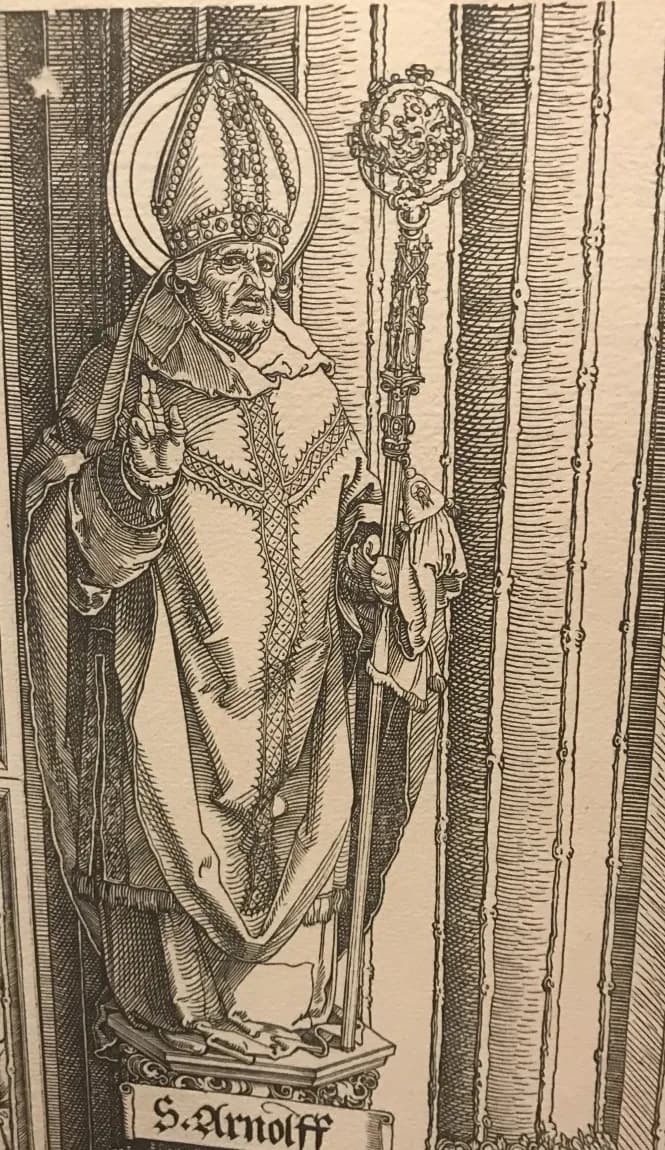
- Born
- About 580, of a Frankish noble family in Austrasia 1; between 582 and 590 by his tenth-century Life 2
- Patron saint of
- Metz; brewers and millers; finding lost things 2
Saint Arnulf of Metz spent most of his life running a kingdom. He was a Frankish noble who governed six provinces for the kings of Austrasia, became bishop of Metz without ever leaving the court, and tutored the young King Dagobert, and through his son Anseghisel he became an ancestor of Charlemagne. 12 Then, in the late 620s, he gave it all up, went into the mountains of the Vosges with his friend Romaricus, and lived there as a hermit until he died. 123
A career at the court of Austrasia
Arnulf was born about 580, says Francis Schaefer in the 1907 Catholic Encyclopedia, to a distinguished Frankish family living in Austrasia, the eastern part of the kingdom Clovis had founded. 1 The Norwegian bishops' saints database (katolsk.no) follows his tenth-century Life in putting his birth between 582 and 590, notes that others give August 13, 582, or about 570, and suggests the family villa at Lay-Saint-Christophe, just north of Nancy, as his birthplace. 2 Both say he did well at school; katolsk.no adds that his mother shaped his faith. 12
He was sent, as was the custom, to the court of Theodebert II, king of Austrasia from 595 to 612, to learn government. 1 Under Gundulf, the mayor of the palace, he rose quickly to be among the king's first ministers, distinguished both as a military commander and in civil administration, and at one time he had six provinces in his care. 12 At court he made a friend of his own age, another young noble named Romaricus. katolsk.no says the two helped each other keep a Christian life in a world that was still half barbarian, and that Arnulf sometimes felt a need to be alone in the middle of a feast or a hunt. 2
He married a Frankish noblewoman, and they had two sons, Anseghisel and Clodulf. 1 katolsk.no gives her name as Doda, while noting that the name first appears in the tenth century, and says he had thought of withdrawing from the world before his family pressed him to marry. 2 The encyclopedia notes that even while he was enjoying worldly rewards and honors, his thoughts often turned to monasteries, and that he and Romaricus planned a pilgrimage to the abbey of Lérins with the evident purpose of giving their lives to God. 1
Austrasia in those years was torn apart by the feud of Queen Brunhilda's family. After Theodebert's death in 612, Arnulf, Pepin of Landen and other nobles turned to Clothaire II, king of Neustria, and brought him into Austrasia. 1 katolsk.no gives Arnulf and Pepin a leading part in the opposition to Brunhilda, which ended in 613 with her overthrow and Clothaire as king of all the Franks. 2
Bishop of Metz, and still a minister
Before the plan for Lérins could be carried out, the see of Metz fell vacant. Arnulf was universally thought a worthy candidate, and he was consecrated bishop about 611, according to the encyclopedia. 1 katolsk.no dates it to 614 and adds that his wife had by then entered a convent at Trier, and that the king approved the election on one condition, that Arnulf keep his offices of state. 2
He kept them. Schaefer says he set his people the example of a virtuous life, took part in a council of the Frankish bishops at Reims in 625, and remained a leading figure in the nation's life. 1 katolsk.no has him at councils in Clichy in 626 and Reims in 627, and says he used public money for widows, the poor and orphans. 2 When Clothaire entrusted Austrasia to his young son Dagobert, Arnulf became the boy's tutor and chief minister, and when father and son fell out, he worked with other bishops and nobles to reconcile them. 1
His family's future was settled in these years. His son Anseghisel married Begga, a daughter of Pepin of Landen, and their son was Pepin of Heristal, founder of the Carolingian dynasty. 12 In this way Arnulf was the ancestor of Charlemagne, and katolsk.no notes that the Carolingians are sometimes called the Arnulfings after him. 12 Clodulf became his third successor as bishop of Metz. 12
Schaefer reads the whole career as a picture of what a bishop was in the Merovingian state: an adviser to the king, a judge, an ambassador, and for the people "the link uniting royalty with its subjects." He concludes: "The opportunities for good were thus unlimited; and Arnulf used them to good advantage." 1
The hermitage in the Vosges
He was not easy in the work. The encyclopedia says he dreaded the responsibilities of a bishop and grew weary of court life, and that about 626 he obtained a successor at Metz. 1 katolsk.no places the resignation in 629, after Clothaire's death, and tells the story that Dagobert opposed it so strongly that he threatened Arnulf's sons, and gave way only after Arnulf, on leaving the city, stopped a fire in the palace with the sign of the cross. 2 By then Romaricus had already left the court and, with Saint Amatus, founded the monastery at Habendum that later took his name, Remiremont. 2
Arnulf joined him in the mountains of the Vosges. 123 katolsk.no says he chose a hermitage of his own near Romaricus's monastery, served by a few monks, and spent his last years in prayer and fasting and in caring for lepers, who came up the steep paths to find him. 2 It also says he trained two young monks of Remiremont at Romaricus's request. 2 Near the end, in katolsk.no's account, Romaricus crossed the ravine to sit with him, and Arnulf said he expected to come before God having done no good in this world. 2
He died there about 640. 1 katolsk.no gives July 18, 640, with a query beside August 16, 641. 2 Romaricus buried him, and about a year later Bishop Goeric of Metz carried his body back to the city and laid it in the basilica of the Holy Apostles. 1 katolsk.no says the procession came down the old Roman road along the Moselle, that the church was renamed for Arnulf in 717, and that today only a fragment of his skull and his ring survive, in the cathedral of Metz. 2
The ring and the beer
Two legends attached themselves to him, and katolsk.no tells both as legends. In the first, Arnulf threw his gold ring into the Moselle from a bridge at Metz, and it was found later in the belly of a fish served at his table as bishop. 2 Another version has him say he would believe his sins forgiven when the ring came back to him. 2 katolsk.no says the story was said to come from Charlemagne by way of Paul the Deacon, and that the ring kept at Metz, gold set with a stone engraved with fish in a net, was carried in procession on his feast, survived the Revolution in the hands of a mint officer, and returned to the cathedral treasury in 1846. 2
The second is set on the road to Metz. When the bearers of his body stopped near Champigneulles in the heat of summer, there was almost nothing left to drink, and the duke leading the procession prayed to Arnulf; the barrels were found full, with enough left over for the next day. 2 That story, says katolsk.no, is why the brewers of Lorraine took him for their patron. It adds that he is often confused with Saint Arnulf of Soissons, another patron of brewers. 2
What is Saint Arnulf the patron saint of?
Saint Arnulf's feast day
Saint Arnulf's feast day is July 18. 23 The current Roman Martyrology remembers him on that day at Metz as a bishop who counseled Dagobert, king of Austrasia, and who laid down his office to live as a hermit in the Vosges. 23 katolsk.no adds that the Bollandists took July 18 to be the day of a translation rather than of his death; that French martyrologies give August 16 as his death; that the canonesses of Remiremont kept both days; and that Metz keeps a feast of his translation on August 19. 2
Praying with Saint Arnulf
Arnulf's life divides cleanly in two, and the first part was not a mistake to be repented of. He governed provinces, married, raised sons, sat in councils and served three kings, and the encyclopedia's verdict on all of it is that he used the opportunities well. 1 The longing for solitude that katolsk.no describes was there through all of it, at feasts and on hunts, and for years he did not act on it. 2
When he did, he took the people he loved into account. Romaricus had gone first; Arnulf followed his friend and lived near him rather than in his house. 2 He was still sought out, and the lepers who climbed to his cell found him there. 2
His last recorded words, in katolsk.no's telling, are a confession that he had done no good in the world, from a man the Church has remembered on its calendar ever since as someone who did a great deal. 23 The life does not settle the distance between those two judgments. It leaves a public man who kept a private hope alive for most of his life, and went after it at the end.
Saint Arnulf of Metz, pray for us.
Sources
- 1.Francis Schaefer, "St. Arnulf of Metz," The Catholic Encyclopedia, Vol. 1 (New York: Robert Appleton Company, 1907).
- 2."Den hellige Arnulf av Metz (582-640)," Den katolske kirke (katolsk.no), Catholic Diocese of Oslo (in Norwegian).
- 3.Roman Martyrology, entry for July 18, "Sant'Arnolfo, vescovo," as printed in "Santo del giorno," Conferenza Episcopale Italiana (in Italian).
Saints to turn to next
Others in this collection who are turned to for some of the same things.
- Saint Dominic of Silosc. 1000 - December 20, 1073PrayerMarriage and familyWork and vocation
- Saint Edward the Confessorc. 1003 - January 5, 1066Marriage and familyWork and vocationPrayer
- Saint Isidore the Farmerc. 1070 - May 15, 1130Work and vocationPrayerMarriage and family
- Saint Kinga1224 or 1234 - July 24, 1292Marriage and familyPrayerWork and vocation