Saint Kinga
1224 or 1234 - July 24, 1292
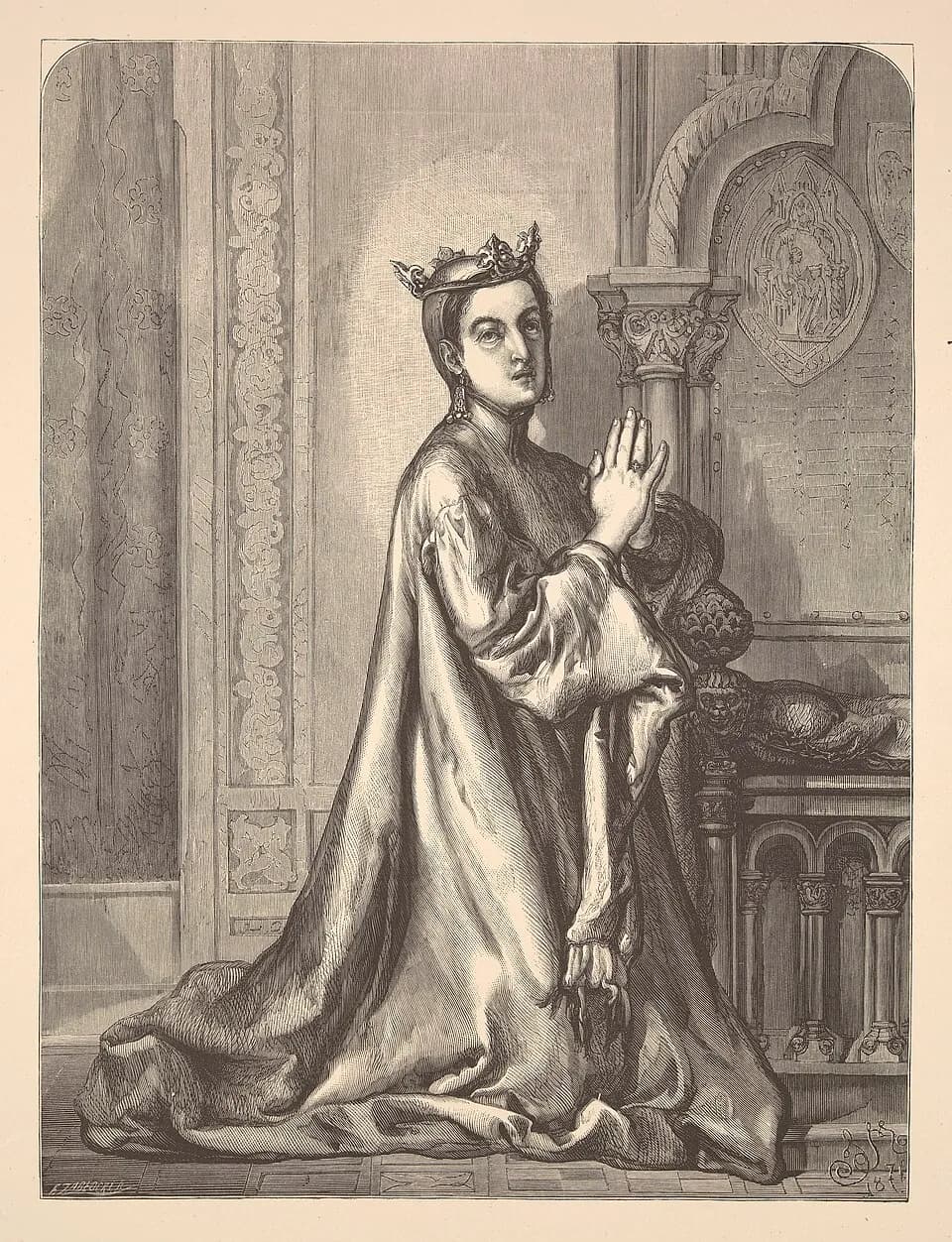
- Not to be confused with
- Saint Cunegunde the Empress, canonized by Innocent III in 1200 7
Saint Kinga was a Hungarian king's daughter who married a Polish prince, persuaded him to live with her in a vow of chastity, gave her dowry to rebuild a country wrecked by the Tartars, and ended her life as a Poor Clare in the convent she founded at Stary Sacz. 123 She is sometimes called Cunegunda, and is a different saint from the Empress Cunegunde of two centuries earlier. 27 John Paul II canonized her at Stary Sacz on June 16, 1999, and her feast in Poland is July 24. 13
A daughter of the Arpad kings
Kinga was the daughter of King Bela IV of Hungary and his wife Maria, a daughter of the Byzantine emperor. 34 The 1908 Catholic Encyclopedia and the New Catholic Encyclopedia both give her birth as 1224; the biography L'Osservatore Romano published for the canonization says 1234, at Esztergom, the third daughter of the family. 235
Few families have produced as many saints. Her aunt was Saint Elizabeth of Hungary, her sister Saint Margaret of Hungary, and another sister, Jolenta, is a Blessed. 123 John Paul II, standing at Stary Sacz, reeled off the holy women of the Arpad line, and asked, "Is it not obvious that the light of holiness in her family led Kinga to God's holy name?" 1
A child bride in Poland
The marriage was a matter of state. 34 The 2020 essay in L'Osservatore Romano, citing the chronicler Jan Długosz, says she was brought to Poland in 1239, aged five, to marry Boleslaus, the young Prince of Sandomierz, later called the Chaste; the Krakow lords hoped it would bind Hungary to them against the Tartars. 4 The New Catholic Encyclopedia dates the marriage itself to 1239, while the essay says the wedding was not held until about 1247. 34 The 1908 encyclopedia says she consented to it "with extreme reluctance." 2
John Paul II said she arrived first at Wojnicz and then Sandomierz, and found friends in her future mother-in-law Grzymisława and her sister-in-law Salomea, women of deep piety, prayer and Scripture reading, whose company in "the first, difficult years" shaped her. 1 She took as her own patroness her relative Hedwig of Silesia. 1 With Bishop Prandota of Krakow she worked for the canonization of Saint Stanislaus, which the 2020 essay dates to 1253. 14
The vow of chastity
Kinga wanted to belong wholly to God, and John Paul II says that when she had to marry, "she convinced him to live a life of virginity for the glory of God." 1 The sources place the vow differently. 124 The Pope says that after "a waiting-period of two years" the couple made a vow of perpetual chastity "in the hands of Bishop Prandota"; the 1908 encyclopedia says "not long after their marriage"; the 2020 essay says it came after the Tartars had invaded and been driven back, as an offering of thanks. 124
The essay is careful about what the vow meant. It was "a conscious choice, not at all easy for Bolesław," and it was not a sign of a marriage in crisis. 4 Boleslaus often wrote in official documents that he had decided something on his wife's advice. 4 John Paul II, preaching on it, said the way she lived was "perhaps difficult to understand nowadays", and drew from it the lesson that "both marriage and virginity lived in union with Christ can become a path to holiness." 1
Princess of Little Poland
According to the 1999 biography, she governed with her husband, signing and sealing documents jointly, through forty years in a country left weak by two Tartar invasions. 5 John Paul II says that "in order to raise the country from ruin she did not hesitate to give away the entire dowry received from her father," and that she received the land of Sacz in exchange. 1 The rock salt mines of Wieliczka and Bochnia, he said, are "linked to her name"; the 2020 essay credits her with founding them, with trained miners brought in from Hungary, so that the country had a steady income. 14
She cared for her people directly. 12 The 1908 encyclopedia says she visited the poor and the sick in the hospitals and nursed lepers "with a charity scarcely less than heroic." 2 The old biographies, John Paul II said, record that the people called her their "comforter", "physician", "nurse" and "holy mother." 1 He also linked her and her convent to the first book in Polish, the Psalter of David. 1
The Poor Clare of Stary Sacz
Boleslaus died in 1279. 23 The 1908 encyclopedia says her people begged her to take over the government, and instead she sold everything she had for the poor. 2 All the sources agree that she founded the Poor Clare convent at Stary Sacz, but they tell her entry differently. 235 The 1908 encyclopedia has her entering on her husband's death and spending thirteen years there; the 1999 biography says she founded the convent in 1280, lived in it as a guest for eight years, and entered only in 1288, later becoming prioress. 25
She asked the sisters never to mention that she had been a queen or that she had founded the house. 2 The 2020 essay adds that she placed the convent directly under the Pope, which kept its property out of the hands of Leszek the Black. 4 She died there on July 24, 1292. 235
A long road to canonization
Pope Alexander VIII approved her cult in 1690, and in 1695 the Congregation of Rites declared her chief patroness of Poland and Lithuania. 23 A canonization cause was funded in the eighteenth century, the 2020 essay says, and then interrupted by the partitions of Poland. 4 Her heroic virtues were declared on July 3, 1998, and John Paul II canonized her at Stary Sacz on June 16, 1999. 3
What is Saint Kinga the patron saint of?
Saint Kinga's feast day
Saint Kinga's feast is kept in Poland on July 24, according to the New Catholic Encyclopedia, the day of her death in 1292. 3 The Franciscans have kept her on other days: July 27 in both the 1908 encyclopedia and the New Catholic Encyclopedia, and July 23 in the calendar of the Secular Franciscan Order in the United States. 236
Praying with Saint Kinga
She was married at the will of others, and then made something of it that neither family had planned. 14 John Paul II read her marriage as a defense of marriage itself, "this indissoluble union of love between two persons", which "is the way of holiness, even when it becomes the way of the Cross." 1
Her charity had a practical edge. 14 She gave away a dowry to rebuild a country, brought in miners, took legal care of her convent's land, and still went in person to the lepers. 124 The Pope held her up to people in public life, asking that politics and economics never lack "the spirit of service, honesty, truth, and concern for the common good." 1
At the end she gave up a throne for a cell and asked the sisters to forget who she had been. 25 The 1908 encyclopedia says she was known in the convent above all for "her heroic humility." 2
John Paul II built his homily on a single line: "Saints do not fade away." 1 What kept her from fading, he said, was love, and "having renounced natural motherhood, she became a true mother to all." 1
Saint Kinga, pray for us.
Sources
- 1.Pope John Paul II, Homily at the Canonization of Blessed Kinga, Stary Sacz, June 16, 1999.
- 2.Stephen Donovan, "Blessed Cunegundes," The Catholic Encyclopedia, vol. 4 (New York: Robert Appleton Company, 1908).
- 3."Kinga, St.," New Catholic Encyclopedia, 2nd ed. (Detroit: Gale, 2003), via Encyclopedia.com.
- 4.Anna Szczepan-Wojnarska, "Kinga, the chaste queen at the service of the poor," L'Osservatore Romano, August 2020.
- 5."St. Kinga," L'Osservatore Romano, July 7, 1999, in the Catholic Culture library.
- 6."Franciscan Saints, Blesseds, and Feasts," National Fraternity of the Secular Franciscan Order, USA, 2023.
- 7.Michael Ott, "Pope Innocent III," The Catholic Encyclopedia, vol. 8 (New York: Robert Appleton Company, 1910).
Saints to turn to next
Others in this collection who are turned to for some of the same things.
- Saint Isidore the Farmerc. 1070 - May 15, 1130Work and vocationPrayerPoverty and simplicityMarriage and family
- Saint Alexius of RomeFifth century, by traditionPoverty and simplicityMarriage and familyPrayer
- Saint André BessetteAugust 9, 1845 - January 6, 1937PrayerWork and vocationPoverty and simplicity
- Saint Benedict the Moor1524 or 1526 - April 4, 1589Work and vocationPoverty and simplicityPrayer