Saint Edward the Confessor
c. 1003 - January 5, 1066
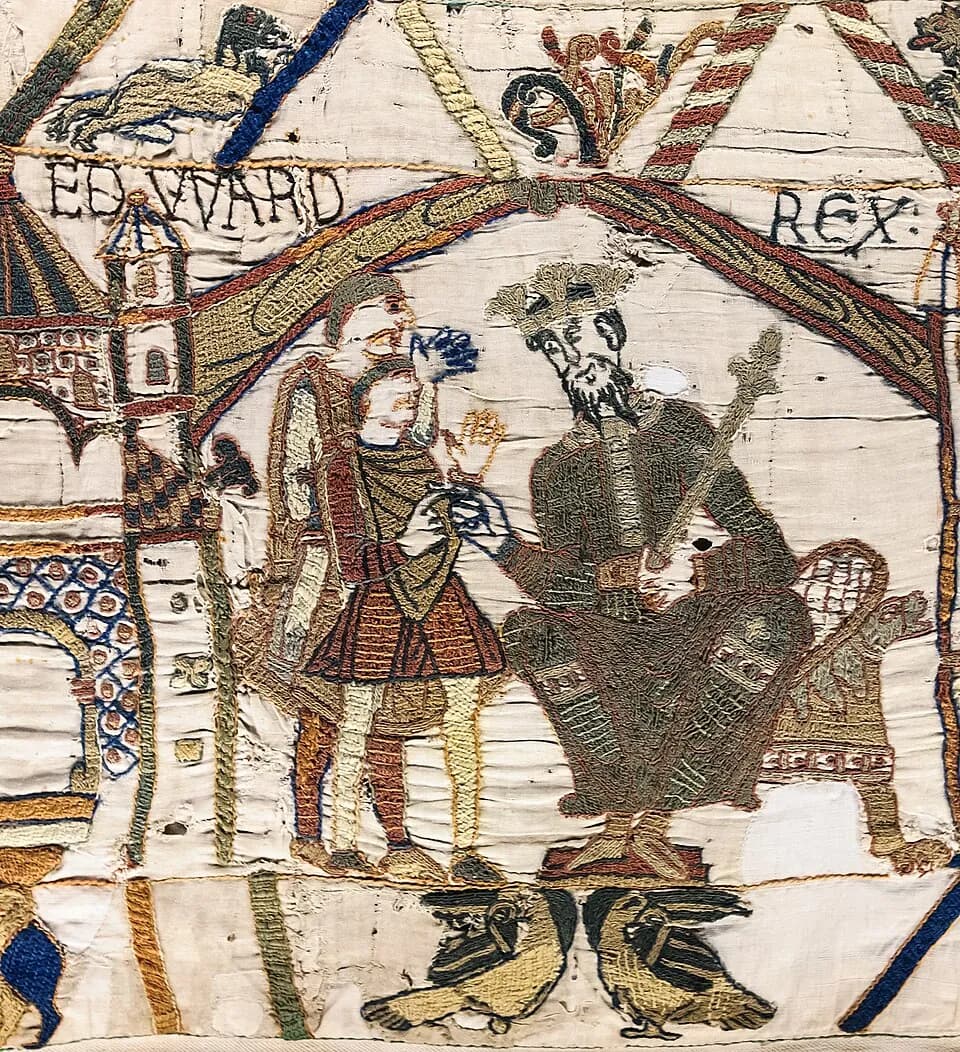
- Patron saint of
- Kings, difficult marriages and separated spouses, according to CatholicIreland.net 5; difficult marriages, according to the English Dominicans 6. Formerly patron of England, and afterward of the English royal family 56
- Feast day
- October 13, the anniversary of the translation of his body in 1163 156; Vatican News lists him on January 5 2
- Died
- January 5, 1066 1
Saint Edward the Confessor was the king of England who rebuilt Westminster Abbey, saw it dedicated a week before he died on January 5, 1066, and was buried inside it. 1 He is the only English king the Church has canonized, 67 and the year of his death is the year everyone remembers for another reason: with no child to succeed him, the crown went to Harold, and William of Normandy came to take it. 5 His feast is kept on October 13, the day his body was moved to a new shrine in 1163. 1
An English prince raised in Normandy
Edward was the son of King Ethelred II and of Emma, a daughter of Duke Richard of Normandy. 1 Through his mother he was half-brother to King Hardicanute, her son by her second husband, the Danish king Canute. 1 FaithND, at the University of Notre Dame, gives his birth as between 1003 and 1005; the 1909 Catholic Encyclopedia says 1003. 17
The Danes were taking England, and the boy was sent away. The encyclopedia says he was "hardly ten years old" when he and his brother Alfred went to be raised at their uncle's court in Normandy. 1 Fr. Patrick Duffy, writing for CatholicIreland.net, puts the flight in 1015, when Canute invaded, with Emma taking both sons. 5 Mark Davoren, an English Dominican, makes Edward thirteen and the exile nearly a quarter of a century. 6 The crown was settled on Canute's children by Emma, and Edward spent, in the encyclopedia's words, "the best years of his life in exile." 1
One attempt to come home went badly. When Canute died in 1035 and his son Harold seized the throne, Edward and Alfred were persuaded to try for the crown; Alfred fell into Harold's hands and was cruelly killed, and Edward went back to Normandy. 1 The encyclopedia describes the young man of those years as fond of Mass and the company of religious, though not above hunting. 1 Davoren mentions the hunting too, along with "well known fits of rage." 6
King at about forty
Hardicanute died suddenly in 1042, and Edward, then about forty, was called to the throne by acclamation, welcomed even by the Danish settlers. 1 Duffy says the nobility invited him back in 1041 and he became king the following year; Vatican News and FaithND both date his coronation to 1043, and FaithND places it at Winchester, then the seat of the Saxon kings. 257 Davoren gives a later date, 1047, for his return and coronation at Winchester. 6
The encyclopedia calls his reign "one of almost unbroken peace." 1 He fought only to drive back a Welsh incursion and to help Malcolm III of Scotland against Macbeth, and the quarrels stirred up by Earl Godwin and his sons were settled without bloodshed. 1 He ended the hated Danegeld tax, gave freely to the poor and to the Church, and lived on his own estates without new taxes; later generations, feeling oppressed, kept asking for "the good St. Edward's laws" back. 1 Vatican News says the same in a sentence: a mild and gentle king of deep prayer who promoted peace and "abolished war taxes to help the poorest of the poor." 2
The other accounts are less serene. Duffy writes that Edward's favor toward the Normans, above all his choice of the Norman Robert of Jumièges for Canterbury, angered the Anglo-Saxon nobles, and that Godwin of Wessex led their resentment. 5 Davoren calls the whole reign "a constant struggle to maintain order," with ambitious earls, Welsh princes and Scottish kings on the borders, and churchmen under the control of his enemies. 6
Duffy also passes on a story about the king and a servant he caught stealing from him three times, and let go each time, saying: "He needs the gold more than I do." 5 He gives it as a story. The encyclopedia records that Edward was the first king of England to touch the sick for the "king's evil," and that many sufferers were cured; Duffy says only that he "was also said" to cure scrofula by the king's touch. 15
A marriage without children
In 1045 Edward married Edith, the daughter of Earl Godwin. 15 The encyclopedia says he took her "yielding to the entreaty of his nobles," and that he had already made a vow of chastity, so "he first required her agreement to live with him only as a sister." 1 Duffy reads the match politically, as a way of bringing Norman and Anglo-Saxon together, and treats the celibacy more cautiously: "It was said that he and his wife were so ascetic that they lived together as brother and sister. Certainly the union was childless." 5 Davoren says only that the marriage "produced no children and was tied up in dynastic disputes." 6
The three accounts agree that there was no heir. They do not agree on why, and this page does not settle it for them.
Westminster Abbey
Edward had bound himself to go on pilgrimage to the tomb of Saint Peter in Rome. Because leaving would have harmed his people, the pope commuted the vow into the rebuilding of Saint Peter's abbey at Westminster. 1 Vatican News describes the work as a monastery "out of which would grow the Abbey of Westminster," and FaithND notes its Norman Romanesque style, a mark of the years he spent in Normandy. 27 The church was dedicated only a week before his death, and he was buried in it. 1
Nearly a thousand years later, on September 17, 2010, Benedict XVI came to the abbey and said he had come "as a pilgrim from Rome, to pray before the tomb of Saint Edward the Confessor." 3 He called Edward "a model of Christian witness" and spoke of "the grandeur of a humility and obedience grounded in Christ's own example." 3 Recalling the visit at his general audience the next week, he said it was the first time a Successor of Peter had entered the abbey, and that Catholics and Anglicans "venerated St Edward the Confessor together at his tomb" while the choir sang. 4
1066
Edward died on January 5, 1066. 1 Duffy writes that, with the marriage childless, "it was no surprise that, on Edward's death, Godwin's son Harold was proclaimed king. William of Normandy then invaded to lay his claim to the English throne." 5 He adds that "it is said that Edward may have named both Harold and William to succeed him." 5 Davoren calls the succession "a messy affair," and FaithND notes that the Norman Conquest came in the reign of his successor, making Edward the last Anglo-Saxon king before it. 67 The 1909 encyclopedia does not mention the succession at all. 1
Canonization and the shrine
Pope Alexander III canonized Edward in 1161. 1 Duffy reports the view that the cause owed much to King Henry II, a Norman who gained from honoring a king with both Norman and Anglo-Saxon blood, and to the life written by the Westminster monk Osbert de Clare. 5 Davoren notes that many historians call the canonization a political act, but answers that "there is much evidence that after his death a cult very quickly established itself around the saintly King." 6 FaithND describes the question as one of "considerable dispute." 7
On October 13, 1163, his body, found incorrupt, was solemnly moved to a new shrine by Saint Thomas of Canterbury in the presence of Henry II. 1 Duffy adds that Saint Aelred of Rievaulx preached at the translation. 5 FaithND explains the title: in early tradition a confessor was a saint who confessed the faith by his life without dying a martyr. 7
What is Saint Edward the Confessor the patron saint of?
According to Duffy, the Church "regards Edward the Confessor as the patron saint of kings, difficult marriages, and separated spouses." 5 Davoren names him patron of difficult marriages. 6 Neither the encyclopedia nor Vatican News lists a patronage. 12
He was also once patron of England. Duffy says so until 1348, when Saint George took his place, and adds that Edward remained patron of the English royal family; Davoren gives "about 1350," when Edward III proclaimed George. 56 In the United States he has a more local tie: he was the patron saint of Fr. Edward Sorin, C.S.C., who founded Notre Dame, and FaithND says his feast has traditionally been a day of celebration at the university. 7
Saint Edward the Confessor's feast day
Praying with Saint Edward the Confessor
Most of Edward's life was spent waiting. He was a boy when he was sent abroad, his brother died in the one attempt they made to come home, and he was about forty when the crown finally came to him. 1 Nothing in the sources suggests he arranged any of it.
His sanctity was worked out in the ordinary business of ruling: taxes lifted, alms given, quarrels with powerful families settled without killing anyone. 12 The same sources that praise him also record resentful nobles, a temper and a disputed succession. 56 Benedict XVI chose to speak of his humility and obedience. 3
Those who pray to him for a difficult marriage are asking a man whose own marriage the sources cannot fully explain. It was childless, it was arranged around a powerful father-in-law, and whatever the private arrangement was, it is reported rather than known. 156 Its cost was public: within the year, England had two claimants and an invasion. 5
His church still stands over him. Benedict XVI prayed there in 2010 beside the leaders of other Christian communities, and the place where they knelt together was Edward's tomb. 34
Saint Edward the Confessor, pray for us.
Sources
- 1.George Phillips, "St. Edward the Confessor," The Catholic Encyclopedia, Vol. 5 (New York: Robert Appleton Company, 1909).
- 2."St. Edward, King of England," Saint of the Day, January 5, Vatican News.
- 3.Benedict XVI, Address at the Ecumenical Celebration at Westminster Abbey, September 17, 2010.
- 4.Benedict XVI, General Audience, September 22, 2010.
- 5.Patrick Duffy, "St Edward the Confessor (1003-1066) King of England," Saints of the Day, CatholicIreland.net, October 13, 2012.
- 6.Mark Davoren, O.P., "Saints of the Month - 13 October: St. Edward the Confessor," Godzdogz, English Province of the Order of Preachers, October 12, 2011.
- 7."St. Edward the Confessor," Explore the Saints, FaithND, University of Notre Dame.
Saints to turn to next
Others in this collection who are turned to for some of the same things.
- Saint Dominic of Silosc. 1000 - December 20, 1073PrayerMarriage and familyWork and vocation
- Saint Isidore the Farmerc. 1070 - May 15, 1130Work and vocationPrayerMarriage and family
- Saint Martha of BethanyFirst centuryWork and vocationPrayerMarriage and family
- Saint Scholasticac. 480 - February 10, 542 or 543PrayerMarriage and familyWork and vocation