Saint Martha of Bethany
First century
- Patron saint of
- Cooks, homemakers and restaurant servers; with Mary and Lazarus, siblings 9. The city of Tarascon in Provence 6
- Home
- Bethany, about two miles from Jerusalem 2
- Family
- Sister of Mary and of Lazarus 2
- In the Gospels
- Only Luke 10:38-42 and John 11-12 4
Saint Martha of Bethany welcomed Jesus into her house, complained that her sister had left her to do the serving alone, and was told, "Martha, Martha, you are anxious and worried about many things." 1 Four days after her brother Lazarus died, she went out to meet Jesus on the road and said to him, "I have come to believe that you are the Messiah, the Son of God, the one who is coming into the world." 2 Both scenes are hers. Since 2021 the General Roman Calendar has kept her on July 29 together with her sister Mary and her brother Lazarus. 8
The household at Bethany
Martha is named in only two places in the New Testament, the tenth chapter of Luke and the eleventh and twelfth of John. 4
John places the family at Bethany, "the village of Mary and her sister Martha," and adds that Bethany "was near Jerusalem, only about two miles away." 2 Luke does not name the village at all. The encyclopedia observes that Luke "would seem to imply" that the family lived in Galilee, at least at one time, and that John's wording may point to a change of residence. 4
What both Gospels agree on is the friendship. "Now Jesus loved Martha and her sister and Lazarus," John says, naming Martha first. 2 Franciscan Media points out that Jesus came to this house "simply as a welcomed guest," and that the sisters "felt free to call on Jesus at their brother's death, even though a return to Judea at that time seemed to spell almost certain death." 9
Martha and Mary in Luke
Luke tells it in five verses. Jesus entered a village "where a woman whose name was Martha welcomed him." Her sister Mary sat at his feet listening. "Martha, burdened with much serving, came to him and said, 'Lord, do you not care that my sister has left me by myself to do the serving? Tell her to help me.'" And Jesus answered: "Martha, Martha, you are anxious and worried about many things. There is need of only one thing. Mary has chosen the better part and it will not be taken from her." 1
Two popes have preached on the passage and they read its first verse a little differently. Benedict XVI took the detail that Martha received him into her home to mean that "Martha is the elder of the two, the one in charge of the house." 10 Pope Francis was more cautious: "Perhaps Martha was the older of the two sisters; we do not know. But surely this woman had the charism of hospitality." 11 Luke himself does not say.
On the rebuke itself they agree. Benedict heard affection in the doubled name and found in the reply "no contempt for active life, nor even less for generous hospitality," only a reminder that listening to the word of the Lord is the one necessary thing. 10 Francis said that Jesus "certainly does not condemn the attitude of service, but rather the stress with which one lives at times," and ended by asking for the grace to serve "with the hands of Martha and the heart of Mary." 11 Vatican News puts it plainly: the Church holds Martha up as a model of industriousness, and the two sisters as the active and contemplative lives, which "should be seen as complementary, and not opposed to one another." 7
Martha at the death of Lazarus
John gives the other side of her. When Lazarus fell ill the sisters sent word to Jesus; by the time he arrived, Lazarus had been in the tomb four days. 2 "When Martha heard that Jesus was coming, she went to meet him; but Mary sat at home." Her first words were a reproach and a statement of trust at once: "Lord, if you had been here, my brother would not have died. But even now I know that whatever you ask of God, God will give you." 2
Jesus told her that her brother would rise, and she answered that she knew he would, "in the resurrection on the last day." Then he said: "I am the resurrection and the life; whoever believes in me, even if he dies, will live, and everyone who lives and believes in me will never die. Do you believe this?" She said: "Yes, Lord. I have come to believe that you are the Messiah, the Son of God, the one who is coming into the world." 2
Franciscan Media calls this "Martha's great glory." 9 The encyclopedia sees in it "the other and deeper side of her character," a growing faith in Christ's divinity that was "the occasion of the words: 'I am the resurrection and the life.'" 4 Vatican News says that in her answer Martha "condenses the whole of the faith into a simple confession of belief." 7
At the tomb, when Jesus orders the stone taken away, it is Martha who objects: "Lord, by now there will be a stench; he has been dead for four days." He answers her, "Did I not tell you that if you believe you will see the glory of God?" and Lazarus comes out. 2
The dinner before Passover
Six days before Passover Jesus came back to Bethany. "They gave a dinner for him there, and Martha served, while Lazarus was one of those reclining at table with him," and Mary anointed his feet with costly nard. 3 The encyclopedia calls the likeness between Luke's Martha and John's "very remarkable": the woman who frets at the tomb is the one "busy about much serving," and here she is serving again. 4
John does not say whose house it was. Matthew and Mark put a dinner and an anointing in the house of Simon the Leper, and the encyclopedia argues that John should be read as meaning the same, adding drily that "it remains to be proved that Martha could not 'serve' in Simon's house." 4
Provence and the Tarasque
A later tradition carries the family to France. Vatican News introduces it as what "tradition tells us": that after the first persecutions Martha, Mary, Lazarus and other disciples left their own land and arrived at Saintes-Maries-de-la-Mer in Provence, bringing the faith with them. 7 The encyclopedia's version has them put out to sea "in a vessel without sails, oars, or helm." 5
The same article is blunt about its worth. "Like the other legends concerning the saints of the Palestinian group, this tradition, which was believed for several centuries and which still finds some advocates, has no solid foundation." 5 It finds no trace of the story before the middle of the eleventh century. 5
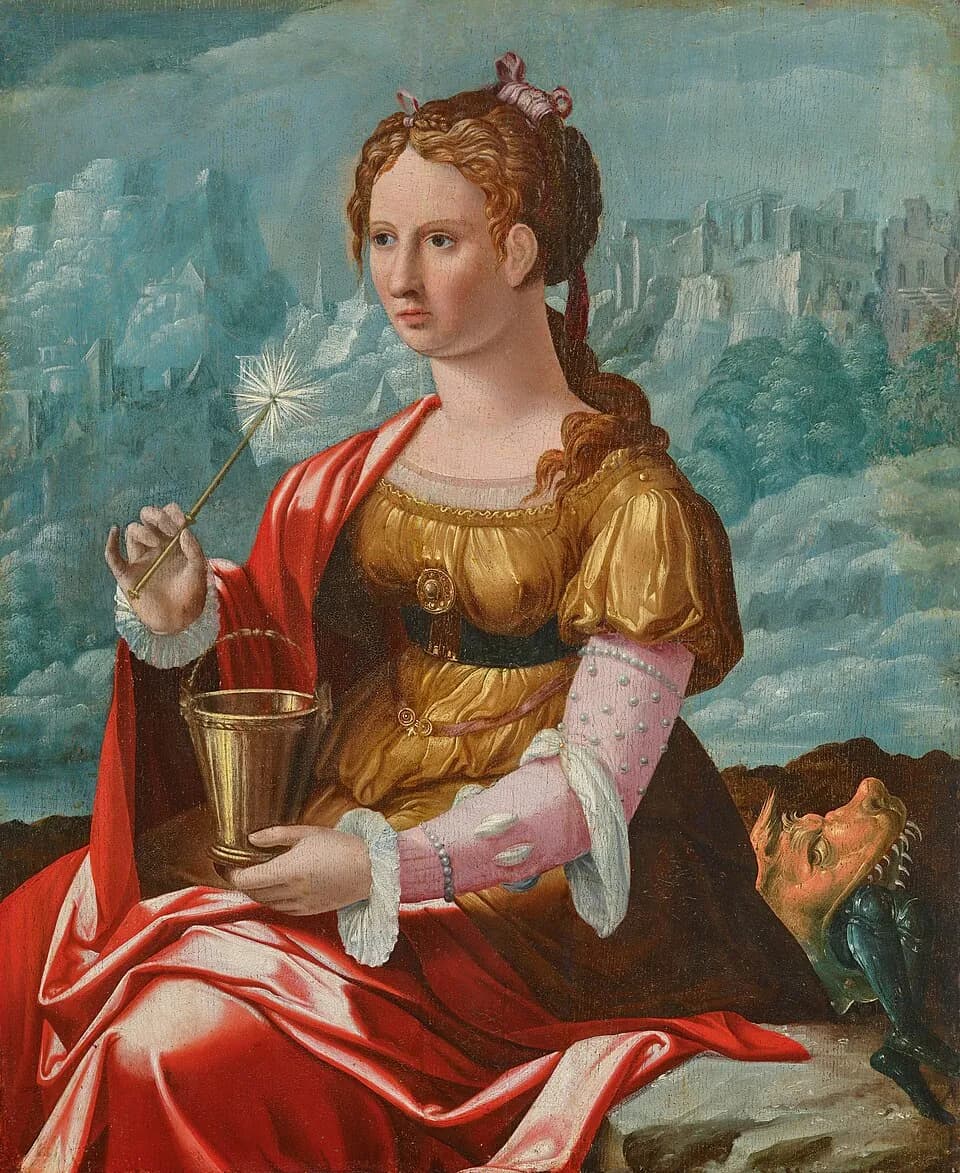
Martha has a story of her own within it. The encyclopedia's article on the Archdiocese of Aix records that the city of Tarascon has her as its patron, "who, according to the legend, delivered the country of a monster called 'Tarasque'." 6 That single sentence is all the sources consulted say about it. The sixteenth-century painter of the panel on this page put a small scaly beast at her side.
What is Saint Martha the patron saint of?
Franciscan Media lists Saint Martha as the patron saint of cooks, homemakers and restaurant servers, and lists Martha, Mary and Lazarus together as patron saints of siblings. 9
The city of Tarascon in Provence also has her as its patron, according to the 1907 Catholic Encyclopedia, on the strength of the legend of the Tarasque. 6
Saint Martha's feast day
Saint Martha's feast day is July 29. 79 According to Vatican News, her liturgical memorial was begun by the Franciscans in 1262, who kept it on July 29, eight days after the feast of Mary Magdalene. 7
For centuries Martha was kept on that day alone. On January 26, 2021, the Congregation for Divine Worship and the Discipline of the Sacraments issued a decree, signed by Cardinal Robert Sarah and Archbishop Arthur Roche, explaining why. "The traditional uncertainty of the Latin Church about the identity of Mary - the Magdalene to whom Christ appeared after his resurrection, the sister of Martha, the sinner whose sins the Lord had forgiven - which resulted in the inclusion of Martha alone on 29 July in the Roman Calendar, has been resolved in recent studies and times, as attested by the current Roman Martyrology, which also commemorates Mary and Lazarus on that day." 8 The 1910 encyclopedia had written of the family's Galilean connection while "supposing Mary of Bethania and Mary Magdalene to be the same person." 4
Pope Francis therefore "decreed that 29 July be designated in the General Roman Calendar as the Memorial of Saints Martha, Mary and Lazarus." 8
Praying with Saint Martha
Luke does not tidy up Martha's complaint. She asks Jesus whether he cares. 1 Benedict XVI called her "evidently resentful," and both he and Francis read the answer she got as gentle rather than crushing. 1011 Neither pope pretended the complaint had not happened, and the Gospel does not say how she took the reply.
The confession at Bethany comes from the same woman. She meets Jesus on the road with a reproach, "if you had been here," and in the same breath with "even now I know." 2 She is grieving and she is plain-spoken, and she is the one to whom Jesus said "I am the resurrection and the life." 24
At the tomb she objects to the smell. 2 The Gospel leaves faith and practicality side by side in her, and the Church holds her and Mary up as two parts of one life rather than rivals. 711
When the calendar was changed in 2021 it was to put her sister and brother beside her. 8 The decree describes a household in which Jesus "experienced the family spirit and friendship of Martha, Mary and Lazarus," and gives each of them one verb: Martha "generously offered him hospitality." 8
Saint Martha of Bethany, pray for us.
Sources
- 1.Luke 10:38-42, New American Bible (Washington, D.C.: United States Conference of Catholic Bishops), as published on vatican.va.
- 2.John 11, New American Bible (Washington, D.C.: United States Conference of Catholic Bishops), as published on vatican.va.
- 3.John 12, New American Bible (Washington, D.C.: United States Conference of Catholic Bishops), as published on vatican.va.
- 4.Hugh Pope, "St. Martha," The Catholic Encyclopedia, Vol. 9 (New York: Robert Appleton Company, 1910).
- 5.Léon Clugnet, "St. Lazarus of Bethany," The Catholic Encyclopedia, Vol. 9 (New York: Robert Appleton Company, 1910).
- 6.Georges Goyau, "Archdiocese of Aix," The Catholic Encyclopedia, Vol. 1 (New York: Robert Appleton Company, 1907).
- 7."Saint Martha, Disciple of the Lord," Saint of the Day, Vatican News.
- 8.Congregation for Divine Worship and the Discipline of the Sacraments, "Decree on the Celebration of Saints Martha, Mary and Lazarus in the General Roman Calendar," Prot. N. 35/21, January 26, 2021.
- 9."Saints Martha, Mary, and Lazarus," Saint of the Day, Franciscan Media.
- 10.Benedict XVI, Angelus, Castel Gandolfo, July 18, 2010.
- 11.Pope Francis, Angelus, St. Peter's Square, July 21, 2019.
Saints to turn to next
Others in this collection who are turned to for some of the same things.
- Saint Dominic of Silosc. 1000 - December 20, 1073PrayerMarriage and familyWork and vocation
- Saint Edward the Confessorc. 1003 - January 5, 1066Marriage and familyWork and vocationPrayer
- Saint Isidore the Farmerc. 1070 - May 15, 1130Work and vocationPrayerMarriage and family
- Saint Scholasticac. 480 - February 10, 542 or 543PrayerMarriage and familyWork and vocation