Saint Scholastica
c. 480 - February 10, 542 or 543
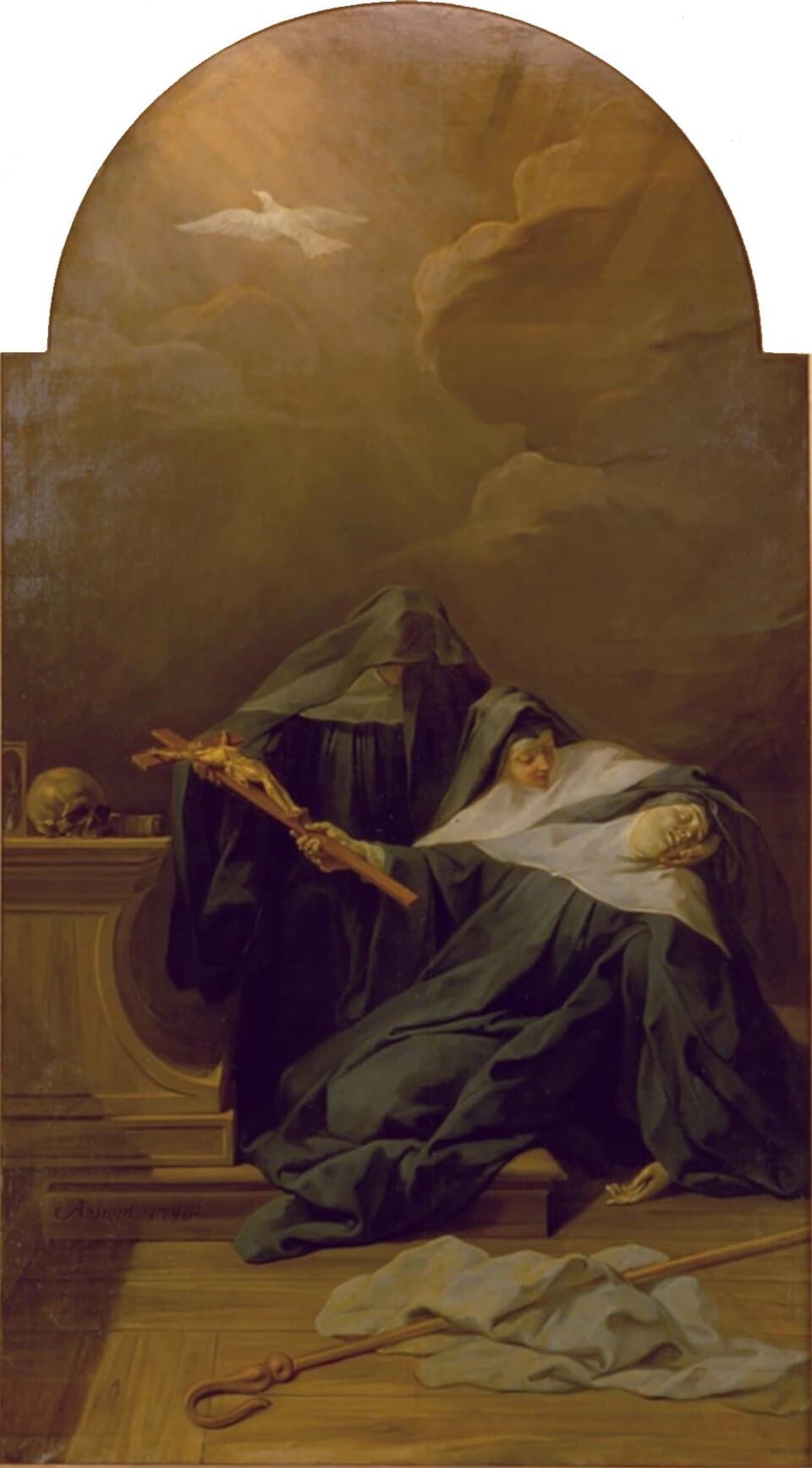
Everything known about Saint Scholastica comes from two short chapters that Pope Gregory the Great wrote in 593, some fifty years after her death, and in them she wins an argument with Saint Benedict. 1245 Her brother refused to stay the night, so she put her head down on the table and prayed, and a storm broke out of a clear sky that kept him there until morning. 1 She is remembered as the first Benedictine nun and is the patron of cloistered nuns, and her feast is February 10. 45
How little is known
The only early source is the second book of Gregory's Dialogues, written three years after he became pope, at the request of monks of his own household. 2 Book II is a life of Benedict, and Gregory names where he got it: four of Benedict's disciples, among them Constantinus, the next abbot of Monte Cassino, and Honoratus, who was abbot of Subiaco while Gregory was writing. 13 Scholastica appears in two of its thirty-eight chapters. 1 Vatican News calls the Dialogues "the only reference text with a few references to the life of Saint Scholastica," and the 1907 Catholic Encyclopedia observes that "just before his death we hear for the first time of his sister Scholastica." 34
Before that final visit, Gregory tells us three things about her. She was Benedict's sister, she had been "dedicated from her infancy to our Lord," and she "used once a year to come and visit her brother." 1 He does not name her parents, her birthplace, her age, or her community. He calls her a nun, and in the next chapter says she went back to "her Nunnery." 1 Anything on this page beyond that comes from later tradition, and is marked as such.
Twins, Nursia, and a convent near Monte Cassino
Gregory never says the two were twins. The Catholic Encyclopedia records it as "a tradition, which St. Bede accepts." 3 Franciscan Media states it outright, and adds that she was born in 480 to wealthy parents and brought up with Benedict until he left for Rome to study. 5 Vatican News, introducing its version with "according to reports," places her birth at Nursia, says their mother died immediately after giving birth to twins, and has the two children sent to Rome together. 4
Both modern sources put her community close to her brother. Franciscan Media names it Plombariola, five miles from Monte Cassino; Vatican News calls it Piumarola, about seven kilometers away. 45 Vatican News also has her first entering a monastery near Nursia, and credits her with beginning "the female branch of the Benedictine Order." 4 None of these place names appears in Gregory.
The last visit
Gregory introduces the story with a question to his listener, Peter. Saint Paul asked three times to be delivered from "the prick of the flesh" and was refused; so it should be no surprise that there "was one thing which the venerable father Benedict would have done, and yet he could not." 1
Benedict used to meet his sister "not far from the gate, to a place that did belong to the Abbey." 1 Franciscan Media describes it as a farmhouse, since Scholastica was not allowed inside the monastery, and Vatican News as a little house halfway between the two communities. 45 On the last of these visits they spent the whole day "in the praises of God and spiritual talk" and ate supper together after dark. 1 Still at the table, she asked him to stay "that they might spend it in discoursing of the joys of heaven." 1 He would not, "saying that he might not by any means tarry all night out of his Abbey." 1 Franciscan Media and Vatican News both explain his refusal as keeping his own Rule, though Gregory does not mention the Rule at this point. 145
"At that time, the sky was so clear that no cloud was to be seen." 1 She laid her folded hands on the table, bowed her head on them, and prayed. When she lifted her head, "there fell suddenly such a tempest of lightning and thundering, and such abundance of rain, that neither venerable Benedict, nor his monks that were with him, could put their head out of door." 1 Gregory adds that she had been weeping into her hands, "such a flood of tears upon the table, that she drew the clear air to a watery sky." 1
Benedict was not pleased. "God forgive you, what have you done?" he said. Her answer, in the old translation: "I desired you to stay, and you would not hear me, I have desired our good Lord, and he hath vouchsafed to grant my petition: wherefore if you can now depart, in God's name return to your monastery, and leave me here alone." 1 Franciscan Media's modern version is shorter: "I asked a favor of you and you refused. I asked it of God and he granted it." 5 He stayed, Gregory says, "against his will," and the two of them talked through the night. 1
She did more which loved more
Gregory does not say that Benedict was wrong to refuse. His point is that even a man of Benedict's holiness did not always get what he wanted, and he gives the reason in one sentence: "it is not a thing to be marvelled at, that a woman which of long time had not seen her brother, might do more at that time than he could, seeing, according to the saying of St. John, God is charity and therefore of right she did more which loved more." 1 Vatican News puts the same line, in another translation, at the head of its page: "She was capable of more, who loved the more." 4
Franciscan Media says Scholastica "sensed her death was close at hand" and asked him to stay for that reason. 5 Gregory says nothing of the kind. In his telling she wanted a night's conversation about heaven with a brother she saw once a year. 1
The dove
The next morning she returned to her community and he to his abbey. Three days later Benedict was standing in his cell, looked up, and "beheld the soul of his sister (which was departed from her body), in the likeness of a dove to ascend into heaven." 1 He gave thanks "with hymns and lauds," told his monks she had died, and sent them to bring her body back so it could be buried "in that grave which he had provided for himself." 1 Gregory ends the chapter: "as their souls were always one in God whiles they lived, so their bodies continued together after their death." 1
Benedict was later laid in the same grave, in the oratory of Saint John the Baptist that he had built where an altar of Apollo once stood. 13 Gardner's 1911 note says their bodies "are supposed to lie together under the high altar" at Monte Cassino but calls this "a little uncertain," since they are said to have been taken to France at some point, and the encyclopedia records a similar doubt about whether Benedict's relics went to Fleury. 13 Vatican News writes of visitors to Monte Cassino today standing before "the tomb of the Holy Brother and Sister." 4
When she died
What is Saint Scholastica the patron saint of?
Saint Scholastica's feast day
Praying with Saint Scholastica
Nearly all we have of her is one evening. 1 Read plainly, it is the story of a woman who wanted more time with her brother, was told no, and took the request over his head. Gregory, a pope writing for the monks of his household, saw nothing in it to apologize for. 2
Her prayer is described more closely than most in the lives of the saints: hands folded on a supper table, head down, crying hard enough that Gregory remembered the tears. 1 It has no formula in it. She wanted something specific and asked for it, and it was granted in a way that left her brother complaining.
Gregory's reason for the outcome is that she loved more. 1 He does not make Benedict the villain, and the rule Benedict was keeping was a good one. The story simply allows that a person can be right about the rule and still be the one who loved less that night.
Three days later she was dead. 1 Gregory does not say she knew, and the night they spent talking about heaven turned out to be their last. Anyone who has had a final conversation without realizing it was final will recognize where this story ends.
Saint Scholastica, pray for us.
Sources
- 1.Gregory the Great, Dialogues, Book II, chapters 33-34, translated by "P.W." (Paris, 1608), re-edited with notes by Edmund G. Gardner (London: Philip Lee Warner, 1911).
- 2.Edmund G. Gardner, Introduction to The Dialogues of Saint Gregory (London: Philip Lee Warner, 1911).
- 3.Hugh Ford, "St. Benedict of Nursia," The Catholic Encyclopedia, Vol. 2 (New York: Robert Appleton Company, 1907).
- 4."St. Scholastica, Virgin, sister of St. Benedetto," Saint of the Day, Vatican News.
- 5."Saint Scholastica," Saint of the Day, Franciscan Media.
Saints to turn to next
Others in this collection who are turned to for some of the same things.