Saints Tarachus, Probus and Andronicus
d. 304
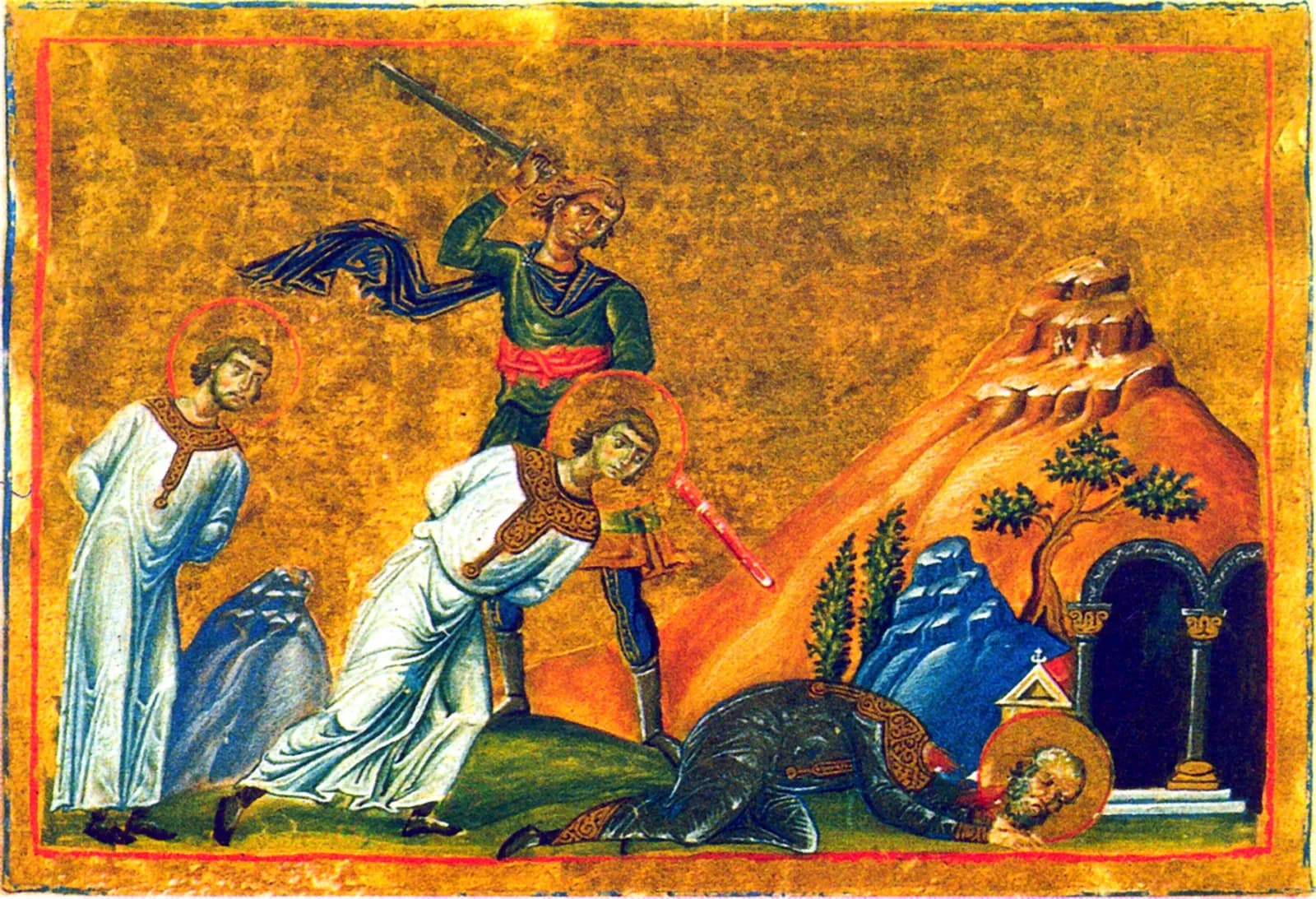
- The three
- Tarachus of Claudiopolis in Isauria, a former soldier; Probus of Side in Pamphylia; Andronicus of a leading family of Ephesus 12
Saints Tarachus, Probus and Andronicus were three Christians of southern Asia Minor, an old soldier, a man who had sold his estate and a young man of good family, who were tried three times in three cities of Cilicia in 304 and killed in the arena at Anazarbus. 124 Their Acts are among the most vivid of the early martyr narratives, a record of interrogations with an epilogue signed by eyewitnesses. 2 Whether those Acts are the court record they claim to be has been argued for three centuries; that the three men lived and died for Christ, the 1912 Catholic Encyclopedia says, there "can be no doubt." 1
Three men from three cities
EWTN describes them as "differing in age and nationality, but united in the bonds of faith." 4 Tarachus was a Roman citizen born at Claudiopolis in Isauria, about the year 239 according to katolsk.no. 12 He had served as a soldier and an officer, and left the army when he became a Christian, fearing he would be ordered to act against the law of God. 2 In the Acts as katolsk.no gives them, he tells the governor that he was called Victor while he bore arms, that his captain Publius gave him his discharge, and that he is sixty-five years old. 2
Probus was born at Side in Pamphylia. 12 katolsk.no says he was a plebeian whose father came from Thrace, and that he had given up a considerable fortune to serve Christ. 2 Andronicus, the youngest, belonged to a prominent family of Ephesus. 12
All three were denounced as Christians to Numerian Maximus, governor of Cilicia, during the persecution of Diocletian and Maximian, arrested at Pompeiopolis and taken to Tarsus. 24
Three trials
The first hearing was at Tarsus. 124 The Acts open with the governor asking the old soldier his name, and Tarachus answering, twice, only that he is a Christian, and being struck in the mouth for it. 2 Probus says that Christian is his first and most honorable name and Probus the one he goes by in the world. 2 Andronicus gives the same answer. 2 After the hearing, EWTN says, their limbs were torn with iron hooks and they were taken back to prison "covered with wounds." 4
A centurion named Demetrius and an under-officer named Athanasius appear in the Acts urging the prisoners to sacrifice and save themselves, and the men refuse each time. 2 The second hearing was at Mopsuestia, where, katolsk.no's version says, the governor found the wounds of Andronicus healed, accused the jailers of tending them in secret, and heard the jailer swear that nobody had been near him. 2 The third was at Anazarbus. 124 There Probus and Andronicus had wine and meat from the pagan altars forced into their mouths, and each protested that what the body suffers against its will does not defile the soul. 2 By the end, katolsk.no says, Probus had been blinded and Andronicus's tongue cut out. 2
Their answers in the Acts are short and often defiant. When the governor called his faith folly, Tarachus replied that this folly was the salvation of his soul, and that he would never give it up. 2 When Probus was threatened with having his tongue torn out, he answered that besides the tongue he spoke with he had an inner, immortal one that the governor could not reach. 2 The governor kept them alive for the public games. 24
The arena at Anazarbus
The last part of the Acts is told by three Christians, Marcian, Felix and Verus, who watched from a hill behind the amphitheater, hidden behind a heap of stones they had piled up so as not to be recognized. 2 The martyrs could no longer walk and were carried into the arena and thrown down in the sand. 2 Many in the crowd, katolsk.no says, began to murmur against the governor, and some left. 2
Then the beasts were let in. In EWTN's words, "the most ferocious animals, on being let loose on them, came crouching to their feet and licked their wounds." 4 katolsk.no names a bear that had killed three men that day and that lay licking the wounds of Andronicus, and a lioness that lay down at the feet of Tarachus. 2 The governor had the bear killed where it lay. 2 Kirsch summarizes it in one line: they were condemned to the beasts, "and when the animals would not touch them in the amphitheatre they were put to death with the sword." 1 EWTN says the judge reproached the jailers "with connivance" and had the martyrs dispatched by the gladiators. 4
The bodies were thrown in with those of dead gladiators and guarded overnight by six soldiers. 2 According to the eyewitnesses, a storm scattered the guard, and the Christians found the three by a light that shone over each of them, carried them off and hid them in a cave in the mountains nearby. 2 Marcian, Felix and Verus promised to keep watch over the relics for the rest of their lives, and asked to be buried in the same tomb. 2
Can the Acts be trusted?
Kirsch says there are two accounts of the martyrdom. 1 The first was held by Ruinart, who printed it in his collection of the Acts of the martyrs, "to be entirely authentic." 1 katolsk.no reports the claim that the text came from the governor's own archive and was bought by Christians for 200 denarii, and notes that this is disputed as well. 2
Later scholars were less sure. Harnack "expressed doubts as to the genuineness of the account," and Delehaye placed it among the legends of martyrs he called "historical romances." 1 katolsk.no says the authenticity of the Acts is contested and that the story of their sufferings has been considerably embroidered. 2
The martyrs themselves are not in question. The "Martyrologium Hieronymianum" lists them on several days: at Tarsus in Cilicia on September 27, in Cilicia on April 5 and on a day between October 8 and 11, and in Palestine on May 13, which Kirsch takes to be either an error or a sign of a shrine there. 1 The current Roman Martyrology names Anazarbus as the place where they gave their lives. 3
What are Saints Tarachus, Probus and Andronicus the patron saints of?
None of the sources consulted gives them a patronage. katolsk.no mentions a supposed patronage of silversmiths for Andronicus and explains it as a probable confusion with Andronicus of Antioch, who had been a silversmith before becoming a hermit. 2 They are remembered chiefly as a group, three very different men tried and killed together. 14
Saints Tarachus, Probus and Andronicus's feast day
Praying with Saints Tarachus, Probus and Andronicus
The three had little in common but the faith. One was an aging veteran, one had already given away his property, one was young and well connected. 124 The Acts let each answer in his own voice, and all three begin with the same word for who they are. 2
The Acts are frank about what was done to them, and this page has not softened it. Two were made to swallow food from pagan altars, and in the story each answered that the soul is not stained by what the body is forced to suffer. 2 Andronicus put it most plainly: God, who sees the secrets of the heart, knew that he had not consented. 2
Whether the court record is genuine or a later retelling, three Christians who watched from behind a pile of stones are the people who carried the bodies away in the storm and spent their lives guarding the grave. 2 Kirsch, who doubts much of the rest, has no doubt that there was a grave to guard. 1
Saints Tarachus, Probus and Andronicus, pray for us.
Sources
- 1.Johann Peter Kirsch, "Sts. Tarachus, Probus, and Andronicus," The Catholic Encyclopedia, Vol. 14 (New York: Robert Appleton Company, 1912).
- 2."De hellige Taracus, Probus og Andronikos av Tarsus ( -304)," Den katolske kirke (katolsk.no), Catholic Diocese of Oslo (in Norwegian).
- 3.Roman Martyrology, entry for October 11, "Santi Táraco, Probo e Androníco, martiri," as printed in "Santo del giorno," Conferenza Episcopale Italiana (in Italian).
- 4."St. Tarachus," Saints, EWTN.
Saints to turn to next
Others in this collection who are turned to for some of the same things.