Saint Symmachus
Died July 19, 514
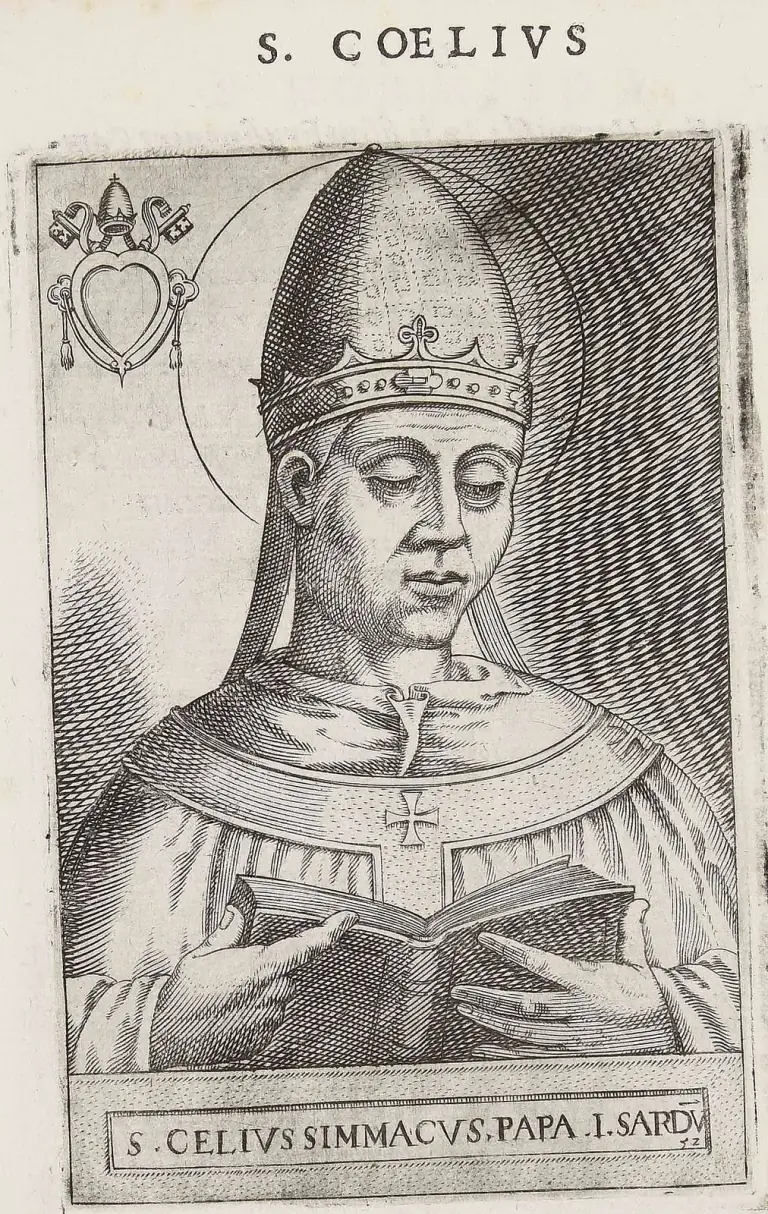
Saint Symmachus was pope from 498 to 514, a Sardinian convert from paganism whose election was challenged on the very day it took place, when a rival party consecrated the archpriest Laurentius as antipope. 123 The schism that followed ran for some eight years, and for four of them Symmachus lived beside Saint Peter's while his rival held the Lateran. 12 A synod of Italian bishops, asked to try him, declared that it could not judge the pope and left the charges to God. 1 His feast is July 19. 4
A convert from Sardinia
The Liber Pontificalis says Symmachus was a Sardinian and the son of Fortunatus. 3 He said of himself, Loomis notes, that he came out of paganism and learned the Catholic faith at Rome, and he was baptized there. 13 He entered the Roman clergy and was ordained deacon. 12 The same book that records his origins describes him warmly: "He loved the clergy and the poor; he was a good man and sagacious, kindly and courteous." 3
That praise has to be read with its author in view. Kirsch notes that the life of Symmachus in the Liber Pontificalis is "very favourable to the pope," while another continuation of the papal lives, the so-called Laurentian Fragment, takes his rival's side. 1 Loomis passes on Duchesne's judgment that the writer seems to have known the same troubles at first hand. 3
Two popes elected on one day
Pope Anastasius II had tried to soften the long quarrel with Constantinople known as the Acacian schism, and a party in Rome thought he had gone too far. 23 When he died in November 498, the majority of the clergy elected Symmachus at the Lateran basilica on November 22, and he was consecrated at once. 12 Later the same day a minority, friendly to Byzantium and backed by much of the Senate under its leader Festus, met in Santa Maria Maggiore and chose the archpriest Laurentius. 12
Both sides took the dispute to Theodoric, the Ostrogothic king who ruled Italy from Ravenna, though he was an Arian. 12 He ruled that the see belonged to whichever man had been ordained first or had the larger following, and gave it to Symmachus. 13 At a synod on March 1, 499, the new pope gave Laurentius the see of Nuceria in Campania, out of compassion, the Liber Pontificalis says. 13 The synod also decreed that any Roman cleric caught canvassing for votes for the next pope during a pope's lifetime should be deposed. 12
Accused before the king
The peace lasted about two years. In 501 Symmachus kept Easter on March 25 by the old Roman reckoning, while others kept it on April 22, and the Laurentian party, led by the senators Festus and Probinus, accused him before Theodoric. 123 Summoned to Ravenna, he got as far as Rimini, where he learned that the charges now included unchastity and the misuse of church property. 23
He went back to Rome without seeing the king. Kirsch says he refused to acknowledge Theodoric as his judge. 1 Loomis says he fled back by night without waiting to face him, and katolsk.no says he left in panic, which looked to many like an admission of guilt. 32 His opponents took the Lateran, and he took refuge at Saint Peter's, then outside the walls. 12 At their request the king sent Bishop Peter of Altinum to Rome as a visitor to run the Church in the accused pope's place, which the Liber Pontificalis says "the canons forbade." 13
The synod that would not judge him
Symmachus agreed to a synod but protested against the visitor. 1 Kirsch and katolsk.no date it to 502; Loomis's note calls it the synod of 501. 123 At the first session, in Santa Maria in Trastevere, the pope offered to answer the charges if he were first restored, and the bishops agreed, but Theodoric refused. 12 On his way to a later session in September he was attacked by his opponents; Kirsch says several of the priests with him were killed or badly wounded, Loomis that many were killed. 13 After that he would not appear, though invited three times. 1
About the middle of September the bishops declared that they could not pass judgment on the pope, because there was no precedent for an occupant of the Roman see being tried by other bishops. 1 On October 23, 502, they left the decision "to the judgment of God." 12 Symmachus was declared free of the charges and entitled to the full exercise of his office, and those who returned to obedience would go unpunished. 12 Kirsch says the decision was signed by seventy-five bishops; the Liber Pontificalis speaks of 115. 13 Kirsch calls this session the "Synodus Palmaris"; katolsk.no gives that name to the whole synod. 12
Four years at Saint Peter's
Theodoric did not enforce the verdict, and Laurentius came back to Rome and lived in the Lateran palace. 12 For four years the city had two bishops, and Symmachus kept to the episcopal house beside Saint Peter's. 12 The Liber Pontificalis describes clergy loyal to him murdered in the streets, consecrated women driven from their houses and beaten, and two priests, Dignissimus and Gordianus, clubbed and cut down, until it was unsafe for a cleric to walk abroad by day or night. 3 Loomis reads the passage as a picture of the general lawlessness of those years, and notes that Gordianus was the father of the later Pope Agapitus. 3
Help came from outside. Bishop Avitus of Vienne, at the request of the bishops of Gaul, wrote to the Senate on his behalf. 1 The deacon Dioscorus of Alexandria went to Theodoric for him, and the king, now at odds with Constantinople himself, ordered Festus to hand back the churches. 12 Kirsch dates the end to four years after the synod and katolsk.no to 506; Loomis says Symmachus petitioned the king in 505. 123 Laurentius withdrew to an estate belonging to Festus. 1 A small party still refused Symmachus, and katolsk.no adds that some, among them the devout deacon Paschasius, were never reconciled to him. 12 The last of them returned under Hormisdas. 1
Both sides wrote pamphlets, and the pope's supporters went further. During the dispute they produced four apocryphal documents, now called the Symmachian forgeries, which invented precedents from earlier popes for the claim that a bishop of Rome could not be tried by other bishops. 12 Kirsch adds that the forgeries were not the first documents to hold that view. 1
The work of a long pontificate
Symmachus opposed the emperor Anastasius I over the Henoticon, the emperor Zeno's edict of faith, and defended the Eastern bishops who would not accept it. 1 The emperor called him a Manichaean, and the pope answered firmly. 123 He gave Caesarius of Arles the pallium, the first known grant of it to a bishop outside Italy, and made him his representative in Gaul and Spain; Kirsch dates the letters to 513 and 514, katolsk.no to 514. 12
In Rome he expelled the Manichaeans and burned their books. 13 He built or restored a long list of churches, among them Saint Andrew beside Saint Peter's, Saint Pancratius over the martyr's tomb, and Saints Sylvester and Martin, and he put up residences on either side of the forecourt of Saint Peter's. 123 katolsk.no calls these the beginning of the Vatican palace, and Vatican News says he "is said to have built the first palace on the Vatican." 25 He built hospices for the poor at Saint Peter's, Saint Paul's and Saint Lawrence's. 13
He sent money and clothing every year to the African bishops whom the Arian Vandals had driven into exile, and ransomed captives in Liguria, Milan and other provinces. 13 He also had the Gloria sung at more Masses: on every Sunday and feast of the martyrs, according to the Liber Pontificalis; only at papal Masses, says Loomis; at Masses celebrated by bishops, says katolsk.no. 32
In 514, faced with riots and a revolt in Thrace, the emperor finally invited the pope to a council at Heraclea, but katolsk.no says Symmachus was dead before the letter reached Rome. 2 He died on July 19, 514, and was buried at Saint Peter's, in the portico. 123 The Liber Pontificalis says he "slept in peace as a confessor." 3
What is Saint Symmachus the patron saint of?
Saint Symmachus's feast day
Saint Symmachus's feast day is July 19, the day he died and was buried. 13 The current Roman Martyrology, as the Italian bishops print it, records him that day at Saint Peter's in Rome, as a pope who suffered long from the fanaticism of schismatics and died at last a confessor of the faith. 4 Vatican News and katolsk.no give the same day. 52 The 1897 English Martyrology entered him on July 19 as a pope "who, for a long time had much to bear from a faction of schismatics." 6
Praying with Saint Symmachus
The Martyrology does not remember Symmachus for winning. 4 It remembers a pope who suffered long from schismatics: the division took up half his pontificate, including years when priests loyal to him were killed in the streets of Rome. 134
His story is not tidy. The sources disagree about whether he left Rimini on principle or in fear, his own partisans forged documents in his defense, and a deacon katolsk.no calls devout was among those who never accepted him. 123 The Church still counts him among the saints. 4
Through the worst of it he went on building lodgings for the poor, sending help every year to exiled bishops in Africa, and buying captives their freedom. 13 Vatican News, in three sentences about him, finds room to say that he freed slaves. 5
Saint Symmachus, pray for us.
Sources
- 1.Johann Peter Kirsch, "Pope St. Symmachus (498-514)," The Catholic Encyclopedia, vol. 14 (New York: Robert Appleton Company, 1912).
- 2."Den hellige pave Symmachus," Den katolske kirke, the saints database of the Catholic Church in Norway, katolsk.no (in Norwegian).
- 3.The Book of the Popes (Liber Pontificalis), vol. 1, "LIII. Symmachus (498-514)," translated with notes by Louise Ropes Loomis (New York: Columbia University Press, 1916), Internet Archive.
- 4.Roman Martyrology, entry for July 19, "San Simmaco, papa," Santo del giorno, Conferenza Episcopale Italiana (in Italian).
- 5."St. Symmachus, Pope," Saint of the day, July 19, Vatican News.
- 6.The Roman Martyrology, July 19 (Baltimore: John Murphy Company, 1897), Internet Archive.
Saints to turn to next
Others in this collection who are turned to for some of the same things.