Saint Stephen I
Died August 2, 257
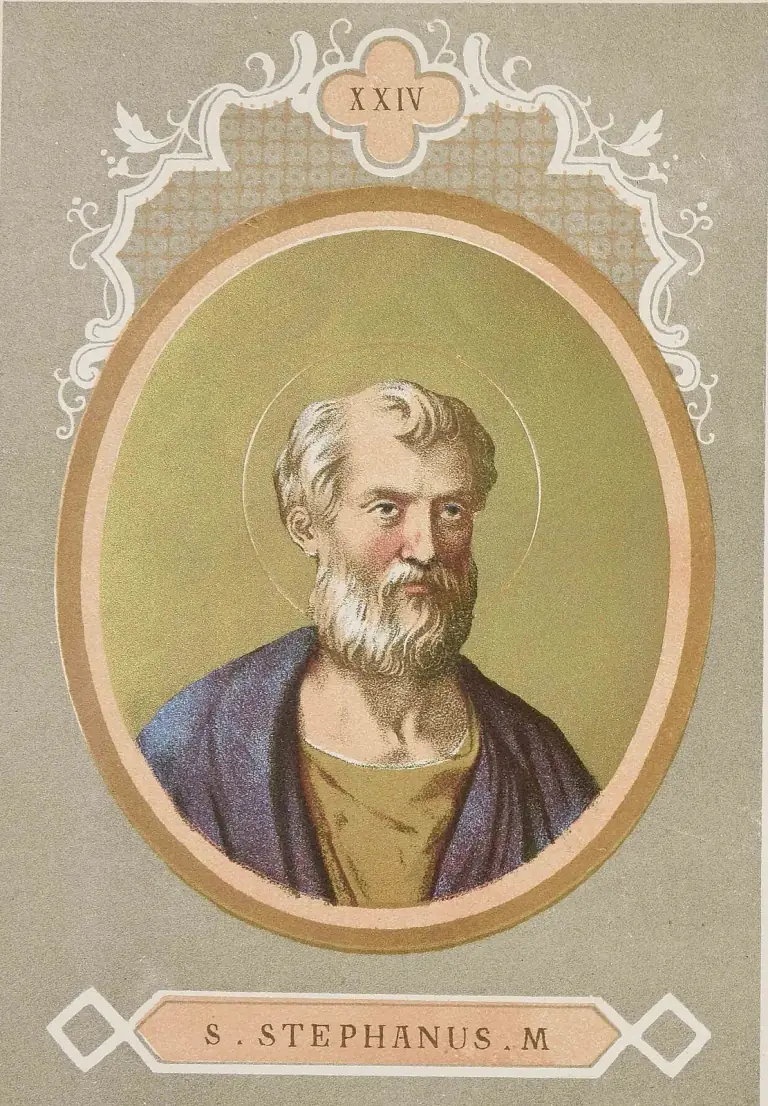
- Born
- A Roman; son of Jovius, says Mann 1; of the gens Julia and son of Jobius, says katolsk.no after the Liber Pontificalis 29
- Pope
- From 254 to August 2, 257 14; consecrated May 12, 254, says Mann 1; March 12, 254, says the Holy See 4; the 23rd pope in the Holy See's list 4
Saint Stephen I was bishop of Rome from 254 to 257, and the one question history remembers him for is still answered his way: a person baptized in the name of the Trinity by a heretic or a schismatic is not to be baptized again. 123 Holding that line set him against Cyprian of Carthage, the bishops of Africa and a large part of the churches of Asia Minor, and he died in August 257 with the quarrel unresolved. 25 The current Roman Martyrology remembers him for forbidding the rebaptism of those who came into full communion with the Church, so that the union with Christ given in baptism, which happens only once, would not be obscured. 3
From archdeacon to bishop of Rome
Stephen was a Roman by birth. 19 Horace Mann, writing in the 1912 Catholic Encyclopedia, says the most ancient catalogs call him the son of Jovius, and he sees no reason to doubt the Liber Pontificalis when it says that Pope Lucius I, on his way to martyrdom, handed the care of the Church to his archdeacon Stephen. 1
The dates do not quite agree. Mann says it is "generally believed" that he was consecrated on May 12, 254, and died on August 2, 257. 1 The Holy See's list of popes gives March 12, 254, for the start of his pontificate, and Butler has him chosen on May 3, 253. 410 Eusebius, writing early in the fourth century, gives him only two years. 5
katolsk.no notes that he was elected in a lull between the persecutions of Decius and Valerian, and that the trouble of his reign came from inside the Church. 2 Most of what is known about him, Mann says, is connected one way or another with the rigorist teaching of Novatian and his party, who refused to readmit Christians who had lapsed under persecution. 1 The Liber Pontificalis also credits him with a small rule of his own: priests and deacons were not to wear their consecrated vestments for daily use, outside church. 19
Arles, Spain and Syria
Two smaller cases came to him early, and in both Cyprian of Carthage is the only witness. 1 Marcian, bishop of Arles in Gaul, had joined the Novatianists and was refusing reconciliation even to the dying. 12 Faustinus of Lyons wrote to Rome more than once; for a reason nobody knows, Stephen did not act. 1 The Gallic bishops turned to Cyprian, who wrote to Stephen and asked him to move: "Let letters be directed by you into the province and to the people abiding at Arles, by which, Marcian being excommunicated, another may be substituted in his place." 6 Since Cyprian says no more about it, Mann supposes that Stephen did as he was asked. 1
The second case went the other way. Basilides and Martial, bishops in Spain, had obtained certificates during the persecution saying they had sacrificed to the gods, and their own province deposed them. 12 Basilides went to Rome and persuaded Stephen to restore them both. 12 The Spanish churches appealed to Cyprian, and a council of African bishops confirmed the depositions. 12 It did not blame Stephen: Basilides, the council wrote, had "deceived Stephen our colleague, placed at a distance, and ignorant of what had been done, and of the truth." 7
There is one glimpse of him outside the quarrels. Dionysius, bishop of Alexandria, writing to Stephen, lists the churches of the East rejoicing at the end of the persecution, among them "all Syria, and Arabia to which you send help when needed, and whither you have just written." 5 Mann reads this as Stephen keeping up the Roman custom of relieving distant churches in their need. 1
The baptism controversy
The question was what to do with someone who had been baptized in a heretical or schismatic sect and now wanted to join the Church. 2 Cyprian and the churches of North Africa held that such a baptism was no baptism at all, because baptism could only be given within the Church; the convert had to be baptized. 2 Many churches of Syria and Asia Minor agreed. 2 Stephen, who stood for the tradition of Rome, Alexandria and Palestine, held that a baptism given in the name of the Trinity with the Church's own profession of faith was valid, and that the convert needed only the laying on of hands in reconciliation. 2 Eusebius says that Cyprian was the first to require rebaptism, and that Stephen, "considering it unnecessary to add any innovation contrary to the tradition which had been held from the beginning, was very indignant at this." 5
Stephen's own words survive only because Cyprian sent a copy of his reply to a bishop named Pompey, with a commentary on its "error." 6 The sentence Cyprian quotes is the one the controversy turns on: "If any one, therefore, come to you from any heresy whatever, let nothing be innovated (or done) which has not been handed down, to wit, that hands be imposed on him for repentance." 6 Cyprian answered that a custom without the Gospel behind it was only a human tradition. 6
African councils in 255 and 256 backed Cyprian. 2 Stephen, katolsk.no says, was determined to make the Roman practice hold everywhere. 2 He wrote to the churches of Cilicia, Cappadocia and Galatia, Dionysius of Alexandria reports, "saying that he would not commune with them for this same cause; namely, that they re-baptized heretics." 5 When Cyprian sent envoys to Rome with the decisions of his council, Stephen refused to receive them, katolsk.no says, or even to offer them hospitality. 2
Firmilian, bishop of Caesarea in Cappadocia, wrote to Cyprian in a fury. He accused Stephen of "audacity and pride" and wrote that "he who so boasts of the place of his episcopate, and contends that he holds the succession from Peter," was setting up "many other rocks." 8 katolsk.no draws the historian's point from that complaint: Stephen defended his authority by appealing to the primacy of the Roman see as Peter's, and as far as anyone knows he was the first pope to ground it formally in the Lord's words to Peter in Matthew 16:18. 2 It also notes that his opponents blamed the split in the Church on him. 2
How it ended
An open break between Rome and a large part of Christendom was now possible. 2 Dionysius of Alexandria, who shared Stephen's view of the question, still felt bound to write and plead for a gentler course. 25 The situation could have become desperate, katolsk.no says, had Stephen not died on August 2, 257, and Cyprian a year later as a martyr. 2 Peace came under Stephen's successor, Sixtus II. 2
Butler, writing in the eighteenth century, tells the story more kindly to Stephen. He reports Augustine's judgment that Stephen "thought of excommunicating them; but being endued with the bowels of holy charity, he judged it better to abide in union." 10
The principle Stephen defended is the Church's own. katolsk.no says the Church still follows his direction, which makes it possible in principle to recognize sacraments given outside the Church, and that before the century was out all of Africa had come round to Rome on the question. 2 Mann quotes the Anglican Archbishop Benson of Canterbury, who judged that Stephen "triumphed, and in him the Church of Rome triumphed, as she deserved." 1
Martyr or not?
The Liber Pontificalis says he "was crowned with martyrdom." 9 One manuscript adds a full story: Stephen exiled, then imprisoned with nine priests, two bishops and three deacons, holding a synod in prison and handing the Church's vessels to his archdeacon, and beheaded six days later. 9 Loomis, the translator, marks the paragraph as a seventh-century interpolation and notes that the early lists mention Stephen simply as bishop, not as martyr. 9
The 1897 English Roman Martyrology still told the dramatic version: in the persecution of Valerian, soldiers burst in while he was saying Mass, and he finished the sacred mysteries unmoved and "was beheaded in his seat." 11 Butler thought the acts "deserve some regard," and says his relics went to Pisa in 1682 and his head to Cologne. 10
Modern writers are cooler. Mann calls the evidence for martyrdom "generally regarded as doubtful." 1 katolsk.no points out that the Liberian calendar of 354 lists Stephen among the bishops who died and not among the martyrs, and concludes he most likely died a natural death. 2 The current Martyrology names him simply as pope. 3
What is Saint Stephen I the patron saint of?
Saint Stephen I's feast day
Saint Stephen I's feast day is August 2, the day of his death. 13 The current Roman Martyrology, as the Italian bishops print it, commemorates him that day at the Catacomb of Callistus. 3 katolsk.no gives the same day, and the 1897 English Martyrology kept him there too, as pope and martyr. 211 He is not the Stephen of December 26, who is the deacon stoned in Jerusalem. 311
Praying with Saint Stephen I
Stephen is not an easy saint to warm to. The sources that know him best describe a man sure of his authority and short with those who disagreed, who would not receive the envoys of a bishop as holy as Cyprian. 28 Butler saw only meekness in him, and the truth probably sits somewhere between. 10
What he defended was a gift rather than a rule. Baptism, as the Martyrology puts it, unites a Christian to Christ once, and Stephen would not let that union be treated as if it had never happened because the person who gave it was in the wrong camp. 36
The quarrel also shows the Church being patient with her saints. Stephen and Cyprian died a year apart, each convinced, and both are kept as saints. 210 The peace came through a third bishop who wrote letters, and through a successor who simply resumed communion. 25
Saint Stephen I, pray for us.
Sources
- 1.Horace K. Mann, "Pope St. Stephen I," The Catholic Encyclopedia, Vol. 14 (New York: Robert Appleton Company, 1912).
- 2."Den hellige pave Stefan I (-257)," Den katolske kirke (katolsk.no), Catholic Diocese of Oslo (in Norwegian).
- 3.Roman Martyrology, entries for August 2, "Santo Stefano I, papa," and December 26, as printed in "Santo del giorno," Conferenza Episcopale Italiana (in Italian).
- 4."Stephen I," The Supreme Pontiffs, The Holy See.
- 5.Eusebius of Caesarea, Church History, Book 7, chapters 2 to 5, trans. Arthur Cushman McGiffert, Nicene and Post-Nicene Fathers, Second Series, Vol. 1 (1890), at New Advent.
- 6.Cyprian of Carthage, Epistle 66, to Stephen, and Epistle 73, to Pompey, trans. Robert Ernest Wallis, Ante-Nicene Fathers, Vol. 5 (Buffalo: Christian Literature Publishing Co., 1886), at New Advent.
- 7.Cyprian of Carthage and the African bishops, Epistle 67, to the clergy and people in Spain, trans. Robert Ernest Wallis, Ante-Nicene Fathers, Vol. 5 (1886), at New Advent.
- 8.Firmilian of Caesarea, letter to Cyprian against the letter of Stephen (Epistle 74 among Cyprian's letters), trans. Robert Ernest Wallis, Ante-Nicene Fathers, Vol. 5 (1886), at New Advent.
- 9.The Book of the Popes (Liber Pontificalis), trans. Louise Ropes Loomis (New York: Columbia University Press, 1916), "Stephen I (254-257)."
- 10.Alban Butler, "St. Stephen, Pope and Martyr," The Lives of the Fathers, Martyrs, and Other Principal Saints, Vol. 8, August 2 (Dublin: James Duffy, 1866).
- 11.The Roman Martyrology, August 2 and December 26 (Baltimore: John Murphy Company, 1897).
Saints to turn to next
Others in this collection who are turned to for some of the same things.