Saint Stephen
First century
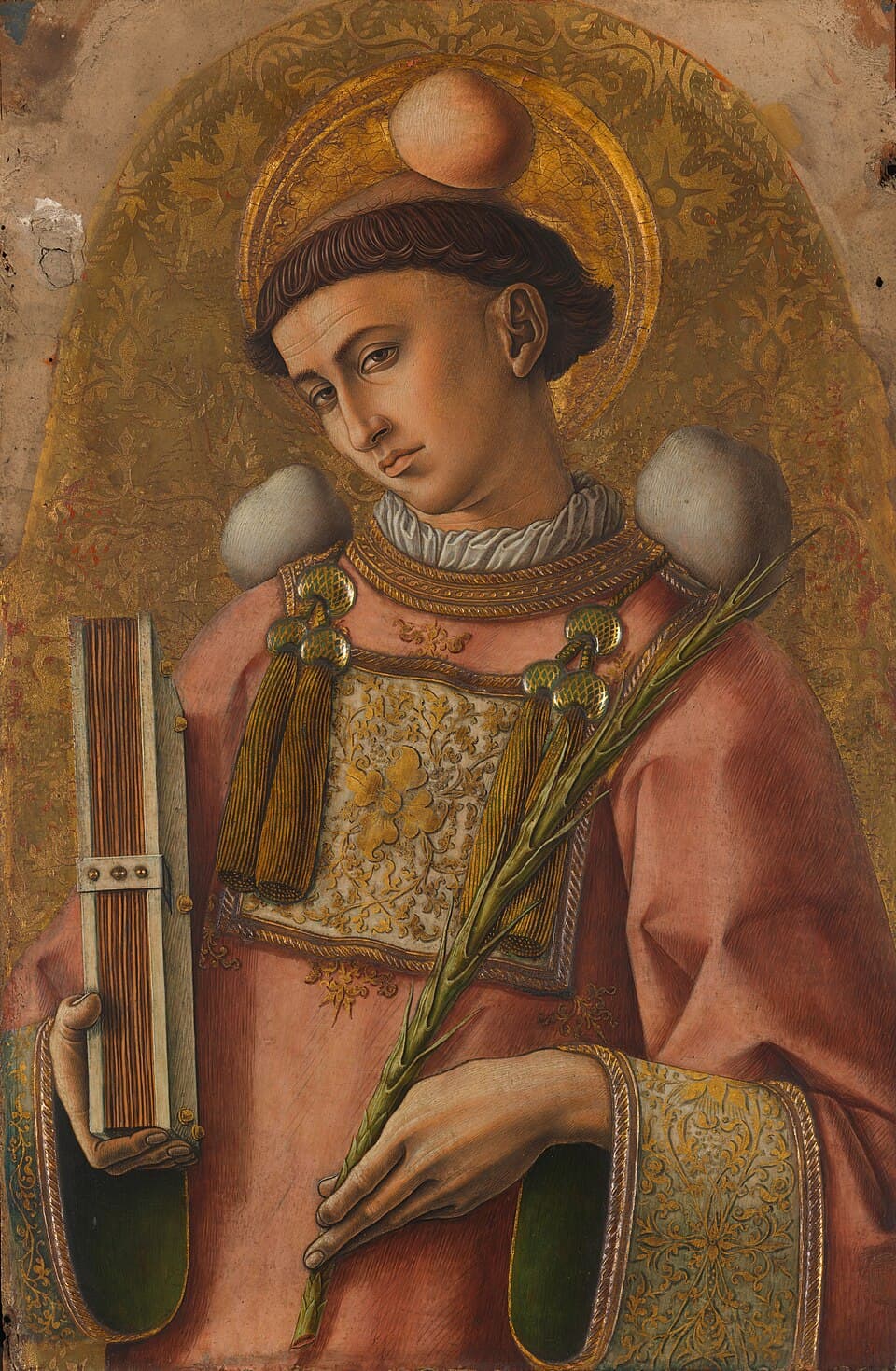
- Known as
- The first Christian martyr. Souvay calls him "One of the first deacons and the first Christian martyr" 1
- Chosen
- One of seven men "of good repute, full of the Spirit and of wisdom" set over the daily distribution 12
- Name
- Greek, suggesting a Hellenist; a fifth-century tradition makes Stephanos a rendering of the Aramaic Kelil, "crown" 1
- Only firsthand source
- Acts of the Apostles 6:1-8:2, which Souvay says is the only one there is 1
- Buried
- Tomb lost for centuries; relics found in 415 at Caphar Gamala, moved in 460 to the basilica outside the Damascus Gate 1
Saint Stephen was appointed to hand out food, and was killed for a sermon. 12 The seven men chosen in Acts 6 were given a practical job, the daily distribution to widows who were being overlooked, and within two chapters the first of them is dead outside the wall with the coats of the executioners piled at the feet of a young man named Saul. 12 Everything known about him firsthand fits in two chapters of one book. 1
The job he was given
The problem in Acts 6 is unglamorous and entirely recognizable. The Jerusalem church was made up of Jewish Christians, some from the land of Israel and called Hebrews, others from the Greek-speaking Diaspora and called Hellenists. 2 The most destitute of the Hellenists, above all widows with no other support, were at risk of being passed over in the daily distribution. 2 The Apostles, meaning to stay with prayer and the ministry of the word, had seven men chosen to take the work on. 12
Stephen is named first of the seven and is the only one the book follows. 1 Souvay reads his Greek name as marking him a Hellenist, a Jew born abroad whose first language was Greek, and notes a fifth-century tradition that Stephanos was a rendering of an Aramaic original, Kelil, meaning crown, said to have been inscribed on a slab found in his tomb. 1 He was almost certainly a Jew by birth rather than a convert, since Nicolas alone among the seven is described as a proselyte. 1
Everything else about his early life is missing. Souvay says the period before the appointment "remains for us almost entirely in the dark," notes that the inference that he studied under Gamaliel "has not been proved," and treats the claim that he was one of the seventy disciples as doubtful. 1 What the text does give is a character reference repeated three times: a man of good reputation, full of the Holy Spirit and wisdom, full of faith, full of grace and fortitude. 1
Whether he was a deacon
This is where the sources separate, and the difference is worth seeing.
Souvay simply calls him one of the first deacons, in the opening clause of the article. 1 Benedict XVI will not go that far. Tradition sees in the group of seven the seed of the future ministry of deacons, he says, "although it must be pointed out that this category is not present in the Book of Acts." 2 The word is not there; the office as later defined is not there; what is there is seven men and a laying on of hands.
Benedict then does something useful with the gesture itself. In the Old Testament, laying on hands transmitted an office, as Moses did to Joshua. 2 Antioch used it to send out Paul and Barnabas. 2 The letters to Timothy refer to it, and warn against being hasty with it. 2 In the case of Stephen and his companions, Benedict concludes, it was "certainly an official conferral of an office by the Apostles, but at the same time an entreaty for the grace to carry it out." 2 That is a careful sentence, and it is careful because the sources will not support a tidier one.
What neither source doubts is that the charitable job did not stay a charitable job. Luke insists that Stephen, "full of grace and power," was also preaching, and that is what killed him. 2 Benedict draws the moral directly: charitable social commitment and the courageous proclamation of the faith were not separable in him, and were never meant to be. 2
The speech and the stoning
His opponents came out of the synagogues of the Libertines, the Cyrenians, the Alexandrians and those from Cilicia and Asia - Greek-speaking Jews, his own constituency. 1 They challenged him to a dispute and came off worse, and Souvay is unsentimental about what followed: "wounded pride so inflamed their hatred that they suborned false witnesses." 1 The charge was blasphemy against Moses and against God, sharpened into a claim that he had said Jesus would destroy the temple and change the customs Moses handed down. 1
Souvay concedes that the accusation had something to work with. Stephen had said that the Most High does not dwell in houses made by hands. 1 Benedict puts the content more sharply: the speech rereads the whole Old Testament in a Christological key, placing the Cross at the center of the history of salvation, and it says that the temple cult is finished because the risen Jesus is the new and true temple. 2 Benedict's judgment is that "it was precisely this 'no' to the temple and to its cult that led to the condemnation." 2
The detail of the killing that most readers miss is that it was not a lynching. Souvay points out that the stoning "does not appear in the narrative of the Acts as a deed of mob violence," and that those taking part must have understood themselves to be carrying out the law. 1 The condemned man was taken outside the city, as Leviticus required; custom placed him on a height and threw him down with his hands bound; and the witnesses whose testimony convicted him had to cast first, which is why they laid their garments at Saul's feet. 1 People doing something monstrous in an orderly way, and following procedure while they did it.
He prayed twice on the way down. "Lord, lay not this sin to their charge," and then "Lord Jesus, receive my spirit." 1 Benedict observes that the martyrdom is shaped on the passion of Jesus himself, and that both prayers have their counterpart there. 2
What his death set off
The killing began the first persecution in the history of the Church, and the Judeo-Hellenist Christians scattered out of Jerusalem. 2 Benedict tracks what the scattering did: "Those who were scattered went about preaching the word," and the Gospel reached Samaria, Phoenicia, Syria, and finally Antioch, where it was first proclaimed to pagans and where the name Christians was first used. 2 He puts it in five words - "their persecution and consequent dispersion became a mission" - and then quotes Tertullian, that the blood of Christians is seed. 2
The other consequence was standing at the edge of the crowd holding coats. Benedict makes the point that Saul must have heard the speech, and was probably among those who "were enraged and... ground their teeth against him" at it. 2 After Damascus, the man who had listened to Stephen's Christological reading of the Old Testament took it up, deepened it, and made it the content of his own preaching. 2 Benedict's phrase for this is that "St Stephen's vision was brought about in St Paul's mission." 2
The grave was lost for a long time. Souvay reports that the location was unknown for centuries until a priest named Lucian learned in 415 that the body lay at Caphar Gamala, north of Jerusalem; the relics went first to the church on Mount Sion and then, in 460, to the basilica Eudocia built outside the Damascus Gate, on the spot where tradition put the stoning. 1 Souvay adds a small piece of scholarly housekeeping that is easy to admire: the rival opinion placing the martyrdom east of the city, near the gate now called St Stephen's Gate, is "unheard of until the twelfth century." 1 Benedict, writing much later, locates the site where Souvay does, beside the Dominicans' École Biblique. 2
What is Saint Stephen the patron saint of?
Neither of the sources used here states a patronage for Saint Stephen. He is widely called the patron of deacons and of stonemasons, but nothing in the encyclopedia article or in Benedict XVI's catechesis says so, and this profile does not supply what its sources will not. 12 What both do call him, without qualification, is the first Christian martyr. 12
Saint Stephen's feast day
The feast of Saint Stephen is December 26. 1 Souvay states the date in his opening line, and Benedict XVI refers to him as the saint "whom the Church commemorates the day after Christmas." 12 The placement is deliberate rather than accidental: the first martyr is kept on the day following the Nativity, which is why the carol about the feast of Stephen is set in deep winter.
Praying with Saint Stephen
Stephen is the patron of nobody in these sources and the first of a very long line, and both facts are worth sitting with. He was picked for a logistics problem. Widows were being missed in a queue, and seven capable men were found to fix it. Nothing in the appointment suggests anyone expected what happened next.
Benedict's first lesson from him is the one most easily skipped: "charity and the proclamation of faith always go hand in hand." 2 Stephen was made responsible above all for charity, and it proved impossible to separate the charity from the preaching, and the preaching is what cost him. 2 Plenty of arrangements in ordinary parish life assume those two can be divided between different people. This is the account of the first time somebody tried.
There is also the question of what he prayed while it was happening. He asked that the sin not be charged to the men doing it. 1 The prayer is not recorded as having changed anything on the day - the stones kept coming, and Souvay notes drily that nobody present realized what the blood would turn out to be the seed of. 1 Its effect, if the sources are read together, was slower and stranger than that, and it landed on the man minding the coats. 2
Benedict ends by saying the Cross will never be absent, that persecution runs through the Church's history, and that accepting one's own cross is how Christian joy is learned in hard stretches. 2 That is not a comfortable ending and he does not make it one. What Stephen has to offer is not a technique for avoiding the situation. It is the record of somebody in it, still praying for the people responsible.
Saint Stephen, pray for us.
Sources
Saints to turn to next
Others in this collection who are turned to for some of the same things.