Saint Sophronius of Jerusalem
c. 560 - 638
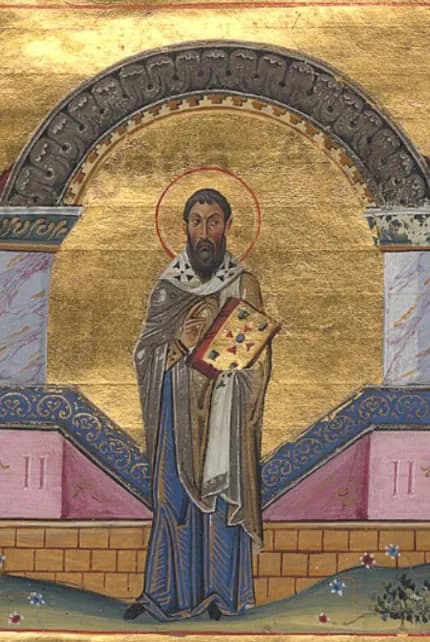
Saint Sophronius of Jerusalem was a monk from Damascus who became patriarch of Jerusalem in 634, wrote the first full defense of the teaching that Christ has a human will as well as a divine one, and then had to hand the Holy City over to the caliph Omar after a four-month siege. 124 He died soon afterward, in 638 by most accounts. 34 His feast is March 11. 56
The monk from Damascus
He was born in Damascus around 560. 234 Catholic Culture says he was called "the Sophist" for his command of Greek, and that he and his friend John Moschus took up the ascetic life together in their late teens or early twenties. 3 The Roman Martyrology calls Moschus his teacher as well as his friend. 5
Where he was a monk is told three ways. Adrian Fortescue, in the Catholic Encyclopedia, says simply that he "had been a monk of the monastery of St. Theodosius." 2 Robert Shaffern says he joined the laura of Saint Chariton in the Judean countryside, one of the cliffside communities where monks prayed alone in their cells and gathered in church for the Office, and that Moschus was his master there. 4 Catholic Culture reports both of the older traditions, that the two friends lived near the Jordan or that they lived in Egypt, and puts Sophronius in the Theodosius monastery only later. 3
The two traveled for years. Shaffern says they left for Egypt in 604 to study monasticism where it began, became advisers to the patriarch of Alexandria, and were encouraged by him to collect the stories of the desert fathers, which Moschus gathered into The Spiritual Meadow. 4 Catholic Culture dates the move to Alexandria to 605 and says Persian invasions drove it, with a second flight to Rome when the Persians reached Alexandria in 616. 3 Shaffern agrees that the two found refuge in Rome. 4 These were the years in which Persia took Syria, Palestine and Egypt, and carried the relic of the True Cross off from Jerusalem. 4
Sophronius came back to Palestine, in 619 according to Catholic Culture, and lived in the Theodosius monastery. 3 He wrote throughout. Catholic Culture lists an encomium, twenty-three anacreontic odes on the feasts of the Church, and sermons, and says that a collection of patristic texts and a life of Saint John the Almsgiver are lost, and that the Orthodox remember him chiefly as author of the life of Saint Mary of Egypt. 3
One operation or two
The quarrel that made his name began as a peace offer. Since the fifth century Eastern Christians had been divided over the Council of Chalcedon's teaching of two natures in Christ. 4 The emperor Heraclius and Sergius, patriarch of Constantinople, hoped to conciliate the Monophysites with a formula that spoke of "one operation" in Christ. 12 At Alexandria the patriarch Cyrus proclaimed a reunion on that basis and was delighted with the result. 1
Sophronius, whom John Chapman's encyclopedia article calls "a much venerated monk of Palestine," was in Alexandria at the time. 1 He "strongly objected to the expression." Cyrus could not persuade him, so he went to Constantinople and told Sergius that the clause had to be withdrawn. 1 Catholic Culture dates the Constantinople journey to 633 and says neither visit succeeded. 3 Sergius would not undo the union. He did write to Cyrus that both phrases, one operation and two, had better be dropped, and he referred the matter to Pope Honorius. 1
Honorius answered Sergius, in Chapman's words, "reproving Sophronius" for his "new expression" and praising Sergius for setting it aside. 1 Chapman adds that learned theologians like Sophronius and Maximus the Confessor "were not at a loss" in a debate that left others puzzled. 1
Patriarch and the synodal letter
In 634 Sophronius was made patriarch of Jerusalem, in succession to Modestus according to the Martyrology. 125 At his enthronement he published a letter on the question. Chapman describes it as "a formal defence of the dogma of two operations and two wills, which was afterwards approved by the sixth council," and as "the first full exposition of the Catholic doctrine." 1 Fortescue calls it "one of the most important documents of this controversy." 2
Chapman notes two things about the letter. It went to all the patriarchs with a humble request for corrections. And it leans on Pope Leo the Great, of whom Sophronius writes: "I accept all his letters and teachings as proceeding from the mouth of Peter the Coryphæus, and I kiss them and embrace them with all my soul." 1 He also compiled a large collection of passages from the Fathers in support. 1
He could not go to Rome himself. He took Stephen, bishop of Dora, the senior bishop under him, to Calvary, and there, as Stephen later told it, charged him to go in his place: "Swiftly pass, then, from end to end of the world, until thou come to the Apostolic See, where are the foundations of the holy doctrines." He was to press the case there again and again. 1 Sophronius gave his reason for staying: he was hindered "by reason of the invasion of the Saracens which is come upon us for our sins." 1
The surrender of Jerusalem
The invasion was already close. Catholic Culture observes that his Christmas homily of 634 suggests the Saracens then held Bethlehem. 3 After the Byzantine army was destroyed at the Yarmuk, Jerusalem was besieged for four months, with an assault every day in Fortescue's account. 24 Fortescue says the patriarch "acted throughout as the head of the Christian defenders." 2 Shaffern adds that he had the city's relics, the True Cross among them, sent to Constantinople for safety. 4
When resistance was hopeless he negotiated. In Fortescue's telling he appeared on the walls, asked to speak with the Arab commander, and proposed terms: the Christians would keep their churches and sanctuaries, and no one would be forced to accept Islam. He insisted the caliph ratify them in person. 2 Omar came from Medina, signed, and entered the city with Sophronius "and courteously discoursed with the patriarch concerning its religious antiquities," a line Fortescue takes from Gibbon. 2 Shaffern pictures him going out heavy-hearted to meet the caliph at the gates. 4 Fortescue dates the surrender to 636, Catholic Culture to 637. 23
Sophronius did not live long after it. Shaffern says he seems to have gone into voluntary exile and died in 638, "many said of a broken heart," and Catholic Culture says he died of grief a year after the fall. 34 Fortescue gives his years as patriarch as 634 to 638 "or 644." 2 The two encyclopedia writers differ on what came next: Chapman says the see "was invaded by the Bishop of Joppa," a supporter of the emperor's one-will decree, and Fortescue that it lay vacant until 705 while Stephen of Dora acted as the pope's vicar for Palestine. 12
What is Saint Sophronius of Jerusalem the patron saint of?
None of the sources consulted for this page names Saint Sophronius as patron of any place, group or cause, and the page does not supply one. 1234 Catholic Culture gives no patronage for him, only how he is shown in art: vested as a bishop, his right hand raised in blessing, holding a Gospel book or a scroll. 3 It also counts him among the Fathers of the Church. 3
Saint Sophronius of Jerusalem's feast day
Saint Sophronius of Jerusalem is commemorated on March 11. Vatican News lists "St. Sophronius of Jerusalem, Bishop" on its calendar for that day, and the current Roman Martyrology enters him at Jerusalem on March 11. 56 Shaffern writes that his feast "is observed on March 11," and Catholic Culture marks the day as a commemoration from the Roman Martyrology. 34
Praying with Saint Sophronius of Jerusalem
By Catholic Culture's dates Sophronius was past seventy when the two great tasks of his life arrived together. 3 In the same four years he had to say exactly what the Church believes about the will of Christ, against a compromise that had the emperor and the patriarchs of Constantinople and Alexandria behind it, and he had to decide what to do with a city that could no longer be defended. 12
On the first he was stubborn. A phrase that pleased nearly everyone and brought much of Egypt back to the Church struck him as false, and he traveled from Alexandria to Constantinople to say so, was rebuked by a pope for it, and said it again at length as soon as he had a see to say it from. 1 Then he asked the other patriarchs to correct him if he was wrong. 1
On the second he gave way, on conditions. The terms he held out for were the churches and the freedom of his people not to change their religion, and he made the caliph come and sign. 2 Catholic Culture says he died of grief. 3
The scene Stephen of Dora remembered is the one to keep. An old bishop who cannot leave his flock walks another man up to Calvary and puts the errand on his conscience before "the God who was crucified for us in this holy place." 1 Sophronius did not see the outcome. His letter was approved by a later council. 1
Saint Sophronius of Jerusalem, pray for us.
Sources
- 1.John Chapman, "Monothelitism and Monothelites," The Catholic Encyclopedia, vol. 10 (New York: Robert Appleton Company, 1911).
- 2.Adrian Fortescue, "Jerusalem (A.D. 71-1099)," The Catholic Encyclopedia, vol. 8 (New York: Robert Appleton Company, 1910).
- 3."St. Sophronius," Liturgical Year calendar for March 11, Catholic Culture.
- 4.Robert Shaffern, "The Last Ancient Patriarch of Jerusalem: Saint Sophronius," Crisis Magazine, July 12, 2012; Catholic Culture Library.
- 5."San Sofronio, vescovo," Santo del giorno, 11 marzo (Roman Martyrology entry, in Italian), Conferenza Episcopale Italiana.
- 6."St. Sophronius of Jerusalem, Bishop," Saint of the Day, 11 March, Vatican News.
Saints to turn to next
Others in this collection who are turned to for some of the same things.
- Saint Catherine of AlexandriaDied c. 310Study and teachingCourageSuffering and illness
- Saint John Fisher1469 - June 22, 1535CourageStudy and teachingSuffering and illness
- Saint José de AnchietaMarch 19, 1534 - June 9, 1597Study and teachingCourageSuffering and illness
- Saint Maximus the Confessorc. 580 - August 13, 662CourageSuffering and illnessStudy and teaching