Saint Siricius
c. 334 - November 26, 399
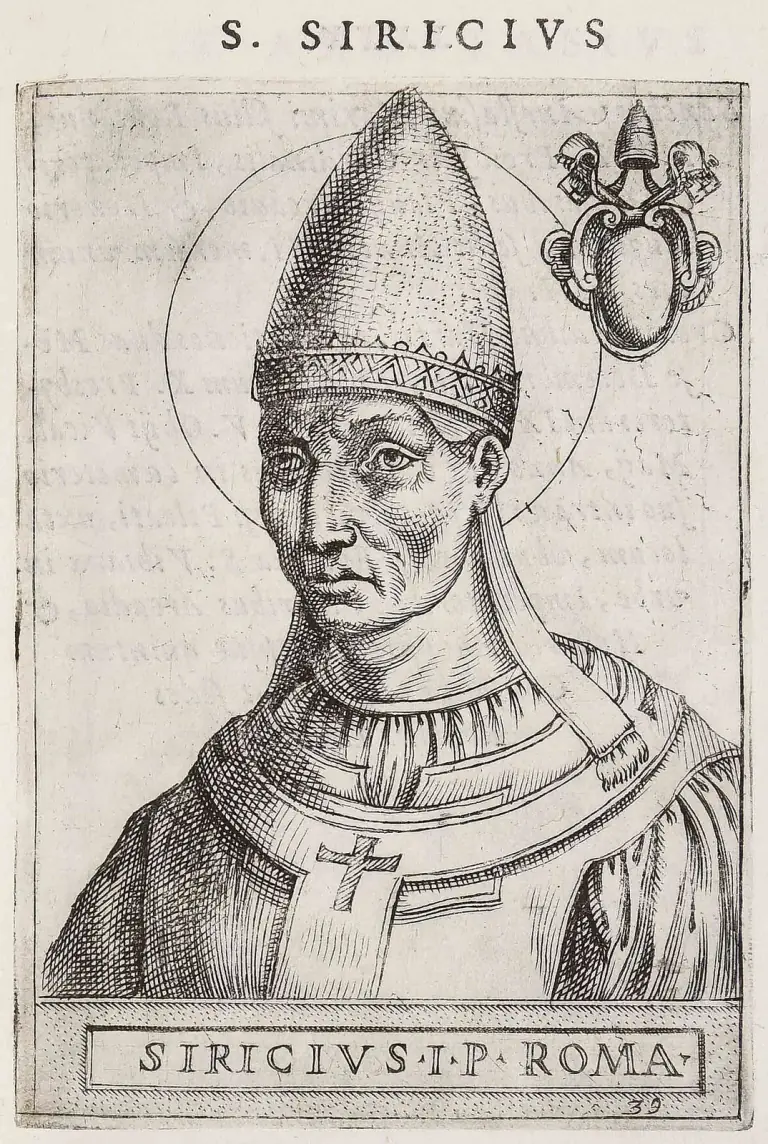
Saint Siricius was bishop of Rome from 384 to 399, the successor of Pope Damasus. 1 His answer to a Spanish bishop, Himerius of Tarragona, written in February 385, is the oldest papal decretal that survives complete: a ruling on church discipline sent out with the force of law. 12 Jerome thought him a simple man and said so, and the Church left him out of its martyrology for over a century and a half on that account, before Benedict XIV put him back. 25 His feast is November 26. 1
A deacon of Rome
Siricius was a Roman, the son of a man named Tiburtius. 14 Johann Peter Kirsch, in the Catholic Encyclopedia, puts his birth about 334. 1 He entered the service of the Church young, and the inscription on his grave records that he was lector and then deacon under Pope Liberius. 1 The Norwegian bishops' saints database (katolsk.no) adds that he was still a deacon under Damasus. 2
When Damasus died in December 384, Siricius was elected unanimously. 12 Kirsch says he was consecrated probably on December 17; katolsk.no suggests the election fell on the 15th. 12 Ursinus, who had set himself up as a rival to Damasus eighteen years before, still pressed his claim. 1 The emperor answered it by writing in February 385 to approve the election and praise the new bishop's piety, on the 23rd by Kirsch's date and the 25th by katolsk.no's, which names him as Valentinian II. 12 After that, Kirsch says, "no difficulties arose." 1
The letter to Himerius
A letter had come to Rome from Himerius, bishop of Tarragona in Spain, addressed to Damasus, who was now dead. It put fifteen questions on baptism, penance, church discipline and the celibacy of the clergy. 12 Siricius answered it in February 385, on the 10th by Kirsch's reckoning and the 11th by katolsk.no's. 12
Kirsch calls it "the oldest completely preserved papal decretal," a decision on discipline and canon law given with authority. 1 He is careful to add that it was not the first of its kind, since Siricius himself refers to "general decrees" sent out by Liberius, which are lost. 1 katolsk.no describes the change of tone: these letters were no longer brotherly advice but were written in the style of imperial edicts and carried the same force. The letter opens, it says, by claiming that the pope, or rather the apostle Peter present in him, bears the burden of laying down such rules. 2
Some of the rulings are recorded. Arians who came over to the Catholic Church were not to be baptized again. 2 Louise Ropes Loomis, in her notes to the Liber Pontificalis, quotes the passage: those baptized "by the impious Arians" were to be received "by merely the invocation of the sevenfold Spirit and the laying on of the episcopal hand." 4 Baptism was normally to be given only at Easter and Pentecost; there were rules on the age and fitness of candidates for ordination, on clerical continence and celibacy, and on penance. 2 Himerius was told to make the decrees known in the neighboring provinces so that they would be kept there too. 1
Synods and decrees
On January 6, 386, eighty bishops met in synod at Rome and restated the Church's law in nine canons, on the consecration of bishops, celibacy and other points. 1 katolsk.no says they met at the relics of the apostle Peter, and gives one of the canons: no bishop was to be consecrated without the knowledge of the apostolic see, or by a single consecrating bishop. 2 Siricius sent the decisions to the bishops of North Africa, and probably to others who had not been there. 1 "In all his decrees," Kirsch writes, "the pope speaks with the consciousness of his supreme ecclesiastical authority and of his pastoral care over all the churches." 1
katolsk.no adds two further steps. In 385 he gave the bishop of Thessalonica the right to approve every episcopal appointment in eastern Illyricum, which laid the ground for the later papal vicariate there. And he was, it says, the first pope to reserve to himself the title papa. 2 Vatican News, in its calendar note, likewise says historians count him the first pope to have himself called "Papa." 6
Jovinian, Bonosus and Priscillian
A Roman monk named Jovinian began to teach that fasting, good works and celibacy earned no higher merit, and won followers among the monks and nuns of the city. 1 katolsk.no says he had once been famous for his own strict life, gave it up, and persuaded many religious to marry; he also taught that Mary lost her virginity in giving birth. Shocked lay people asked the pope to act. 2 Siricius held a synod that condemned Jovinian and eight of his followers, about 390 to 392 by Kirsch's dating and in 392 or 393 by katolsk.no's. 12 He sent the decision to his friend Ambrose of Milan, whose own synod of northern Italian bishops condemned them too. 1 katolsk.no is careful to add that Siricius was no enemy of asceticism, as has sometimes been said. 2
Siricius and Ambrose also opposed Bonosus, a bishop who taught that Mary had borne other children after Christ; Kirsch makes him bishop of Sardica, katolsk.no of Naissus. 12 The pope left the judgment of the man himself to the bishop of Thessalonica and the bishops of Illyricum. 1
With Priscillian the pope stood on the side of mercy. The Spanish ascetic had been tried before the usurper Maximus at the urging of other bishops, and executed with some of his followers. 1 Siricius condemned the bishops who had brought the case to a secular court and excommunicated Felix of Trier, who had supported them. 1 katolsk.no says he rebuked Maximus sharply in 386, and that in 397 he joined Ambrose in recommending gentle treatment for Priscillianists who repented. 2
Antioch and the basilica of Saint Paul
In the East he helped end the long schism at Antioch, where two lines of bishops had claimed the see for years. When the last rival died, an embassy came to Rome, sent with the help of John Chrysostom and Theophilus of Alexandria, asking the pope to recognize Flavian and take him back into communion. 1 katolsk.no says Siricius agreed. 2
In Rome his name stayed on a building. The basilica over the grave of Saint Paul on the Via Ostiensis was rebuilt as a church of five aisles during his pontificate, and he dedicated it in 390. 12 Kirsch, writing in 1912, says the name of Siricius could still be read on one of the columns that survived the fire of 1823. 1
Jerome and Paulinus
Two famous contemporaries thought little of him. katolsk.no says Jerome had some hope of succeeding Damasus himself, and was driven out of Rome by an action in which Siricius at least had a hand. 2 Paulinus of Nola, visiting Rome in 395, met a guarded reception and complained of what Kirsch renders as "the haughty policy of the Roman bishop." 1 Kirsch explains it by irregularities in Paulinus's own election and consecration. 1
Jerome's remark is the better known. Writing years later of the quarrel over Origen's books at Rome, he spoke of the new teaching "imposing on the bishop who fancied others as guileless as he was himself." 5 The occasion, Kirsch explains, was a letter of communion that Siricius gave to Rufinus of Aquileia when Rufinus left Rome in 398. 1 Kirsch thought the judgment unjust: "All that is known of the labours of Siricius refutes the criticism of the caustic hermit of Bethlehem." 1 katolsk.no, which gives Jerome's view as that of a disappointed man, calls Siricius in reality an experienced and forceful pope, inevitably overshadowed by Ambrose. 2
Death and burial
Siricius died on November 26, 399. 12 He was buried in the cemetery of Priscilla on the Via Salaria; katolsk.no places the grave in the basilica of San Silvestro beside it. 123 The Liber Pontificalis dates the burial to February 22, a date Kirsch calls incorrect. 14 The text of his grave inscription is known. 1
He was honored as a saint from early times, but katolsk.no says he was left out of the first edition of the Roman Martyrology in 1584 because of what Jerome and Paulinus had written. 2 Benedict XIV added him in 1748, katolsk.no says, after writing a treatise to prove his holiness. 12
What is Saint Siricius the patron saint of?
Saint Siricius's feast day
Saint Siricius's feast day is November 26, the day he died. Kirsch states it: "His feast is celebrated on 26 November." 1 The Roman Martyrology, in the text published by the Italian bishops, enters him on that day: at Rome, in the cemetery of Priscilla on the New Salarian Way, Saint Siricius, pope, whom Saint Ambrose praised as a true teacher, because, carrying the burden of all who bear the responsibility of bishops, he instructed them in the teaching of the Fathers and confirmed it with his apostolic authority. 3 Vatican News lists him on November 26 as well. 6
Praying with Saint Siricius
Siricius is remembered for paperwork. His great surviving act is a letter answering fifteen practical questions from a bishop he had never met, about whom to baptize and when, whom to ordain, and how to treat penitents. 12 It is the kind of work that rarely makes a saint famous, and it is the work the Martyrology chose to praise: a pope who carried the burden of other bishops and taught them what the Fathers had taught. 3
He was not loved by everyone who mattered. Jerome mocked him as too trusting, Paulinus found him cold, and for a century and a half their opinion kept him out of the Martyrology. 125 The Church took its time and then decided that the critics had been unfair. 12
He could be severe and merciful in the same years. He condemned Jovinian's teaching outright, and he condemned just as firmly the bishops who had handed Priscillian over to the sword, then asked that the Priscillianists who repented be received gently. 12
Saint Siricius, pray for us.
Sources
- 1.Johann Peter Kirsch, "Pope St. Siricius," The Catholic Encyclopedia, vol. 14 (New York: Robert Appleton Company, 1912).
- 2."Den hellige pave Siricius ( -399)," Den katolske kirke (katolsk.no), Catholic Diocese of Oslo (in Norwegian).
- 3.Roman Martyrology, entry for November 26, "San Siricio, papa," as printed in "Santo del giorno," Conferenza Episcopale Italiana (in Italian).
- 4.The Book of the Popes (Liber Pontificalis), I: To the Pontificate of Gregory I, trans. Louise Ropes Loomis (New York: Columbia University Press, 1916), XL, "Siricius," with the translator's notes, Internet Archive.
- 5.Jerome, Letter 127, to Principia, trans. W.H. Fremantle, G. Lewis and W.G. Martley, Nicene and Post-Nicene Fathers, Second Series, vol. 6 (1893), as hosted by New Advent.
- 6."Santo del día, 26 noviembre: s. Siricio, papa," Vatican News (in Spanish).
Saints to turn to next
Others in this collection who are turned to for some of the same things.
- Saint Agnes of Montepulcianoc. 1268 - April 1317Work and vocationDiscernment
- Saint Albert ChmielowskiAugust 20, 1845 - December 25, 1916DiscernmentWork and vocation
- Saint Andrew Avellino1521 - November 10, 1608DiscernmentWork and vocation
- Saint Angela MericiMarch 21, 1474 - January 27, 1540Work and vocationDiscernment