Saint Simeon Salus
Sixth century - c. 590
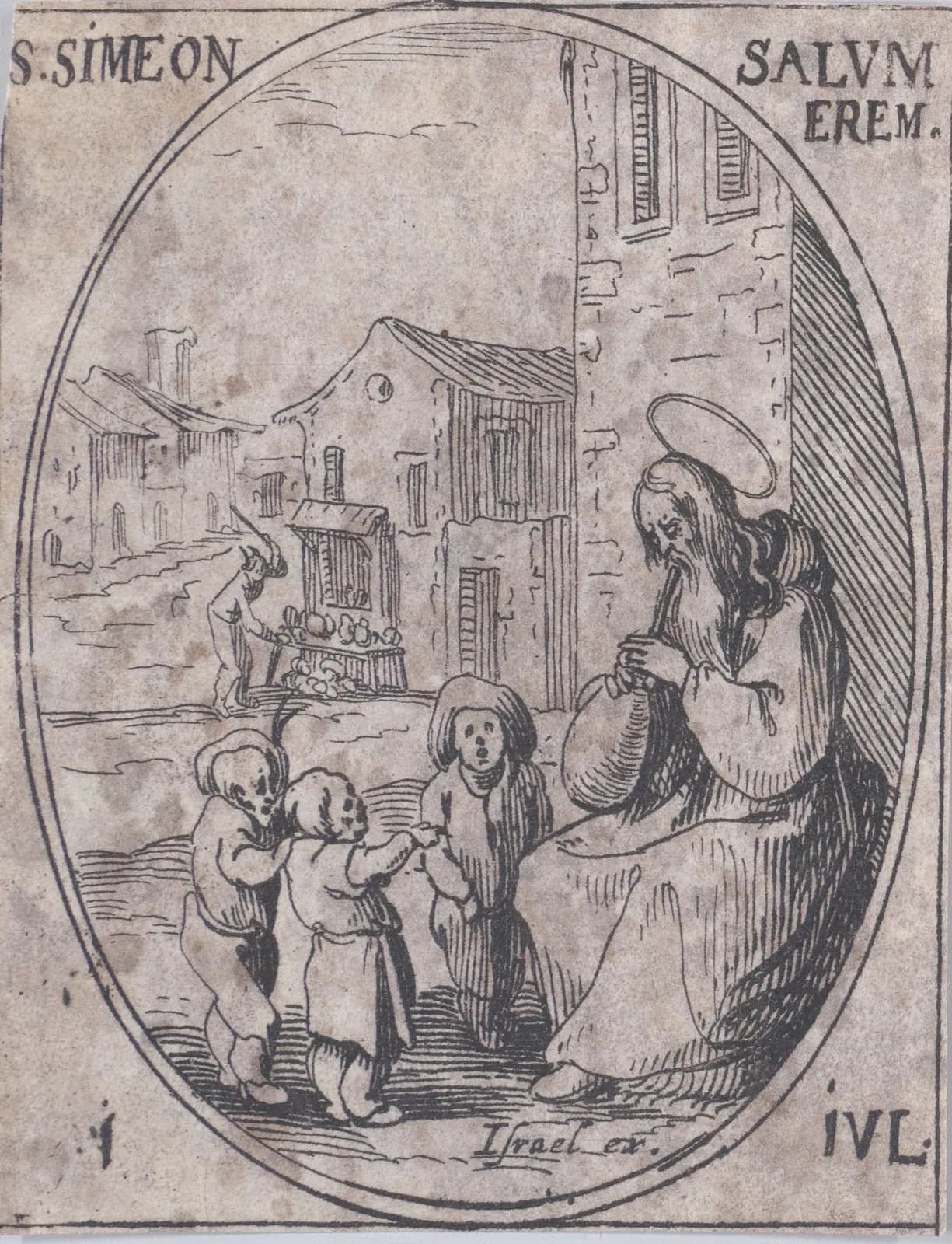
Saint Simeon Salus was a sixth-century hermit who came back from the desert to the Syrian city of Emesa, the modern Homs, and lived there as a holy fool, acting the madman so that no one would honor him. 12 Evagrius, a historian of his own century, wrote that he "had so completely unclothed himself of vain-glory as to appear insane to those who did not know him." 1 The Roman Martyrology remembers him as the man who, moved by the Holy Spirit, wanted to be thought a fool for Christ. 3
Thirty years in the desert
The sources agree that Simeon spent about thirty years as a hermit before he ever played the fool, and disagree about almost everything else in that part of his life. 234 Alban Butler, in his Lives of the Saints, says he was a native of Egypt, born about 522, who made a pilgrimage to Jerusalem and then lived twenty-nine years in a desert near the Red Sea. 4 The Norwegian bishops' saints database (katolsk.no) agrees on the twenty-nine years and places them by the Red Sea in the Sinai desert, but treats Emesa as his home town, to which he returned. 2 A Spanish entry on Catholic.net has him born at Emesa in 522. 5
The current Roman Martyrology, as the Italian bishops print it, does not name the Red Sea at all. It commemorates with Simeon a hermit named John, who for about thirty years was his companion on pilgrimage and in a hermitage near Lake Mareotis in Egypt. 3 The Spanish wording of the Martyrology given on Catholic.net puts the same thirty years with John near the Dead Sea. 5
Butler gives the reasoning that brought him out of the desert. Simeon kept turning over in his mind "that we must love humiliations if we would be truly humble," and that there are times to follow the impulse of the Holy Spirit beyond what ordinary prudence advises. 4 katolsk.no gives the same thought in a shorter form: to learn humility one must love humiliation. 2 Butler says he was sixty years old when he came to Emesa. 4
A fool at Emesa
Evagrius gives the plainest account of how he lived. Simeon kept mostly to himself, "affording to none the means of knowing how and when he propitiated the Deity, nor his time of abstinence or eating." 1 In the streets he seemed to lose his senses altogether, and he would walk into a tavern and eat whatever was in reach when he was hungry. 1 "But if any one saluted him with an inclination of the head, he would leave the place angrily and hastily, through reluctance that his peculiar virtues should be detected by many persons." 1
katolsk.no says that he gave himself to caring for the most wretched and outcast people of the city, prostitutes above all, and that he began behaving like an idiot deliberately so as to share the contempt they lived under. 2 It is frank about the result: his conduct was so scandalous that, if the accounts are accurate, he may at times really have been mad. 2 Some took him for a hypocritical rogue and others for a prophet, and in the end, katolsk.no says, the second opinion won. 2
Evagrius adds that the act was for strangers. With some of his acquaintances Simeon "associated without any assumed appearances." 1
What Evagrius saw in it
Evagrius tells two stories that turn the scandal inside out. A servant girl in a friend's house became pregnant and, pressed to name the father, named Simeon, offering to swear to it. 1 Simeon did not deny it, "saying that he bore the flesh with its frailties," and withdrew from the city as if ashamed. 1 When her labor came and would not progress, they begged him to pray for her, and he said she would not be delivered until she named the real father; she did, and the child was born at once, "as though by the midwifery of truth." 1
He was also seen going into a courtesan's room and shutting the door, staying a long time, and slipping away looking around to be sure no one saw him. 1 The neighbors brought the woman out and questioned her. She swore that she had had nothing but water for three days, and that Simeon had brought her food and a vessel of wine, set a table before her and told her to eat; and she showed them what was left. 1
The last story is a prophecy. Before the earthquake that struck Phoenicia Maritima, ruining Berytus, Byblus and Tripolis above all, Simeon went through the forum with a whip and struck most of the columns, crying, "Stand still, if there shall be occasion to dance." 1 People noted the ones he passed by, and those were the columns that fell. 1 "Many other things he also did," Evagrius ends, "which require a separate treatise." 1 Butler, for his part, says Simeon had lived six or seven years at Emesa when that city was destroyed by an earthquake in 588. 4
The Life by Leontius
The separate treatise was written. Butler cites a life of the saint by Leontius, bishop of Neapolis in Cyprus. 4 Catholic.net says Leontius wrote it some twenty years after Simeon's death, from what a deacon of Emesa named John had told him. 5
Catholic.net retells several of its episodes. In this account Simeon arrived dragging a dead dog tied to his belt, with a crowd of jeering children behind him; on his first Sunday he threw nuts at the altar candles until they went out; he was hired to sell vegetables for a tavern keeper and gave them away to the poor; and he appeared outside the church one Holy Thursday devouring half a lamb, so that no one would credit him with fasting. 5 The same account has him care for the pregnant servant through her whole pregnancy, and says some of the women he befriended ended their lives in a convent. 5 None of the other sources consulted tells these stories, and the page gives them as Catholic.net tells them.
Death and the holy fools
katolsk.no says Simeon died at Emesa about the year 590, when he was nearly seventy. 2 Butler gives no year, says only that God gave him "extraordinary graces" and the gift of miracles, and adds a warning: "we are not obliged in every instance to imitate St. Simeon," and it would be rash to try without a special call. 4
He was not the last of his kind. katolsk.no says later ascetics were known as "idiots for Christ's sake," who sought contempt and mockery by senseless behavior and feigned stupidity, and that they were especially common in Russia, where some of these yurodivy were canonized. 2
What is Saint Simeon Salus the patron saint of?
Saint Simeon Salus's feast day
Saint Simeon Salus's feast day is July 21 in the current Roman Martyrology, which commemorates him near Homs in Syria, together with the hermit John. 3 Older calendars kept him on July 1: katolsk.no gives that date and says his name is in the Martyrology, Butler places him on July 1, and the Spanish entry on Catholic.net lists him on that day. 245
Praying with Saint Simeon Salus
Simeon had thirty years of the desert behind him, the kind of life that made men famous in his century. 24 He left it for a city where he would be laughed at, and arranged things so that the laughter would not stop. 12
Evagrius saw the point in a small detail. Simeon could bear being thought mad, unchaste or a glutton; what drove him out of a room was a respectful bow. 1 The two stories Evagrius tells at length both turn on a false accusation he let stand, once for a frightened servant and once for a hungry woman whose door he had shut behind him. 1
The sources do not make it tidy. katolsk.no wonders aloud whether he was sometimes really mad, and Butler, writing for ordinary readers, tells them not to try it themselves. 24
What remains is a man who fed people in secret and let the city think the worst of him for it. 1
Saint Simeon Salus, pray for us.
Sources
- 1.Evagrius Scholasticus, Ecclesiastical History, Book IV, chapter 34, "Simeon the Monk," trans. Edward Walford (London: Samuel Bagster and Sons, 1846), tertullian.org.
- 2."Den hellige Simeon den Gale (Salus) ( -~590)," Den katolske kirke (katolsk.no), Catholic Diocese of Oslo (in Norwegian).
- 3.Roman Martyrology, entry for July 21, "San Simeone, detto il Folle e San Giovanni, eremita," as printed in "Santo del giorno," Conferenza Episcopale Italiana (in Italian).
- 4.Alban Butler, "St. Simeon, Surnamed Salus," July 1, in The Lives of the Fathers, Martyrs, and Other Principal Saints, Vol. VII (New York: P. J. Kenedy, 1908), Project Gutenberg eBook #49604.
- 5."Simeón el Loco (Salos), Santo," July 1, Catholic.net, from the Archdiocese of Madrid (in Spanish).
Saints to turn to next
Others in this collection who are turned to for some of the same things.
- Saint Aidan of Lindisfarnec. 590 - August 31, 651Poverty and simplicityConversion
- Saint Andrew Corsinic. 1302 - January 6, 1374ConversionPoverty and simplicity
- Saint Bavo of Ghentc. 590 - c. 655ConversionPoverty and simplicity
- Saint Bernard of CorleoneFebruary 6, 1605 - January 12, 1667ConversionPoverty and simplicity