Saint Bavo of Ghent
c. 590 - c. 655
- Died
- October 1, about 655, near Ghent 1
Saint Bavo of Ghent was a wealthy and violent Frankish landowner named Allowin who, after his young wife died, was brought to the faith by the missionary bishop Saint Amandus, gave everything he owned to the poor, and ended his life as a hermit near Ghent around 655. 123 An abbey at Ghent took his name, and so in time did the city's cathedral. 16 His feast is October 1, and he is the patron of the dioceses of Ghent and Haarlem. 15
Allowin
He was born about 590 in Hesbaye, the country around Liege, in the time of the Merovingian kings. 13 The Flemish pages put the year at 586 or 589. 24 His name was Allowin. The name Bavo came later. 123
Two of the sources give him a remarkable family. Katolsk.no, the website of the Catholic Church in Norway, and Kerknet's list of the saints of the Low Countries both make him a son of Pepin of Landen, mayor of the palace of Austrasia, and of Itta of Nivelles, which would make Saint Gertrude of Nivelles and Saint Begga his sisters. 14 The parish page from the Ghent canal zone says only that he was a rich nobleman, sometimes given the title of knight. 2
On his character the sources agree, and they are not kind. Katolsk.no calls him wild and selfish in his youth and says he was known to have sold servants to other nobles as slaves. 1 The parish page describes a quick-tempered man of violence, feared wherever he went. 2 Bishop Lode Van Hecke of Ghent, preaching on his feast, called him simply a hard man. 3
He married the daughter of a count named Adilio, and they had a daughter, Adeltrude, who according to katolsk.no later became an abbess at Maubeuge. 12 Marriage did not change how he lived. 12 But the parish page insists he loved his wife with his whole heart, and the bishop says he was very happy with her and their little girl. 23
A death and a sermon
Then his wife died, still young. The bishop says it turned his whole life upside down and left him desperate. 3 It was at that point that he met Amandus, the missionary bishop whom the encyclopedia calls the "Apostle of the Flemings." 37 Katolsk.no says the conversion followed a sermon Amandus preached at Ghent. 1 The parish page tells it as a slower thing, a man with no sense left in his life listening as a wise monk talked to him about God and about Christ. 2
He gave his fortune to the poor and put himself under Amandus's direction. 12 The Roman Martyrology keeps exactly this: a disciple of Saint Amandus who left the world, distributed his goods to the poor, and withdrew to the monastery founded at Ghent. 5
Among his properties, katolsk.no says, was a deserted place called Ganta, which he gave to Amandus. Amandus built the monastery of St. Peter there under an abbot named Floribert, and the town of Ghent grew up around it. 1 Bavo became a monk in that house, and for a time traveled with Amandus on his missions in France and Flanders. 1 The bishop of Ghent tells it a little differently: the abbey Bavo entered was the one Amandus had founded that would later be called Sint-Baafs, after him. 3
The man on the chain
One story from those years stands out. He met a man whom he had sold into serfdom years before. As penance he had the man lead him on a chain to the town jail. 1 Katolsk.no, which reports it, also warns that the four surviving medieval lives of Bavo are largely legendary, the earliest written about 825, more than a century and a half after his death. 1
In time Amandus allowed him to live as a hermit. 1 Katolsk.no has him living first in a hollow tree, then in a cell he built at Mendonk, and finally in the forest near the monastery at Ghent, where he spent his last three years on vegetables and water and saw no one but Amandus and Floribert. 1 The Flemish tradition is warmer. At Mendonk, the parish page says, legend has him sleeping with a stone for a pillow, but people in trouble knew where to find him and went away comforted. 2 A chapel stands on the site of his hermitage, and the church at Mendonk keeps what is called his penitential stone. 24
Death and relics
He died on October 1. The year is uncertain: katolsk.no says about 655 and notes that the sources range from 624 to 658, the Flemish pages say about 654, and the bishop says he was seventy. 1234 Katolsk.no has him die in his cell near Ghent and be buried in the monastery close by, the one that later took his name; the parish page says he was buried at Mendonk. 12
That abbey was Saint-Bavon, Sint-Baafs in Dutch. 13 Its later history is in the encyclopedia. Charles V obtained the secularization of its monks from Pope Paul III in 1536, and in 1541 their chapter moved to the parish church of St. John the Baptist, "which henceforth bore the name of Saint-Bavon." 6 When the Diocese of Ghent was erected in 1559 that church became its cathedral. 6 Katolsk.no dates the change of name to 1559 and says Bavo was chosen patron of the new diocese at the same moment, and that his relics are still in the cathedral. 1
It is the church that holds the Van Eyck brothers' Adoration of the Lamb, completed in 1432, and the encyclopedia calls it "one of the most beautiful churches in Belgium." 6
What is Saint Bavo of Ghent the patron saint of?
Saint Bavo of Ghent is the patron of two dioceses and their cathedrals: Ghent in Belgium and Haarlem in the Netherlands. 148 By old custom the two cathedral chapters exchange visits for his feast, and in 2014 the bishop of Ghent came to Haarlem to preach on it. 8 The encyclopedia, counting the titulars of churches in the Diocese of Bruges, found seven dedicated to "Bavo, the hermit of Ghent." 7
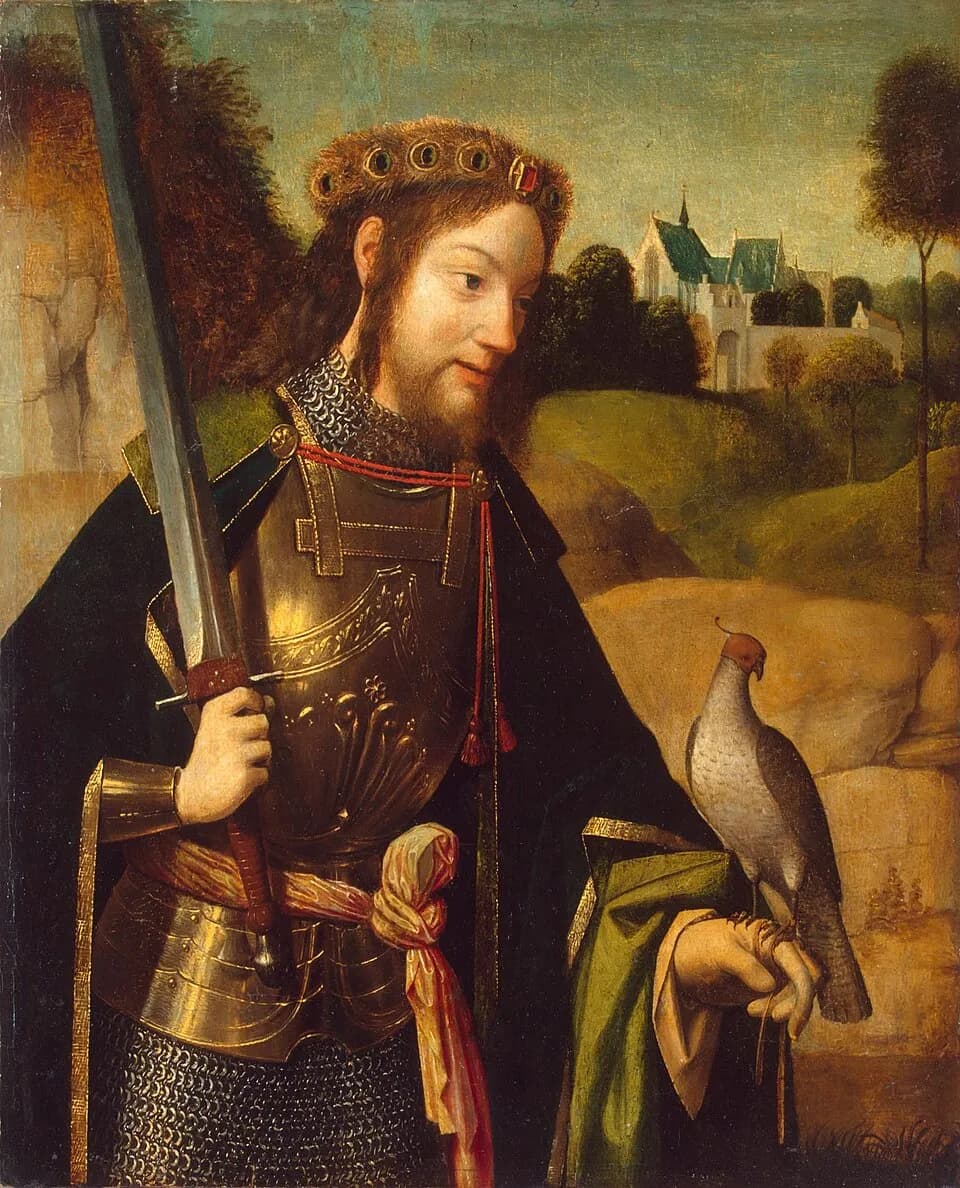
He is also the patron of falconers. Bishop Van Hecke said so from the pulpit while welcoming the Belgian falconry federation to the cathedral for the feast, and explained why: Bavo is usually painted as a nobleman with a falcon on his hand. 3 Katolsk.no adds that artists often show him as he was before his conversion, dressed as a duke or out hawking, and sometimes with a purse, because in medieval Ghent taxes fell due on October 1. 1
Saint Bavo of Ghent's feast day
Praying with Saint Bavo of Ghent
Nothing in his early life recommends him. He had money, land and a temper, and he sold people. 12 The sources do not soften it, and the paintings do not either. They show the falconer and the swordsman, the man he stopped being. 123
What broke him open was grief. Bishop Van Hecke, telling the story in Bavo's own cathedral, said that what he remembered most was the manner of the conversion: a hard man who was happy with his wife and daughter, and then was not, and did not know what to do. 3 Amandus met him there. The bishop asked his congregation whether it is not up to them to bear witness as Amandus did. 3
His repentance was concrete. He gave the land away. He handed the chain to a man he had wronged and let himself be led to the town jail. 1 Whether or not that scene happened as the old lives tell it, it is what the tradition wanted to say about him: that he tried to pay back particular people for particular harms. 1
And the hermit was not hidden. At Mendonk, by the parish's own account, the people who came to his cell were people in need, and they left with comfort and strength. 2 A man once feared in every direction ended as someone people in need went looking for. 2
Saint Bavo of Ghent, pray for us.
Sources
- 1.Per Einar Odden, "Den hellige Bavo av Gent (~590-~655)," Den katolske kirke (the Catholic Church in Norway), last updated January 23, 2009 (in Norwegian).
- 2."Wie is Bavo, de patroonheilige van onze parochie?," Parochie Kanaalzone Lochristi-Wachtebeke, Kerknet, February 13, 2017 (in Dutch).
- 3.Lode Van Hecke, Bishop of Ghent, "Bisschop Lode op het feest van de heilige Bavo. Homilie," Bisdom Gent, Kerknet, October 2, 2022 (in Dutch).
- 4."15 grote heiligen en zaligen uit onze contreien," Kerknet editorial staff (in Dutch).
- 5.Roman Martyrology, entry for October 1, "San Bavone, monaco," as printed in "Santo del giorno," Conferenza Episcopale Italiana (in Italian).
- 6.Gabriel Van den Gheyn, "Ghent," The Catholic Encyclopedia, Vol. 6 (New York: Robert Appleton Company, 1909).
- 7.Henry Parkinson, "Patron Saints," The Catholic Encyclopedia, Vol. 11 (New York: Robert Appleton Company, 1911).
- 8."Kapittel van Gent op bezoek in Haarlem," Bisdom Haarlem-Amsterdam, October 2014 (in Dutch).
- 9."Van verwend kind tot monnik: het verhaal van de heilige Bavo," Bisdom Gent, Kerknet (in Dutch).
Saints to turn to next
Others in this collection who are turned to for some of the same things.
- Saint Aidan of Lindisfarnec. 590 - August 31, 651Poverty and simplicityConversion
- Saint Andrew Corsinic. 1302 - January 6, 1374ConversionPoverty and simplicity
- Saint Bernard of CorleoneFebruary 6, 1605 - January 12, 1667ConversionPoverty and simplicity
- Saint CajetanOctober 1480 - August 7, 1547Poverty and simplicityConversion