Saint Andrew Corsini
c. 1302 - January 6, 1374
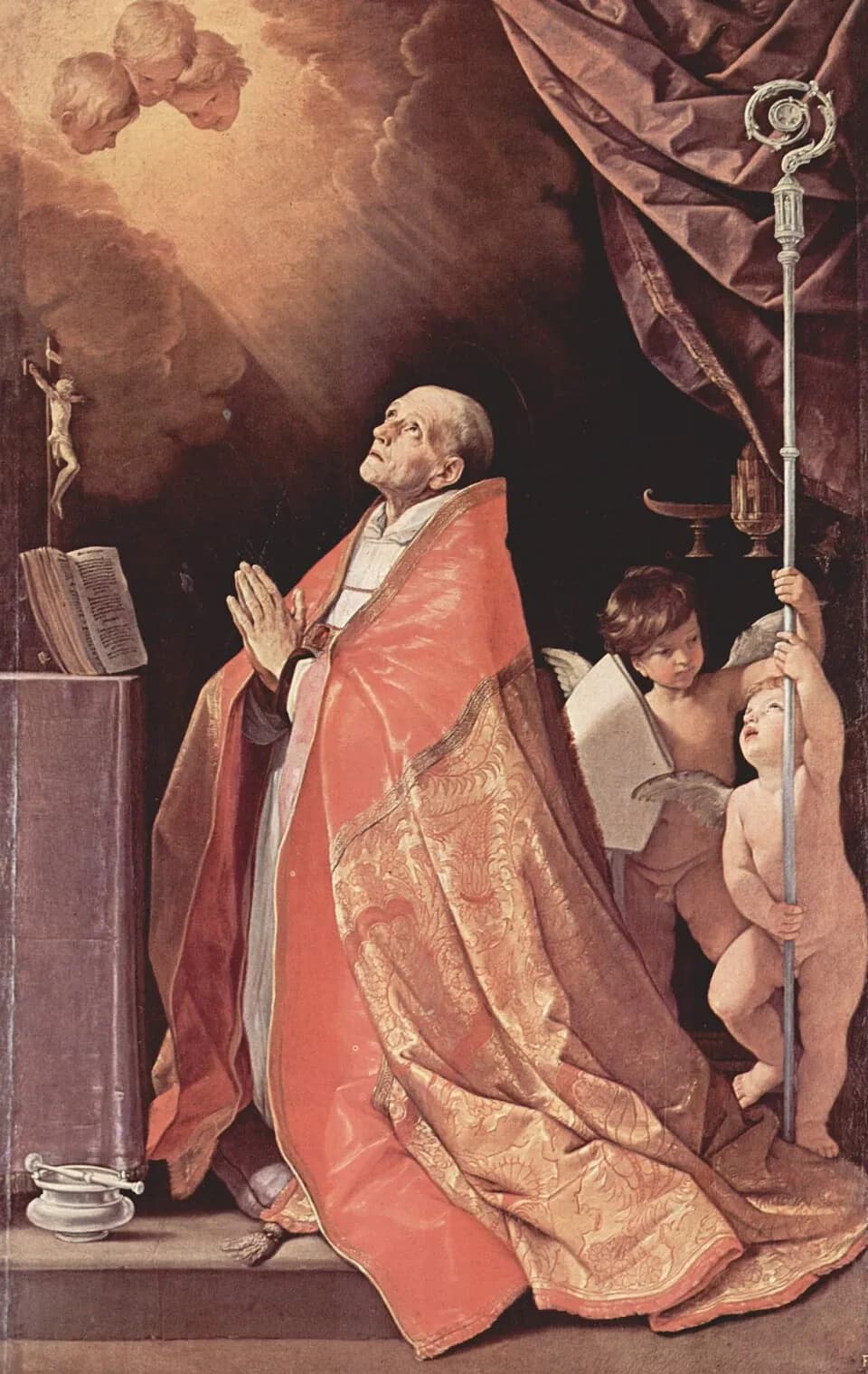
- Buried
- Corsini Chapel, Santa Maria del Carmine, Florence 2
Saint Andrew Corsini was a Florentine nobleman's son who became a Carmelite friar and, in 1349, bishop of Fiesole, the hill town above Florence. 23 He moved into a bishop's house that no bishop had lived in for more than a century, kept wearing his friar's habit, and handed out bread at his own gate. 23 The Carmelites keep his feast on January 9. 4
A Corsini of Florence
He was one of the twelve children of Niccolò and Gemma Corsini, whose family was among the most powerful in the Florentine Republic. 23 The year is uncertain. The Catholic Encyclopedia says 1302; the life the Carmelite Order published for his feast says "around 1300"; and the Carmelite historian Leopold Glueckert puts it between 1315 and 1318. 123
The sources also differ about his youth. The encyclopedia calls him "wild and dissolute" until he was "startled by the words of his mother about what had happened to her before his birth," and does not say what she told him. 1 The Carmelite feast-day life is more cautious: as a young man he "is said to have cultivated a very worldly lifestyle," until the warnings of his devout mother changed his mind. 2 Glueckert finds nothing remarkable at all, writing that he "passed his early years without any unusual happenings, but turned to religion as a teenager." 3
Whatever came before, he entered the Carmelite house in his own city. 124 Nobody knows when he made his profession or when he was ordained. 2 The first document that names him is from 1338, when he is listed as a member of the Florence community, which then had fifty-two friars. 23
Friar, teacher and provincial
The encyclopedia sends him to study at Paris and Avignon, and says that on his return he "became the Apostle of Florence," where people regarded him as a prophet and a wonder-worker. 1 Glueckert has him finish his studies and become a lector, teaching the younger friars at the Carmine, with a short transfer to Pisa in 1344. 3
He rose quickly. The provincial chapter at Pistoia made him a councilor in 1347, and the general chapter that met at Metz in 1348 made him provincial of Tuscany. 34 The feast-day life calls him the first to hold that office. 2 It was the year of the Black Death. Glueckert, citing the province's own necrology, says that more than a hundred Carmelites died, and that the new provincial "set about rebuilding the physical and moral fabric of their world." 3 He was not given long to do it. 3
Bishop of Fiesole
On October 13, 1349, Pope Clement VI named him bishop of Fiesole, about five miles northeast of Florence. 23 The encyclopedia tells the story that he ran away and hid, and was found by a child. 1 The Carmelite life passes on a different one, plainly labeled a legend: that the Mother of God appeared to him and made him promise to accept. 2
He arrived in March 1350. 3 According to Glueckert, it had been more than a hundred years since a bishop of Fiesole had actually lived there, since Florence was more comfortable, and the cathedral and the bishop's house were crumbling. 3 Andrew moved into the old house. He set about restoring the cathedral, which was in danger of collapse, had churches and monasteries renovated, and built lodgings for the canons. 23
He went on living as a friar. He kept his Carmelite habit, brought two friars from the Carmine to live with him, dismissed the large episcopal retinue, and cut the servants to six, who lived with the Carmelites as a religious community. 3 The feast-day life says he was frugal and ascetic even when old and sickly. 2
With his clergy he was strict. He pressed them to do their duties, "for there was much that was amiss," and "was not afraid to remove those unworthy of their office." 2 In 1372 he founded a confraternity for the encouragement and sanctification of priests. 3
Bread at the gate, and peace between enemies
He called himself the "father and helper of the poor." 3 The feast-day life says that no poor person went away from him without a gift, and that "the bishop often sat at the gate of his house and handed out bread himself." 2 His help reached Florence and the country around it too, where he supplied the needy with grain and clothing, and after the plague he gave particular care to the sick. 23
The other thing people came to him for was peace. The Order's calendar entry says that rich and poor alike sought him out as a peacemaker "after the many years of in-fighting and quarrelling which had ruined their families and their cities." 4 Glueckert says he was asked to mediate between powerful families and feuding towns, and was so successful in Fiesole and Florence that he was called on to reconcile factions in Prato and Pistoia as well. 3 The encyclopedia adds Bologna, where it says he was sent as papal legate "to heal the breach between the nobility and the people." 1
Death and veneration
The Carmelite sources give January 6, 1374, as the day he died. 24 The encyclopedia gives 1373, his age as seventy-one, and his time as bishop as twelve years, a figure that does not fit the Carmelite dates. 1 Glueckert, with his later birth date, thinks he was probably in his early sixties. 3
He had asked to be buried in the Corsini family tomb in Florence, but the canons of Fiesole wanted him in their cathedral. A month later, Glueckert writes, with the help of the next bishop, Andrew's brother Neri Corsini, "a contingent of Carmelites stole his body during the night." 3 He lies in the Corsini Chapel of Santa Maria del Carmine. 2 The first tomb was destroyed when fire took most of the church in 1770; the body was unharmed. 3
Pope Eugenius IV permitted his public veneration, in 1440 by the Carmelite account, after the Florentine victory at Anghiari, where Andrew was said to have appeared to the troops and promised it. 12 He has been in the Carmelite breviary since 1462. 2 Urban VIII canonized him on April 29, 1629. 12 A century later a Corsini pope, Clement XII, built a chapel in his honor in the Lateran basilica in Rome; the Carmelite pages date it to 1734 and to 1730. 23
Several stories the Carmelites themselves call legends are attached to him. One is a vision of the Madonna during his first Mass. Another, which the Carmelite life thinks is probably why painters show him with a wolf or a lamb, is that Mary once turned a wolf that threatened him into a lamb. A third is that she told him on Christmas night that he was about to die. 2
What is Saint Andrew Corsini the patron saint of?
None of the sources consulted for this page names Saint Andrew Corsini as the patron saint of anything, and the page does not supply a patronage. 1234 They describe him as a model bishop and a peacemaker, and people did come to him to have quarrels settled, but that is a description of his life and not a stated patronage. 34
Saint Andrew Corsini's feast day
Praying with Saint Andrew Corsini
In 1629, the year Andrew was canonized, Bishop Francis Venturi wrote of him: "He administered the office entrusted to him like a saint. He is rightly held up to all the pastors of the Church as a model of an outstanding bishop." 2 Venturi went on to say that Andrew could not think of the poor without tears, and that "no poor person ever left him sad." 2
What the Carmelite sources record is mostly practical. A house and a cathedral were repaired. Six servants were kept where there had been a crowd. He lived in the town he was bishop of. He sat at the gate with bread. 23 Glueckert observes that bishops of that century "tended to comport themselves like feudal nobility," and that Andrew, who really was a noble, lived like a simple friar. 3
The same pages that describe the bread describe the peacemaking. Families and towns brought him quarrels that had gone on for years, and he was asked back to do it again in other cities. 34
The inscription on his tomb, as Glueckert gives it, called him "marvelous for the example of his life and his eloquence." 3 The example comes first there, before the preaching. 3
Saint Andrew Corsini, pray for us.
Sources
- 1.T. J. Campbell, "St. Andrew Corsini," The Catholic Encyclopedia, vol. 1 (New York: Robert Appleton Company, 1907).
- 2."Feast of St. Andrew Corsini, Bishop," Order of Carmelites (ocarm.org), January 8, 2024; from Helga-Maria M. Jaeger, Gott lebt! Sie sind seine Zeugen.
- 3.Leopold Glueckert, O.Carm., "St Andrew Corsini - Apostle of Florence," Order of Carmelites (ocarm.org).
- 4."St. Andrew Corsini, Bishop," January 9, calendar of feasts and memorials, Order of Carmelites (ocarm.org).
- 5."St. Andrew Corsini, Carmelitan priest, Bishop of Fiesole," Saint of the Day, 9 January, Vatican News.
Saints to turn to next
Others in this collection who are turned to for some of the same things.
- Saint CajetanOctober 1480 - August 7, 1547Work and vocationPoverty and simplicityConversion
- Saint John Francis RegisJanuary 31, 1597 - December 1640Work and vocationPoverty and simplicityConversion
- Saint Leonardo MurialdoOctober 26, 1828 - March 30, 1900Work and vocationPoverty and simplicityConversion
- Saint Odo of Clunyc. 879 - November 18, 942ConversionWork and vocationPoverty and simplicity