Saint Odo of Cluny
c. 879 - November 18, 942
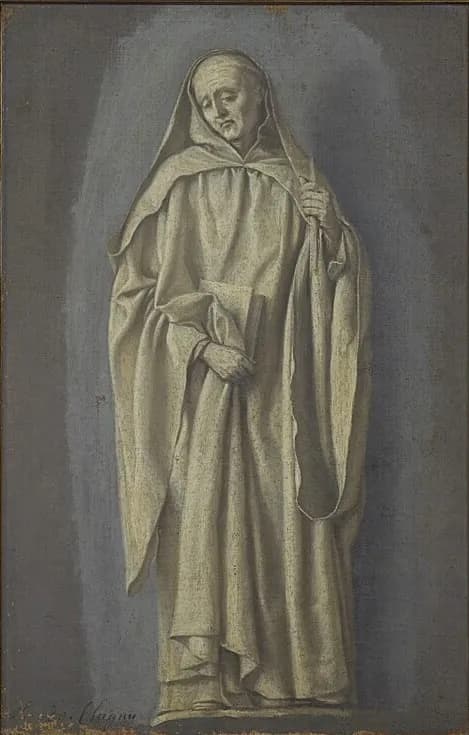
- Born
- 878 or 879, probably near Le Mans, by Löffler; about 880, between Maine and Touraine, by Benedict XVI 12
- Patron saint of
- No patronage is stated by the sources consulted
- Feast day
- November 18 3
Saint Odo of Cluny was the second abbot of Cluny, the Burgundian abbey whose reform spread through the monasteries of tenth-century Europe, and with a papal privilege of 931 he carried that reform to houses in France and Italy, Subiaco and Monte Cassino among them. 124 Benedict XVI, who devoted a general audience to him, called him austere, "but above all he was good," a man who asked the children he met on the road to sing for him. 2 He died at Tours on November 18, 942, and is remembered on that day. 123
Consecrated to Saint Martin
He was born in 878 or 879, probably near Le Mans, according to Klemens Löffler in the 1913 Catholic Encyclopedia; Benedict XVI puts it at about 880, "on the boundary between the Maine and the Touraine regions of France." 12 His father consecrated him to Saint Martin of Tours, the Pope said, "in whose beneficent shadow and memory he was to spend his entire life, which he ended close to St Martin's tomb." 2 Löffler says he spent several years at a ducal court and at Tours. 1
His biographer was a monk of his, John the Italian, and Benedict XVI drew on that Life throughout. 2 It records that at about sixteen, on a Christmas Eve, Odo found a prayer to the Virgin rising to his lips, in which he called her "Mother of Mercy." 2 That remained, the Pope said, "the title by which he always subsequently liked to address Mary." 2
About the same time he came across the Rule of Saint Benedict and began to comment on it, "bearing, while not yet a monk, the light yoke of monks." 2 Later he would call Benedict the "lamp that shines in the dark period of life." 2
Baume and Cluny
About 909 he became a monk and a priest at the abbey of Baume, where he was put in charge of the abbey school. 1 Its abbot was Berno. 1 In 910 William the Pious, Duke of Aquitaine, founded an abbey at Cluny, fifteen miles northwest of Mâcon, endowed it with his whole domain, and placed Berno over it, and there "a somewhat new and stricter form of Benedictine life was inaugurated," as Alston's article on the Congregation of Cluny puts it. 4
Odo moved to Cluny as well, and became its second abbot in 927. 12 Alston counts him first in the line of remarkable abbots, with Mayeul, Odilo, Hugh and Peter the Venerable, who governed Cluny through its first two hundred and fifty years and were "prominently concerned with all the great political questions of their day." 4
Reformer of monasteries
A privilege of Pope John XI in 931 authorized him to reform monasteries in Aquitaine, northern France and Italy, to unite several abbeys under his supervision, and to receive at Cluny monks from houses not yet reformed. 1 Löffler notes that most of the reformed monasteries nevertheless stayed independent, and that several became centers of reform themselves. 1
Between 936 and 942 he went to Italy several times. 1 In Rome he founded the monastery of Our Lady on the Aventine, and he reformed others, among them Subiaco and Monte Cassino. 1 Benedict XVI adds Saint Paul Outside the Walls and Salerno to the places he worked. 2 He was also sent on political errands, and Löffler gives as an example the peace arranged between King Hugo of Italy and Alberic of Rome. 1 His biographer lists his great aims as "concord between kings and princes, the observance of the commandments, attention to the poor, the correction of youth and respect for the elderly." 2
Alston writes that the reform begun at Cluny spread by new foundations and by the joining of existing houses, all of them dependent on the mother house, so that a congregation "came into being almost automatically." 4
The writer and preacher
Löffler lists his writings: a life of Saint Gerald of Aurillac, three books of Collationes, which he calls "moral essays, severe and forceful," some sermons, a long poem on the Redemption called the Occupatio, and twelve choral antiphons in honor of Saint Martin. 1
Benedict XVI found in them a love of the inner life and a sense of the world as "a brittle, precarious reality." 2 In a sermon on Mary Magdalene, Odo wrote that Mary seated at the Lord's feet "is the symbol of the sweetness of contemplative life." 2 He loved his cell, his biographer says, "removed from the eyes of all, eager to please God alone." 2
He cared deeply about the Eucharist, the Pope said, and deplored the carelessness with which it was often celebrated. 2 Faced with what he saw as "the immensity of the vices widespread in society," he urged a radical change of life, and yet would not let that become despair: "Divine mercy is always available; it awaits the hour of our conversion." 2 He liked to call Christ "a lover of men," amator hominum. 2
His biographer stressed above all his "virtue of patience," and added a long list of others: contempt of the world, zeal for souls, and a commitment to peace in the Churches. 2 Monks of many different gifts, John wrote, seemed gathered in this one man, as if Christ had drawn "on the various gardens of monks" to make "in a small space" a paradise. 2 Benedict XVI added that Odo did not only keep to his cell, but exercised the ministry of the word as a "superabundant source." 2
Joy, and a death at Tours
The Pope dwelt on something easy to miss beneath the reformer's severity: "his deep, heartfelt kindness." 2 His biographer said he had never heard "such mellifluous words" on human lips, and recorded that Odo would ask children he met on the road to sing for him and then give them a small present. 2 "Abbot Odo's words were full of joy," John wrote, and "his merriment instilled in our hearts deep joy." 2
He fell ill in Rome in the summer of 942. 2 Sensing that he was dying, he made every effort to get back to Saint Martin at Tours, and he died there during the octave of Saint Martin's feast, on November 18, 942. 12
What is Saint Odo of Cluny the patron saint of?
Saint Odo of Cluny's feast day
Praying with Saint Odo of Cluny
He was a reformer, sent from house to house with a papal privilege to make monks keep their rule, and he could be severe about the state of the world. 12 Benedict XVI admitted that his view of the world "may appear rather distant from our own." 2
Yet what the Pope chose to end on was his goodness: the singing children and their small rewards, the joy his monks remembered, and his habit of calling Christ a lover of men. 2 Mercy, Odo said, is always waiting for the hour of conversion. 2
His life began with a boy calling Mary "Mother of Mercy" on a Christmas Eve and ended with a sick abbot making his way back to Saint Martin's tomb to die. 2 In between he did the work of reform he was given, in many places and for many years. 12
Saint Odo of Cluny, pray for us.
Sources
- 1.Klemens Löffler, "St. Odo," The Catholic Encyclopedia, Vol. 11 (New York: Robert Appleton Company, 1911).
- 2.Pope Benedict XVI, General Audience, "Saint Odo of Cluny," September 2, 2009.
- 3."St. Odo abbot of Cluny," Saint of the Day calendar, November 18, Vatican News.
- 4.George Cyprian Alston, "Congregation of Cluny," The Catholic Encyclopedia, Vol. 4 (New York: Robert Appleton Company, 1908).
Saints to turn to next
Others in this collection who are turned to for some of the same things.
- Saint Aidan of Lindisfarnec. 590 - August 31, 651Poverty and simplicityPrayerConversion
- Saint André BessetteAugust 9, 1845 - January 6, 1937PrayerWork and vocationPoverty and simplicity
- Saint Andrew Avellino1521 - November 10, 1608ConversionWork and vocationPrayer
- Saint Andrew Corsinic. 1302 - January 6, 1374ConversionPoverty and simplicityWork and vocation